CV, capitalism and sexism: The story of a bull, a cow, and an exploited ox
CV, capitalism and sexism: The story of a bull, a cow, and an exploited ox
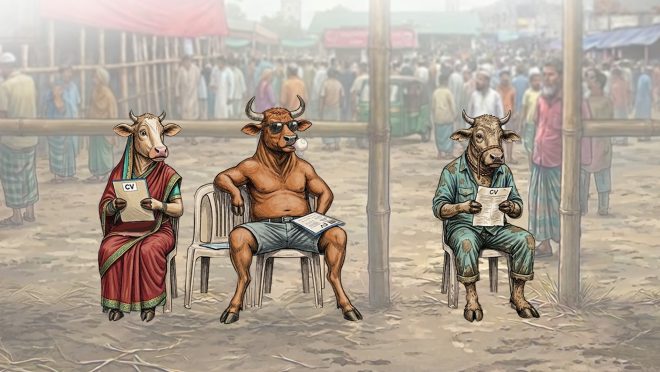
Mr Bull, Mrs Cow, and Mr Ox are the candidates eagerly waiting in the haat. All three are equally nervous, yet excited, excited because it is the one time of year when they are evaluated in the business community fairly. It is the season when demand for their services reaches its peak, when candidates from all over the country flock to different haats to be displayed, bargained over, and sold.
All three of them are part of the same species: Bos taurus, or more specifically known in the South Asian region, Bos taurus indicus. However, race relations among the common Bos taurus have always been amicable. Unlike humans, modern Bos taurus have always seen race as a secondary issue, and their society has the legacy of sharing the common “Mooo!” as its slogan for the “cowmunity”.
However, the job market for the common Bos taurus is quite challenging. Although demand for the animal remains steady throughout the year, there is one particular season when demand reaches unimaginable levels, levels which call upon even the most rural, barely legal Bos taurus to commute miles on end in search of the best companies, or haats, to employ them. And for the three individuals mentioned, no other company is as illustrious as the Gabtoli haat.
In the haat, three cattle are sitting beside each other, all part of the same species, but the cruel, sexist capitalist society has not been kind to the common cow. All three have a specific role to play, and despite belonging to the same species, they are not expected to perform the same role in society.
A bell rings, indicating that a new interviewee is being called upon. Mrs Cow believes it is her turn. CV in hand, and with an enormous blushing udder, she enters the room.
“Please sit down,” the bepari tells Mrs Cow.
Looking at the résumé, the bepari immediately asks, “Are you nursing any calves right now?”
A deeply sexist question to ask during an interview, she knows, but she also knows this is her only shot at the job, and she has an answer prepared.
“I had one calf,” she nervously shares, “but it’s much older now, practically my size.”
Upon closer screening of the CV, the bepari notes all her past experiences: producing calves, milk, and everything else.
However, in a land dominated by bulls and oxen, Mrs Cow has little chance of acceptance.
The bepari lets her down quite subtly.
“We’re not currently looking for females,” he mentions. “However, if that calf of yours is above two, we can look at his CV if you like.”
Utterly disappointed, Mrs Cow leaves the room, and then it is time for Mr Bull.
The moment Mr Bull enters, the bepari’s eyes light up with excitement, a certain glare appearing across his face. He is seeing dollar signs.
It doesn’t matter whether Mr Bull has any experience or any noticeable skill set, for he is still a bull, which means he can still be used for breeding even if he goes unsold.
Mr Bull’s appearance proved it all, cocky and brash, he sat down full horn on display and confidently put his leg up on the table.
The Bepari didn’t mind, he knew Mr Bull would obviously drive a hard bargain, and whatever Mr Bull asked for, the Bepari was ready to meet. Plus, the connection with Mr Bull would eventually help him gather more CVs of his kind next year.
The cruel bourgeois system, as it turns out, always benefits individuals like Mr Bull. It is a reminder of the existing class divisions, layered on top of the already sexist undertones that haats like Gabtoli possesses.
Lastly, it is time for the underdog. The chemically castrated underdog.
Mr Ox enters with subpar expectations. Hard work is nothing new to Mr Ox. Right after birth, his “instrument” was discarded.
Why, you wonder?
Because the cruel bourgeois society had imposed upon him a permanent fate, a fate not unlike the serfs of the pre-Soviet era, for he was destined from birth to plough fields, carry carts, and perform whatever trivial labour there was, all without the fundamental privilege that all others in his species enjoyed: procreation, a privilege available only to the bulls of society.
The bepari, having already rejected Mrs Cow and overpaid Mr Bull, now wants to make a business calculation. He will hire Mr Ox, but at a discounted price, since he knows there are many more like him waiting to come in if this one dares demand his proper worth.
Mr Ox, the most nervous of them all, enters and hands the bepari his CV.
And without even glancing at it, the bepari asks, “Salary koto niba?”
Mr Ox, just like any other fresher or young graduate, is unaware of the market rate, and just like the “kamla” he was born to be, he asks for a salary below the market rate, just so the bepari might be happy enough to hire him quickly.
That haat witnessed the cruelty of modernity in full display: the sexism against the cow, the inherent privileges of the bull, and the misfortune and ignorance of the ox. These are not just the eternal mechanisms of Bos taurus, but of us as well.