Sonadia’s mangroves: The vanishing of a coastal shield
Nearly 10,000 acres of protected mangrove forest on Sonadia Island have disappeared, replaced by shrimp farms despite the island’s status as an Ecologically Critical Area. An on-the-ground investigation traces how the forest, which once shielded the coastline, vanished
Sonadia’s mangroves: The vanishing of a coastal shield
Nearly 10,000 acres of protected mangrove forest on Sonadia Island have disappeared, replaced by shrimp farms despite the island’s status as an Ecologically Critical Area. An on-the-ground investigation traces how the forest, which once shielded the coastline, vanished
Off the western coast of Maheshkhali Upazila, rising from the waters of the Bay of Bengal, Sonadia Island was once a treasure trove of biodiversity. Alive with the scuttling of red crabs, nesting sea turtles and the calls of rare bird species, the government designated the island an Ecologically Critical Area (ECA). Under the law, any form of commercial intervention or alteration of the natural environment in such areas is strictly prohibited.
But the reality today is entirely different.
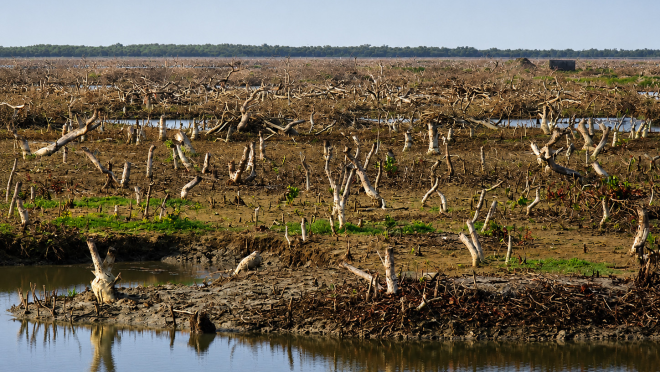
The mangrove forest that once shielded the coastline has disappeared. In its place stand dried roots, charred tree stumps and vast shrimp farms—a silent testament to large-scale environmental destruction.
With the aim of establishing an ecotourism park, the previous Awami League government allocated 9,466.93 acres of Sonadia’s forestland to the Bangladesh Economic Zones Authority (BEZA) for a token payment of Tk1,001. At the time, the island was surrounded by dense green mangrove forests.
In May 2017, BEZA formally took possession of the land from the Coastal Forest Division. However, no visible work on the proposed ecotourism project was carried out afterwards.
By June 2026, however, the mangrove forest had all but vanished. The island’s nearly 10,000 acres of mangroves—including baen and keora trees, along with other species—had disappeared. The only silent witnesses left are the dried roots, trunks and scattered branches of what was once a thriving coastal forest.
The scale of the destruction becomes clear on the ground. Travelling towards Sonadia along the eastbound and westbound canals from Ghotibhanga Ghat in Maheshkhali, long earthen embankments line both sides of the waterways. From a distance, they resemble the foundations of a new road. But a closer look inside the embankments reveals a different picture: thousands of acres of mangrove forest have been cleared to make way for fish farms.

Shrimp farms now occupy large parts of Sonadia’s protected mangrove forest.
Local residents said that nearly 10,000 acres of mangrove forest stretching from Ghotibhanga to Sonadia have been destroyed and converted into shrimp farms. Until May, the same land had been used as salt fields.
The canals are now flanked by vast tracts enclosed by raised earthen embankments. Areas once covered with dense mangroves, including keora, baen and garjan trees, are now filled with rows of shrimp ponds. At least 100 fish farms have been established after the clearance of the forest.
Residents said the land is used for salt production during the dry season before being converted into shrimp farms during the monsoon. In some places, baen and keora trees are still being cut down, while in others the remaining forest is being burned to clear the land.
According to Advocate Mujibul Haque, chairman of the Cox’s Bazar-based environmental organisation Youth Environment Society, mangrove forests are far more than just a collection of trees—they are the coast’s natural defence. They play a vital role in protecting coastal communities from cyclones, storm surges and powerful sea waves. Their destruction, he warned, will leave the coastline significantly more vulnerable.
Advocate Mujibul Haque said keora and baen trees help stabilise coastal soil. Removing them accelerates erosion, alters sediment deposition in rivers and canals, and disrupts the natural flow of tides. Their destruction also wipes out the habitats of numerous species of fish, crabs, birds and other aquatic wildlife. He warned that, for Bangladesh’s climate-vulnerable coastline, the continued loss of mangrove forests could have severe long-term consequences.
Several local residents alleged that influential individuals are behind the clearing of mangrove forests to make way for salt fields and shrimp farms. Although they belong to different political parties, they said there is an informal understanding among them on this issue, leaving local people too afraid to speak out publicly.
The Forest Department has already filed several cases over the destruction. According to the case documents, the accused include relatives of influential figures from several political parties. Among them are Jamaat leader Syedul Haque Sikder, former Awami League MP Ashok Ullah Rafiq’s cousin Shamsher, Kaichar Sikder—the younger brother of Maheshkhali BNP president Abubakkar Siddique and former Awami League mayor Maksud Mia—as well as the sons of former Upazila Awami League president Anwar Pasha Chowdhury and the younger brother of former Upazila chairman Zainal Abedin.
Workers at the shrimp farms claimed that former Upazila Chhatra Dal president Azizul Karim Joy owns two farms in the area. Joy, who is the younger brother of former Jubo League leader Sajedul Karim, denied the allegation when contacted by phone. The workers also alleged that Sajedul Karim’s cousins, Awami League activist Jahangir and Rahmatullah, also own separate shrimp farms there.
Several local elected representatives have also been accused of using their local influence to clear mangrove forests for salt cultivation. Those named include Kutubjom Union Parishad Chairman Sheikh Kamal, who is also a joint general secretary of Jubo League, Union Parishad members Siddique Rimon, Zainal Member and Ekram Member, among others.
Environmental activist Ruhul Amin said those involved in clearing the mangrove forests include individuals affiliated with the Awami League, BNP and Jamaat. “Many big players have been left out of these cases,” he said. “And several of those who were charged have already secured bail from the High Court and are moving around freely.”

Salt harvesting continues on land once protected by forests.
Maheshkhali Gorakghata Range Officer of the Forest Department, Monowar Hossain, said most of the mangrove forest had been cleared while the land was under BEZA’s control.
“Although around 5,000 acres have been returned to the Forest Department, the land has not yet been formally handed over to us,” he said. “There is still no clear directive on removing the shrimp farms. Even if they are removed, we will have to wait at least a year. Because the embankments have caused heavy sedimentation, reforestation will not succeed unless the area is once again regularly inundated by the sea’s natural tidal flow.”
Meanwhile, a fire broke out in the mangrove forest in the Ghotibhanga area of Kutubjom Union. The blaze, which started on 4 June, continued until 7 June.
Local residents alleged that the occupiers deliberately set the forest on fire using kerosene to clear the land more quickly for illegal occupation. They also claimed those involved in the destruction are now using armed guards to protect the area, preventing ordinary people from entering.
Maheshkhali Upazila Executive Officer Imran Mahmud Dalim said drives had been conducted in the past and that the latest allegations would be investigated before further action is taken.
Khandaker Mahmud Pasha, Deputy Director of the Cox’s Bazar office of the Department of Environment, said the department has so far filed two cases against 53 alleged land grabbers over the destruction of Sonadia’s mangrove forest. The investigation report will be submitted to the court soon, he said, adding that no suspects have been arrested so far.
Sonadia, once a safe haven for biodiversity, has now become a testing ground for encroachment and environmental destruction. The dried roots, burnt tree trunks and silent canals bear witness to a disaster that did not happen overnight, but unfolded through years of neglect and organised plunder.
The question now is whether effective action will be taken before it is too late, or whether the last traces of Sonadia’s greenery will disappear into history.
Experts warn that if the destruction continues, coastal erosion will intensify, the natural flow of tides will be disrupted, critical habitats for fish and other aquatic species will disappear, and the impacts of climate change along Bangladesh’s coastline will become even more severe.
Will Sonadia become just another lost forest, or is there still time to halt this silent destruction? For now, its dried mangrove roots seem to be waiting for the answer.