From cheat sheets to smart glasses: how AI is reshaping exams
From cheat sheets to smart glasses: how AI is reshaping exams
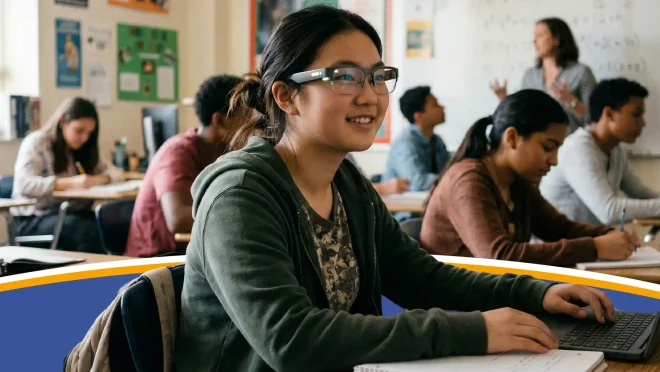
As examination season intensifies across Asia, education authorities are confronting a new and rapidly evolving threat: AI-powered smart glasses that can quietly deliver real-time answers during tests.
From university entrance exams to language proficiency assessments used by employers, recent cases in East Asia suggest that wearable AI is no longer a futuristic concern but an immediate challenge to exam integrity. Educators and regulators now face mounting pressure to rethink how learning is assessed in an age where artificial intelligence can sit, quite literally, on a student’s face.
According to reporting by CNN, test centres in South Korea uncovered two cases last month in which candidates used smart glasses during English-language exams that play a key role in recruitment decisions. In Taiwan, a medical school applicant was caught wearing AI-enabled glasses after invigilators noticed unusual eye movements; a subsequent check revealed heat being emitted from the device’s frame.
While cheating itself is hardly new, the tools have changed. What was once a scribbled note or whispered cue has evolved into discreet, networked eyewear capable of scanning questions and generating answers through large language models in seconds.
High-stakes exams, high-tech shortcuts
The problem is particularly acute in East Asia, where exam performance can determine not only university admission but long-term career prospects and social mobility. In these systems, a single test score can shape a life trajectory, making the temptation to gain an unfair advantage especially strong.
Authorities are responding. During China’s annual college entrance exam earlier this month — taken by more than 10 million students — candidates were required to undergo screening of all eyewear. In the UK, England’s exam regulator has also warned that AI glasses and miniature earpieces could significantly worsen cheating if left unchecked.
Despite these measures, experts say reported cases may only represent a fraction of actual misuse.
“If a few cases are being detected, there are likely many more that are not,” said Thomas Corbin, a lecturer at Deakin University who researches AI-powered wearables and academic assessment, in comments cited by CNN.
From novelty to mainstream
What worries educators most is how quickly smart glasses are shedding their novelty status. Devices are becoming slimmer, cheaper and more autonomous, with built-in AI models that reduce the need for visible connectivity. Beyond exams, this raises broader concerns about privacy, surveillance and the boundaries between human cognition and machine assistance.
Global sales figures underline the speed of adoption. Meta’s collaboration with Ray-Ban helped bring AI glasses into the consumer mainstream, with millions of units sold in a single year. As the technology matures, its potential misuse in controlled environments such as exam halls becomes harder to police.
Corbin likened the moment to the arrival of generative AI tools in essay writing several years ago. “Wearable AI poses the same kind of disruption to exams that ChatGPT once posed to coursework,” he told CNN, adding that traditional exam practices may no longer be sustainable without fundamental reform.
Testing the limits of assessment
That disruption is already being demonstrated in controlled experiments. At Hong Kong University of Science and Technology, assistant professor Meng Zili tested commercially available AI glasses during an undergraduate engineering exam. By simply looking at the question paper, the device transmitted prompts to an AI system, which returned answers displayed on the lenses.
The result placed the AI-assisted submission in the top five of a class of more than 100 students — well above the class average.
For Meng, the experiment raised uncomfortable questions. If AI can outperform most students under exam conditions, what exactly are traditional tests measuring? And how much memorisation should still be expected in an era of ubiquitous machine intelligence?
His colleague, professor Zhang Jun, argues that the pace of technological change has left education systems struggling to keep up. “Every teacher feels this gap,” he said, pointing to the need to rethink both teaching methods and evaluation models.
Adaptation, not avoidance
Not all educators believe the solution lies in banning technology outright. Kong Siu Cheung, a professor at the Education University of Hong Kong, told CNN that AI should be integrated thoughtfully into education rather than treated solely as a threat.
The focus, he argued, should be on developing students’ critical thinking and self-awareness, ensuring AI supports learning without replacing independent thought. “Use the technology,” he said, “but don’t outsource your thinking.”
As AI-powered wearables continue their march into the mainstream, one conclusion is becoming increasingly clear: exam systems built for a pre-AI world may no longer be fit for purpose. Whether through redesigned assessments, open-AI testing models or entirely new approaches to evaluation, educators now face a reckoning that goes well beyond cheating — and into the future of learning itself.