The academic hunger games: Surviving course registration at private universities
Every year, typically before the end of a semester break, private university students are forced to confront a gruelling survival event. Depending on the university’s academic format, this event can be hosted more than once, ensuring that no one ever feels truly safe.
The academic hunger games: Surviving course registration at private universities
Every year, typically before the end of a semester break, private university students are forced to confront a gruelling survival event. Depending on the university’s academic format, this event can be hosted more than once, ensuring that no one ever feels truly safe.
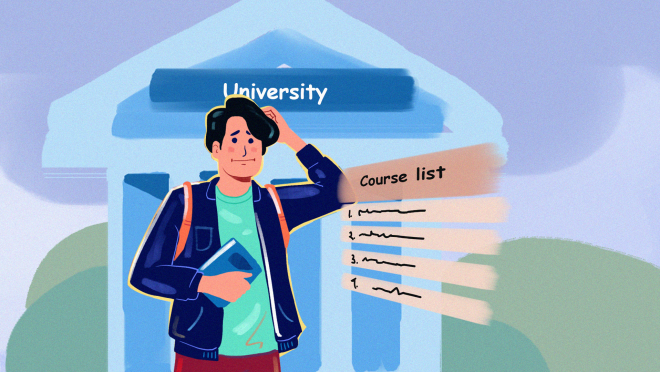
Here, students are thrown into a digital battle arena and pitted against one another like gladiators in the Colosseum. Fortunately, the only casualty is not the person themselves, but their sanity and CGPA.
What am I referring to? To make it sound less intimidating, university authorities usually call it the ‘course registration process’. A more appropriate name, however, would be the “Great Academic Hunger Games”.
Now, why am I making such a big deal out of a registration process? For those unfamiliar, an open credit system allows students to select their own courses each semester and design their class routine. In short, you are in charge of how many courses you take, how many credits you carry, and when your classes happen. At first glance, this sounds ideal. Who would not want a customised timetable based on the stress and pressure they can handle? Sadly, while this sounds great in theory, in reality there is a catch.
If you have ever played musical chairs, then you already understand the system. When the music stops, everyone aims for the same seat, and someone always ends up standing. Except here, the chair is a course, the music is a server countdown, and the prize is not glory, but a tolerable semester.
Suppose your university is offering an excellent course this semester: AI Shenanigans 101: How to Pretend You Did the Homework.
Naturally, you want to take it. Unfortunately, hundreds of other students, some in their first semester and some in their final one, are just as desperate. Also, remember that the basic rules of economics rarely apply here. The market simply does not meet the demand. Despite overwhelming interest, only a limited number of seats, usually between 30 and 50, are offered. At this point, all you can do is recite a prayer: may the fastest internet and finger click win, and may the server show mercy by not crashing.
Now add friends to the equation. You all plan to take the same course together, but there is no guarantee that you will end up in the same section, or even get a seat at all. You might prepare a backup routine in case the original plan collapses. If section one fills up, you aim for the next suitable section. If that fails, you prepare another backup. To be safe, your original routine needs a backup, and the backup needs another backup.
A backup of your backup’s backup is highly encouraged. Emotional preparedness is also recommended, because most of the time things do not go according to plan.
In the end, while the open credit system does offer freedom in choosing courses, timings, and credit loads, there is no guarantee of getting what you want. More often than not, you compromise on timing, preferred faculty members, or both. It may feel frustrating, and to some extent it is, but it has become a fairly common reality in private universities.
Of course, registration policies vary across institutions. Some allow students with higher completed credits to register earlier. Others require consultations with academic advisors, who may guide or even decide course selections. Some follow a strict first-come, first-served policy. Regardless of the system, the outcome is often the same. There is a high chance you will not get your preferred courses, and while it is frustrating, it has somehow been normalised.
So what do you do? While my method is not exactly foolproof, it has at least stopped me from completely losing my mind. There have been semesters where I did not get my Plan A courses, but Plan B or Plan C usually worked. Once, even Plan D had to step in. At that point, I stopped calling it “planning” and started calling it “coping”.
Over time, I have also developed a few personal rituals that I firmly believe have contributed to my survival. First, be very careful with your choice of words when talking about your university right before registration day. Even if you are absolutely correct, swallow your pride and save the criticism for later. Temporarily tone down your freedom of expression. While this may sound superstitious, I promise I do not believe in superstition. I just prefer to be cautious.
Second, always perform a system check before descending into chaos.
Wi-Fi connection? Full bars.
Wi-Fi speed? Acceptable.
Mobile data? Ready.
Hotspot? Armed and dangerous.
Pay your internet bills on time. If necessary, pay them in advance. This is not the day to test whether your ISP is “usually reliable”. If your Wi-Fi decides to be moody, keep mobile data ready so you can switch loyalties instantly.
Of course, technical issues are inevitable. The website may crash. Pages may refuse to load. Buttons may disappear. When this happens, try not to panic. Either the system will miraculously fix itself at some point, which requires relentless refreshing, or you will need to contact the university authorities. It helps to have their number saved and your expectations lowered.
Lastly, pray. A sacrificial offering is optional but recommended.
Ultimately, the entire process resembles Russian roulette, except instead of bullets, you risk inconvenient class timings, unfamiliar faculty members, or being separated from your friends. Even if you do not get what you wanted, it is not the end of the world. There are alternatives, compromises, and eventually, acceptance.
And if all else fails, remember this: thousands before you have survived course registration, and thousands after you will suffer through it too. While the system remains undefeated, so do the students.
For now.