The misunderstood history of hand signs
From the inception of human interaction, individuals have employed their hands for communication.
The misunderstood history of hand signs
From the inception of human interaction, individuals have employed their hands for communication.
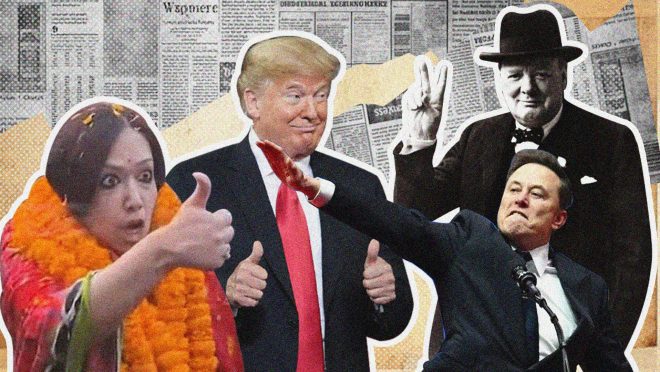
A raised palm, a wave, or a point are examples of gestures that predate written language and frequently convey more information than words ever could.
However, hand signs are not rigid. Culture, history, politics, and circumstance all influence them, which frequently results in dramatically divergent interpretations.
In one context, something that seems positive might be insulting or even harmful. In other words, do not assume that giving someone the thumbs-up always signifies the same thing.
One of the most universally acknowledged gestures is the thumbs-up. In much of the Western world, it is a short and casual sign of approval: good work, everything is ready, you are capable.
The same gesture has been seen as impolite or indecent in other regions of South Asia, Latin America, and the Middle East. Although some of these interpretations have been softened by contemporary media, the underlying cultural differences still exist and can result in misunderstandings. In reality, a symbol that appears to be universal can carry significant cultural connotations.
Modern misunderstandings
A similar situation unfolded recently in Bangladesh. Authorities interpreted Farhana and her group’s thumbs-up gesture, seen in widely circulated footage of the incident, as rude and hostile while they challenged a magistrate’s ruling.
Farhana defended her actions, stating that the gesture was an imitation of another politician’s manner and a protest against what she perceived as administrative bias rather than an insult.
Similarly, the “OK” sign, where the thumb and index finger form a circle, has long been a harmless gesture of affirmation in numerous countries. However, in Brazil and Turkey, it has a vulgar meaning, while in France it can denote worthlessness, meaning “zero”.
This sign has recently become a political symbol in certain online groups, demonstrating how quickly and unexpectedly gestures can change. Even seemingly inoffensive signs can acquire unanticipated ideological significance.
History and politics shape meaning
Gestures have served significant functions throughout global history. The individuals who employed them demonstrate how interpretation is contingent upon circumstance. During the Second World War, Winston Churchill famously represented “Victory” with the V sign, with two fingers raised.
The gesture became one of the most iconic representations of defiance against oppression and helped boost Allied morale. However, the same two-finger gesture, when made with the palm facing inward, is considered offensive in Britain, demonstrating that orientation is just as important as the sign itself.
The raised-arm salute, implemented during Adolf Hitler’s Nazi administration, served as a symbol of allegiance and unity. Following the Holocaust, this gesture was universally rejected and prohibited in numerous countries due to its association with genocidal ideology. The meaning of that arm position was shaped by historical consequence rather than intent alone.
The meaning of the clenched fist, another emblem, has also shifted depending on the movement. When Tommie Smith and John Carlos raised their fists during the 1968 Olympic Black Power salute, the moment united sport with civil rights and became emblematic of solidarity and anti-oppression movements in the twentieth century.
Supporters viewed it as a symbol of resistance and justice, while critics perceived it as unpatriotic. The same gesture can evoke both admiration and contempt depending on context and audience.
Technology has shown that context and individual interpretation remain crucial, rather than standardising meaning.
Misunderstandings can have serious consequences. Politicians have seen their hand gestures go viral for the wrong reasons, tourists have unintentionally offended locals, and diplomats have triggered controversies through misinterpreted signs.
Regardless of intent, Bangladesh’s incident illustrates how even a widely accepted positive gesture such as the thumbs-up can be reframed as controversial in news headlines, political debates, and legal notices. The case highlights a broader reality: in social and political spaces, gestures are never neutral.
Among the study of semiotics, hand gestures are some of the most dynamic forms of expression. History shapes them, politics debates them, the media reinterprets them, and people live with their consequences every day.
Therefore, the next time you confidently make a gesture, remember that somewhere, someone may interpret it very differently.