The price of being indigenous in Bangladesh
Every year on 9 August, global discussions regarding Indigenous communities focus on economic data and ceremonial speeches. Understanding daily life in Bangladesh requires looking beyond policy forums to the red clay of Netrokona, long before daybreak.
The price of being indigenous in Bangladesh
Every year on 9 August, global discussions regarding Indigenous communities focus on economic data and ceremonial speeches. Understanding daily life in Bangladesh requires looking beyond policy forums to the red clay of Netrokona, long before daybreak.
Dawn near the Someshwari River brings a crisp air, marked by rising mist alongside wild lemongrass. By five o’clock, ten-year-old Ringchi begins her morning routine.
She wakes up without an alarm clock, getting up instead to her grandmother’s morning cough. The room feels cold when she steps out of bed, her feet touching the packed dirt floor. She does not stretch under the blanket. Her mind jumps straight to the tasks waiting before sunrise.
Her family holds title to their property, including a garden and inherited real estate. However, land ownership brings in very little cash in an economy that excludes Indigenous applicants from professional roles. In Dhaka, structural prejudice blocks her parents from securing steady employment, forcing them to balance manual jobs to transfer funds back home.
Ringchi misses them constantly. Waking up to an empty house always brings back that same dull ache. She still remembers her mother tucking her in at night, back before her parents had to leave for the city. But Ringchi buries that ache under heavy work. In Mymensingh, she handles household operations independently.
Her responsibilities start beside the kitchen hearth. She blows on yesterday’s charcoal embers to kindle dry twigs, placing a pot of rice over the flame, as the water comes to a boil. Woodsmoke burns her eyes, making her tear up as she watches the rice boil. She wipes her face on her sleeve, sweeps the courtyard, and goes to pump water. The iron handle takes everything she has: she has to jump on it to get the water flowing into the metal bucket. Then she takes her grandmother by the arm and walks her out into the sunlight.
Before sunrise peaks above the trees, Ringchi works in the garden. Garo cultural practices emphasise soil stewardship, allowing ten-year-old Ringchi to recognise which greens grow best near the border clay. She gathers fresh mustard greens and waters the pepper plants before midday temperatures climb. She takes pride in the green rows, feeling relief knowing that whatever happens with money from Dhaka, her garden feeds her household today.
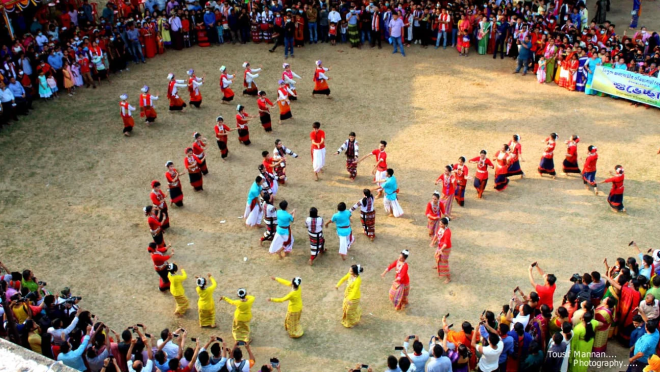
By seven, she gathers her school supplies. The morning commute fills the dirt roads with conversation as Ringchi joins neighbouring children, speaking in Achik, their native language. On the road with her friends, the heavy feeling lifts off her shoulders. She gets an hour to just laugh and be a kid. Inside the schoolhouse, the lessons blend traditional Garo heritage with regular textbooks. Maths lessons run parallel to instruction on matrilineal family structures, where property rights inherit through maternal lines. Sitting at her wooden desk, Ringchi feels pride learning about the matriarchs who came before her, realising her current struggle connects to a line of strong Garo women.
Following the final bell, the return journey includes games along the path, but as her house comes into view, her steps quicken with familiar anticipation.
Back home, she drops her bag at the door and reaches straight for her grandmother’s button phone. Every ring makes her chest tighten; she’s always terrified no one will pick up.
“Ma? Did you get to eat lunch?”
Over a static line, set against city traffic as her parents transition between work shifts, her mother’s voice fills the receiver. Ringchi’s body relaxes, her shoulders dropping. Ringchi shares details about the garden crops and her academic performance, double-checking that her parents maintain their meal schedule. She hides her own exhaustion, putting on a cheerful tone so her mother will not worry miles away in a factory room.
After ending the call, Ringchi arranges the dining table, serving cooked rice alongside garden greens for her grandmother.
Eating together on the porch during the afternoon hours, the scene shows true dedication. Ringchi watches her grandmother eat with a sense of accomplishment. A ten-year-old child manages a family estate through daily effort, carrying fear and love in equal measure.
For this year’s International Day of the World’s Indigenous Peoples, Ringchi’s experience shows what social equity actually takes. Supporting Indigenous populations means breaking down institutional barriers so parents avoid moving to the city for basic employment. True support demands securing land rights while ensuring equal job access and civil rights.