
The tuition trap: Who protects home tutors?
“I want the best for my child, as does any other parent. He is bright, but he does not study on his own. I want someone who is responsible, who will show my child how to be a good human being,” said Sayra Anjum, mother of 15-year-old Siad.
The tuition trap: Who protects home tutors?
“I want the best for my child, as does any other parent. He is bright, but he does not study on his own. I want someone who is responsible, who will show my child how to be a good human being,” said Sayra Anjum, mother of 15-year-old Siad.
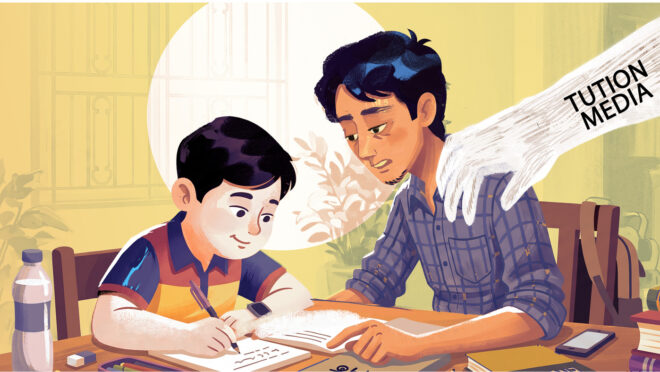
“Tuition media give me access to a top, talented student who has already travelled the path I want for my child. I want him to be a doctor; that is why I hire students from Dhaka Medical College,” she added.
Parents like Anjum are one half of the arrangement. The other half is a student with a bus fare and a stranger’s address. Part-time work is scarce for Bangladesh’s tens of millions of students, and tuition is the job that is left: go to someone’s house and teach their child. Tuition media have made that job easier to find. Parents describe what they want, tutors apply, and the pages do the matching. Sometimes it goes well. Sometimes it goes the way it went for Rafi.
Rafi, a 21-year-old student at Bangladesh University of Professionals, had come to Dhaka from Rangpur. In his second year, he needed a job to cover his rising personal expenses. After weeks of searching, he found a tuition post on a Facebook page: Class 8, all subjects, three days a week, Mirpur, Tk 8,000 a month. He kept the screenshots.
Then came the message from the tuition media: pay 50% of the first month’s salary, Tk4,000, within seven days or lose the tuition. He borrowed the money from his roommate and paid.
At the end of the first month, the guardian said the salary would come the following week. Next week turned to after he received his office bonus. At the end of the second month, there was another reason. Rafi kept going, three evenings a week, two buses each way, because walking away meant losing what he had already put in.
Near the end of the third month, the guardian told him by text message that the boy was moving to a coaching centre and he need not come back. When Rafi asked for his money, he was blocked on every platform, and even the building’s guard was instructed not to let him in.
Rafi called the tuition media. The fee was non-refundable, they told him. Their job had been to find him a tuition, and they had found one. What happened in the house was between him and the family. When he kept calling, they stopped answering.
He walked away with nothing for three months of teaching: Tk24,000 in unpaid salary, and Tk4,000 out of his own pocket in finders’ fees.
The middlemen
Rafi’s story is not the whole industry, and the students who keep coming back to it are not fools. Tutoring pays better than almost anything else a student can get. A tutor with a handful of students can earn more than many fresh graduates do in their first job, and the hours bend around lectures in a way a shop or an office will not.
Tk8,000 for three evenings a week looks small on a payslip. To a student far from home, it is rent.
Sharif, a 22-year-old student at the University of Liberal Arts Bangladesh, said, “I make about Tk27,000 per month from my four tuition fees. I got two of them from Tutoria and two from Tuition Terminal. This has been incredible for me; I can pay my own tuition fee, and that takes some of my guilt away for studying in an expensive private university,” he said.
The media deserve some credit too. Before the pages, a tutor found work through friends who already had tuitions, which meant a newcomer with no contacts in Dhaka had no way in. A page lets a student from Rangpur reach a family in Mirpur he would never otherwise meet, and lets a mother like Anjum find a Dhaka Medical College student without knowing one. The service is real. The trouble is how little of it most pages are willing to stand behind.
The biggest platform, Caretutors, says it has 500,000 registered tutors and 125,000 guardians, and still reaches less than 1% of the country’s 38 to 40 million students. Tutoria, Tuition Terminal and Tuition Media BD are among the other top pages.
The model has worked this way for decades. A tutor registers and hands over a startling amount of personal information: national ID or passport, home address, blood group, an immediate family contact, even marital status.
Then comes the tuition. After an unpaid demo class, if the parents say yes, the media charge 50–60% of the first month’s salary. In most cases, this fee is non-refundable. The guardians often pay the media little or nothing.
A fee for the match
The media’s job ends the moment a family says yes, and that is where the problem starts. The fee is earned at placement, not at payday, so the media lose nothing if the tutor is never paid.
Rafi is not alone. Another student said she was owed nearly Tk16,000 after four months of teaching, and received it only after her own parents phoned the family and threatened legal action. Another was offered far less than the agreed fee at the end of a month, accused of missing lessons and told to leave. Tutors also describe salaries docked for sick days, extra classes demanded for free, and families who vanish on holiday and expect the tutor to wait.
None of these arrangements is written down. When the family breaks the deal, the tutor has nothing to point to and no one to complain to.
Asked about such problems, an employee of an agency said, “The tutor is told that they can cancel the tuition within the first 10 days of working. But we take no responsibility after the tuition has been confirmed. It is written cleanly in our tuition contract.”
It does not have to work this way. Caretutors charge tutors only after they have been paid, issues a signed confirmation letter, and refunds part of its charge if a job ends early. For online tuition, it collects the first month’s salary from the guardian in advance. That is proof a tuition media can protect a tutor’s money when it chooses to. Most simply don’t. And even a signed letter, the platform admits, gives a tutor a record, not a remedy.
Safety that runs one way
Money is the usual risk. Sometimes the risk is far worse.
Adiba Tabassum, a 23-year-old North South University student, recently found herself holding a door with no proper lock shut against an older man with a boti while she was with her student. She called 999 and, she says, reached only an automated prompt that led nowhere. Her family reached her within minutes and got her and her student out. “At the end of the day,” she wrote afterwards, “it’s just you and your family.”
Her ordeal exposes how lopsided the industry’s idea of safety is. On the better platforms, a verification team may check a tutor’s address, academic records and identity before they reach a family’s door. Guardians watch a trial class and can say no. When the tutor arrives, an app logs their location and notifies the guardian.
The tutor gets a check that the job post is genuine. Nothing in the process tells them who lives in the house, and there is no button to press if something goes wrong inside it. Even an industry piece on protecting ‘both sides’ frames the guardian’s worry as the tutor’s identity and character, and the tutor’s worry as getting paid. A tutor’s physical safety is not on the list.
On Facebook pages, the gap is wider still. Tutors say they have no idea whether parents were vetted at all, and some pages simply advise young women to take someone along to a new house. Female tutors describe turning down evening tuitions for their own safety, and receiving unwanted messages from the people running the pages, who also hold their home addresses.
And if a tutor does call for help, 999 has around 80 incoming lines, roughly half its calls are blank or prank calls, and its average response time has been reported at about 20 minutes.
Adiba Tabassum, a 23-year-old North South University student, recently found herself holding a door with no proper lock shut against an older man with a sharp kitchen tool while she was with her student. She called 999 and, she says, reached only an automated prompt that led nowhere. Her family reached her within minutes and got her and her student out.
The cost of a tuition
Take the tuition away, and Sharif is much worse off. It gave him independence. Anjum found her Dhaka Medical College student the same way. Tuition media are fast becoming the gateways through which the next generation of Bangladesh is being shaped. But the trouble lies in who carries the risk.
Adiba is left with trauma that will define the rest of her life, a price no one expects to pay when they set out to teach a child. Rafi will probably find another tuition soon, likely through another page that asks for another fee.
The pages will keep their students, and the students will keep the pages, because nothing better is on offer. The next post Rafi answers will give a class, a locality and a salary. It still won’t say who lives in the house.