The writer who belonged to both sides
I found Sei Somoy the way I find most things now, by accident, half-heartedly, during a load-shedding that had killed the internet along with the lights. Somewhere around the third chapter, I stopped noticing the candle.
The writer who belonged to both sides
I found Sei Somoy the way I find most things now, by accident, half-heartedly, during a load-shedding that had killed the internet along with the lights. Somewhere around the third chapter, I stopped noticing the candle.
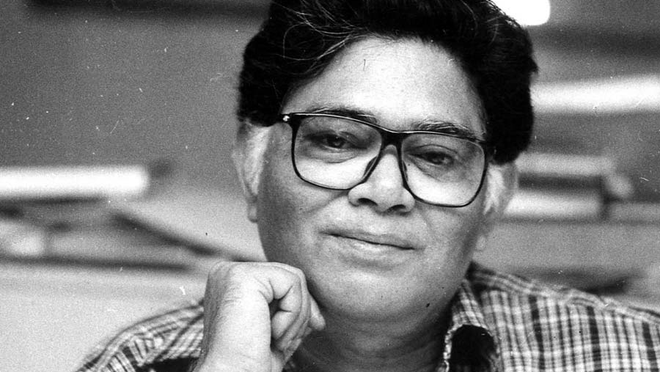
I did not know then that the man who wrote it was born less than three hours from where I was sitting, in a subdivision of Faridpur called Madaripur, in a Bengal that had not yet been cut down the middle.
Sunil Gangopadhyay would have turned ninety-two today. He was born on 7 September, 1934, and he left Madaripur as a small child, years before Partition made the leaving official for everyone else. By the time anyone outside his family was calling him a writer, he belonged entirely to Kolkata. He got a master’s in economics from Calcutta University in 1954, which is a strange fact to sit with when you know what he actually spent his life doing, and two years earlier, still an undergraduate, he had already started Krittibas with a handful of friends who wanted somewhere to be young and unfinished in public.
Most of what gets written about him treats Madaripur the way a CV treats a birthplace, a line to get through before the real biography starts. I keep getting stuck on it instead.
Maybe because I am from this side too, and I know what these towns do to a person even when the person leaves at four years old and keeps no conscious memory of a single street. Maybe it means nothing, an accident of geography I am reading too much into because it flatters something I already believe about this city.
But I went back to Sei Somoy this year, the nineteenth-century Kolkata of it, the printing presses and the drawing rooms of the Bengal Renaissance, and it did not read like a foreign country the way a lot of West Bengal fiction does when I read it here. It read like an earlier room in the same house. Not because the setting was familiar to me. Because the language was not asking my permission to be understood.
That, I think, is the only inheritance that actually survived the crossing intact. Not the land. He never went back to claim that, as far as I can find, and I have no idea whether the house in Madaripur still stands or whether anyone there knows whose birthplace it was. What survived is the Bengali itself, sitting the same in a Dhaka mouth as a Kolkata one, refusing the redrawing that happened to everything around it. He wrote for sixty years in a language that got split by two borders inside a single lifetime and never once behaved like it had been.
There is a detail I only learned recently that I cannot stop turning over. Sunil became close friends with Allen Ginsberg during Ginsberg’s long stretch of travel through India in the sixties, the two of them running in the same restless Kolkata circles, each one making it into the other’s work eventually. Ginsberg later wrote “September on Jessore Road,” about the refugees pouring across the border into India during the Liberation War, dying by the roadside on the same road that runs out of Jessore into what was becoming Bangladesh.
I do not know if Sunil ever spoke about that poem, or about a friend from Kolkata writing an elegy for a road that led straight back towards the district he was born in. But I think about it more than the fact probably deserves. Two men, one route, one of them describing a catastrophe on the ground the other had already left as a child.
I grew up on Kakababu before I knew who wrote him, before I even knew his name was Raja Roychowdhury and not just “Kakababu,” a former Archaeological Survey officer who loses the use of his legs on some secret mission in Afghanistan and spends the rest of his fictional life dragging his nephew Shontu through the Sundarbans and Everest base camp and half of Central Asia chasing riddles anyway, the limp somehow never once slowing the plot down.
I did not know, reading those on some cousin’s shelf as a boy, that the same hand had written thirty-six volumes of that and also the Neera poems, the confessional stuff under the name Nil Lohit that gave Krittibas its whole reputation for being difficult and modern and new.
That range still strikes me as slightly unfair. Most writers spend a career finding one voice and defending it. He held four or five at once for forty years and never let a single one of them go slack.
He died in Kolkata on 23 October, 2012, the city that had, by any honest measure, earned him. I am not trying to reclaim him for Bangladesh here. That would be a small and faintly embarrassing thing to do to a writer this large, the literary equivalent of a distant relative showing up at a funeral to mention a shared surname.
I just think about Madaripur sometimes, on the seventh of September, sitting in a city he never got to walk as an adult, reading sentences written in the same tongue that gets spoken without translation on both sides of a line he never asked to have drawn through his childhood. I do not fully know what to do with that feeling yet, except to notice it arrive every year on this date, and write it down again.