Experts weigh in on Mars’ pyramid rock
A three-sided formation spotted in Nasa imagery is drawing comparisons to the Great Pyramid of Giza. Researchers say the real culprit is rather more mundane
Experts weigh in on Mars’ pyramid rock
A three-sided formation spotted in Nasa imagery is drawing comparisons to the Great Pyramid of Giza. Researchers say the real culprit is rather more mundane
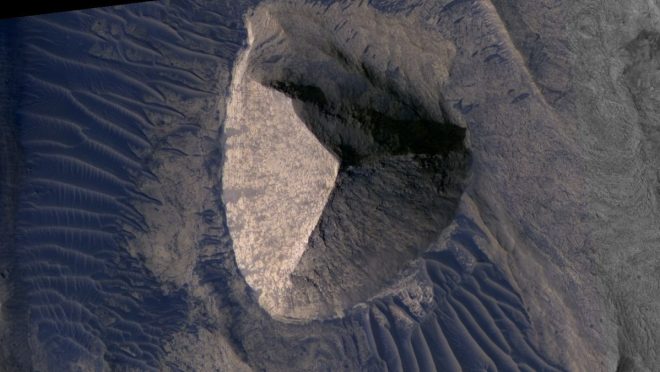
The conspiracy theories surrounding Egypt’s pyramids have kept people busy arguing for decades. Now Mars, it seems, has decided to add fuel to the fire.
A pyramid-shaped rock formation on the Martian surface is making waves online, after filmmaker Brian Cory Dobbs shared satellite imagery on X claiming the structure resembled a three-sided pyramid roughly the size of the Great Pyramid of Giza. The post spread rapidly, drawing tabloid headlines about alien civilisations and bewildered scientists.
In the images, captured by Nasa’s Mars Global Surveyor in 2001, the structure sits inside Candor Chasma, one of the largest canyons within Valles Marineris — the biggest canyon system in the entire solar system. Independent researcher Wilmer Faust first flagged the feature in 2002. Scientists have since nicknamed it the Candor Tetrahedron.
At roughly 290 metres wide and 145 metres tall, the formation is striking. But planetary scientist Pascal Lee of the SETI institute was direct, “Nothing to me screams anything close to ‘alien civilisation’ here.”
The explanation is far more grounded: Candor Chasma is riddled with what geologists call positive relief knobs — buried rock structures harder than the surrounding bedrock, left standing after billions of years of erosion by wind, water, and possibly tectonic activity. The Tetrahedron fits that description well. Its ridges are uneven, its three sides unequal — hardly the precision of a constructed monument.
Natural pyramids exist on Earth too. Colombia’s Cerro Tusa and China’s Guizhou Province both feature strikingly pyramidal mountains born entirely from geological forces.