A story cooked in spice and memory: Chef Ismail on MasterChef UK
On a random evening as I was scrolling through Facebook reels, a video from MasterChef UK caught my eye.
A story cooked in spice and memory: Chef Ismail on MasterChef UK
On a random evening as I was scrolling through Facebook reels, a video from MasterChef UK caught my eye.
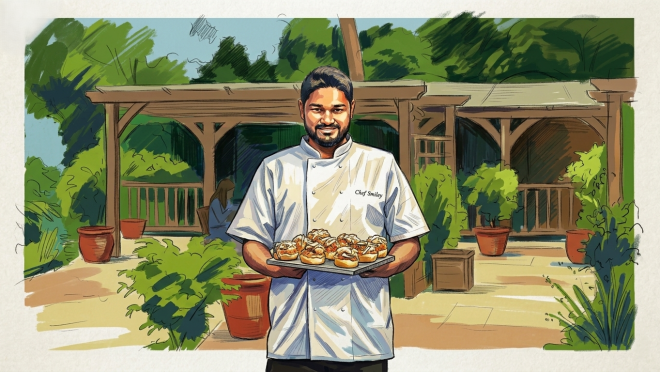
A Bengali chef was making a favourite dish of mine, haleem. He was also expressing an emotional story about his father bringing the famed dish for him and his brother late at night, the taste of which still lingered in his mouth.
Hearing this, I too felt a severe urge to taste that haleem through my phone’s screen.
Instantly realising that wasn’t possible, I decided to do the next best thing, I reached out to Chef Ismail himself.
Cooking is a form of storytelling where flavours, textures, and aromas come together to create mouth-watering experiences. Rooted in the rich culinary traditions of Bangladesh yet inspired by global cuisine, this year’s MasterChef UK semi-finalist Chef Ismail’s approach reflected both authenticity and innovation.
In the competitive world of cooking, platforms like MasterChef provide chefs the opportunity to showcase their skills on an international stage. Chef Ismail embraced this challenge, stepping into a high-pressure environment where creativity, precision, and resilience are tested at every turn, and it is fair to say that, as a semi-finalist, he has succeeded in making Bangladesh proud.
Upon asking how he participated in MasterChef, he mentioned its arduous process. He used to observe advertisements on Instagram, Facebook and even on TV. Then his competitive mindset pushed him towards the hectic application process.
“It was a very long application which included every information about me from childhood, personal life, and of course about professional life. I had to give them all of my social media links, send lots of photos, and I had to make a couple of dishes at home and send those pictures and recipes to them. I needed to tell the stories behind those recipes.”
Once the application was submitted, they contacted Chef Ismail and soon after called for an appointment which lasted about 20 minutes.
“They send videographers to the restaurant where I worked for an intro video. I cooked about four dishes for the intro video,” said Ismail. Later they again called back and said he was in.
Ismail had a shaky start in the very first round, as he explained it was because of nervousness in front of cameras and world-class judges. The judges did not like the taste. In the immediate next round, Ismail prepared his signature dish, meat bhuna. This was a turning point; everyone liked it, including judge Marcus, who liked the technique.
“One of the judges, Marcus, asked me who was the best cook, me or my mum; because I told him that the meat bhuna I cooked was inspired by her. When I told my mum, Marcus showed interest in meeting my mum.”
Monica, another judge, liked it too. The rice was well textured, the salad was amazing and of course the beef he cooked, keeping the fat with the meat by caramelising. It made the meat cooked perfectly and became soft and tender.
Another signature dish was his haleem. The internet was buzzing when the reel of the haleem was first released on the MasterChef page, one of the core reasons why we decided to interview Chef Ismail in the first place.
Ismail also expressed the warmth he received from his fellow contestants.
“They were very, very friendly from day one. The very first day we had four chefs. Everyone was talking with each other, helping each other at the studio while we waited for filming. We got to know each other and still today, we are in touch.”
Not only this, there were also good human beings behind the camera who supported him throughout the journey.
Ismail said the judges loved Bangladeshi food. They loved the spice level. Judges wanted Ismail to make more curry because they loved it.
“They all were over the moon upon trying the food. I was fortunate to cook for them and Matt Tebbutt loved every single dish that carried a bit of Bangladeshi touch.”
Monica and Marcus were also overwhelmed with every single dish he made.
Passion for the kitchen
Ismail used to watch cooking shows on TV but never imagined himself wearing a chef’s apron. It was only after starting work in a restaurant at the age of 18 that he fell in love with cooking.
Ismail started his culinary journey in Central London, where he began as a kitchen cleaner. Observing the chefs sparked his imagination, and he decided to pursue the career of a chef.
“I immersed myself in learning, assisting everyone in the kitchen, that was my first step towards digesting the art of cooking.”
Ismail’s culinary education came from his mother, followed by books and any other source he could get his hands on. Working under the supervision of numerous chefs eventually led him to enrol in a cooking school.
Working as a kitchen porter in a Central London restaurant, Ismail was first inspired by his head chef James Knight. He said, “Watching him manage the kitchen, create new dishes, and craft delicious meals with simple ingredients ignited my passion for cooking.”
Preparing for MasterChef is no easy feat.
“My extensive experience in the kitchen was my preparation, rather than any extra work,” said Chef Ismail.
In 17 years of experience in the kitchen, he has crafted numerous dishes. Upon asking which dish is his favourite, he said, “Choosing a favourite is difficult, as each one holds a special place in my journey.”
However, that haleem in the semi-finals truly holds a special place, he mentioned.
“My father used to bring it from Old Dhaka, and my brother and I eagerly awaited his return late at night. When tasked with cooking street food on MasterChef, haleem was my natural choice.”
Crafting the plate
According to the chef, every element must serve a purpose and complement the star ingredient.
For aspiring chefs, his advice is to study.
“Education does not have to be formal. The internet offers a wealth of resources. Learn, practise, and find a job where you can learn from a professional chef.”
Failure has been a more profound teacher than success. When I asked if there was any defining failure in his journey that shaped him more than success, he said he once overcomplicated a dish, losing sight of his identity as a chef.
“This experience taught me to reset, trust my instincts, stay true to my roots, and focus on clarity over complexity. It was a tough lesson, but it made me more confident, disciplined, and grounded in my cooking.”
When it comes to the definition of the perfect dish, he has a different ethical value.
“A perfect dish is not about flawlessness,” he believes. “It is about balance, intention, and honesty. It is when every element on the plate has a purpose, nothing is accidental, and each component works in harmony. It should reflect the chef’s identity, tell a story.”
Lastly, “Patience, constant tasting, and honesty with oneself are key. In the kitchen, every failed dish is a step closer to perfection,” shared Chef Ismail.
Chef Ismail continues to inspire aspiring cooks in Bangladesh and beyond, proving that passion, hard work, and creativity can open doors to extraordinary opportunities in the culinary world.
Currently he is working on several projects in London, writing a book, and a potential TV programme showcasing Bangladeshi dishes.