Bangladesh’s smartest investment isn't a bridge; it’s a child's wellbeing
Nearly one in four Bangladeshi children under five is stunted by chronic hunger, a permanent drag on the country’s productive capacity. A proposed cash transfer program may be the highest-return investment on the national ledger. But only if it is designed with rigour, not rhetoric
Bangladesh’s smartest investment isn't a bridge; it’s a child's wellbeing
Nearly one in four Bangladeshi children under five is stunted by chronic hunger, a permanent drag on the country’s productive capacity. A proposed cash transfer program may be the highest-return investment on the national ledger. But only if it is designed with rigour, not rhetoric
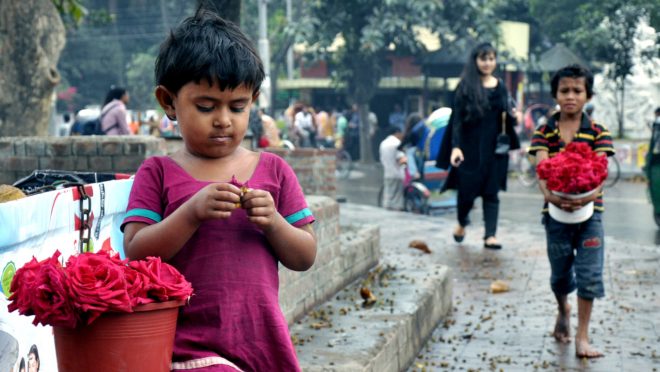
Every year, Bangladesh celebrates the concrete symbols of its remarkable development story — the Padma Bridge, the expanding Dhaka skyline, the garment sector that clothed the world. Yet a quieter crisis, invisible to cameras and ribbon-cutting ceremonies, threatens to stall that progress at its foundation. Approximately one in four children under the age of five in Bangladesh is stunted, physically smaller than they should be due to chronic undernutrition in their earliest years. For economists, stunting is not merely a humanitarian statistic. It is a structural drag on the country’s future productivity, built into the biology of its next generation of workers.
The Bangladesh Nationalist Party’s proposed “Family Card” program, a monthly cash transfer of roughly Tk 2,000 to Tk 2,500 for five million of the country’s most vulnerable households, has predictably attracted political scepticism. In Dhaka’s partisan climate, such initiatives are too often filed under “populist handouts.” That framing is not only uncharitable; it is analytically wrong. Evaluated through rigorous cost-benefit analysis, the Family Card is less a welfare expenditure and more a high-yield investment in human capital, one that compares favourably to nearly any infrastructure project on the national ledger.
The Neurological Argument
The economic case begins in neuroscience. Researchers at Northwestern University have found that in early childhood, the brain can account for nearly two-thirds of the body’s resting metabolic energy expenditure. This is a period of extraordinary neurological construction, the rapid formation of neural architecture that underpins cognition, language, and executive function for the rest of a person’s life. Chronic malnutrition during these years does not simply limit physical growth; it compromises the biological hardware through which children learn, reason, and eventually work.
The consequences are measurable and lasting. A World Bank analysis estimates that stunting imposes a per capita income penalty of between five and seven percent over a lifetime, a permanent tax on earnings that stems not from poor choices, but from an empty plate in infancy. For a nation targeting middle-income status, allowing nearly a quarter of its children to reach adulthood with diminished cognitive capacity is not a social failure alone. It is a macroeconomic miscalculation.
The Return on Investment
The counterargument to this investment is cost. The Family Card program would require substantial fiscal commitment. But the development economics literature offers a compelling rebuttal. Research by Copenhagen Consensus economists’ estimates that every taka invested in direct nutritional interventions targeting mothers and young children in Bangladesh yields approximately 18 takas in long-term economic returns, a benefit-cost ratio that outperforms most physical infrastructure investments. The mechanism is straightforward: better-nourished children learn more effectively, stay in school longer, and enter the workforce with greater productive capacity.
The program’s design reflects this logic. By targeting the poorest households, those who currently spend the bulk of their income on food, the transfer creates immediate purchasing power for higher-quality nutrition: protein, iron, iodine, and zinc, the micronutrients most critical to early brain development.
The Conditions for Success
The Family Card’s promise, however, is conditional. Three risks must be confronted directly.
The first is inflation. Injecting significant liquidity into concentrated, low-income communities will drive up local demand for basic foods. Without corresponding investment in agricultural supply chains, the price of eggs, lentils, and dairy could simply rise to absorb the transfer, neutralising its nutritional impact and enriching middlemen rather than children.
The second is behavioural. Cash alone does not guarantee better nutrition. Without accompanying education on what to purchase, and why, some households may substitute existing food budgets rather than supplement them. Behavioural change communication, teaching families specifically how to translate the transfer into nutrients, is not optional. It is the mechanism by which money becomes brain development.
The third risk is the most structural. Protecting a child’s neurological potential through better nutrition is a necessary condition for growth but not a sufficient one. A well-nourished child enrolled in an underfunded school with absent teachers gains far less than one with access to quality education. The highest returns on nutritional investment, research consistently shows, accrue where education systems are strong enough to translate cognitive potential into actual skills. To capture the full benefit of the Family Card, Bangladesh must pair it with serious supply-side reform in its primary and secondary schools.
A Prerequisite: Administrative Integrity
None of this works without a clean delivery mechanism. A program of this scale is vulnerable to inclusion errors, where political connections rather than economic need determine who receives a card. A digitized, unified beneficiary registry, not periodic, manual household surveys, is the administrative backbone the program requires. Issuing the card exclusively to the mother or female head of household is equally non-negotiable: a robust body of global evidence confirms that maternal control over household income leads to meaningfully higher spending on child nutrition and health.
The Dividend Is Real
Bangladesh stands at a genuine inflexion point. The low-cost labour model that powered its first wave of industrialisation is facing pressure from automation and regional competition. The next phase of growth will depend on a workforce that can innovate, adapt, and produce higher-value goods and services. That workforce is currently under five years old, sitting in homes where the choice between protein and rent is not theoretical.
The Family Card, designed carefully and administered rigorously, is not charity. It is the most direct investment available in the cognitive capital of the next generation. Bangladesh has built remarkable things with concrete and steel. It is time to build with the same ambition in bone and brain.
Md Imtiaz Kabir Prottuy and Mostofa Monzurul Alam write on development economics and South Asian policy
Disclaimer: The views and opinions expressed in this article are those of the authors and do not necessarily reflect the opinions and views of The Business Standard.