Cracking the US PhD dream: A Bangladeshi student’s journey to full funding
Many who wish to study abroad often start their journey keeping the US as their first choice. Abdullah Bin Murad is one of those who turned this dream into reality.
Cracking the US PhD dream: A Bangladeshi student’s journey to full funding
Many who wish to study abroad often start their journey keeping the US as their first choice. Abdullah Bin Murad is one of those who turned this dream into reality.
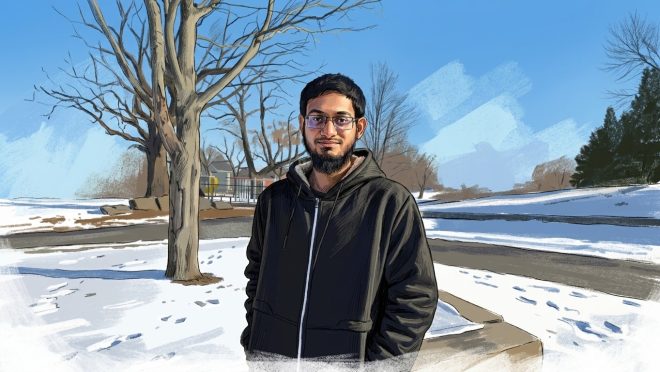
As a current PhD aspirant at Northeastern University, USA, I wanted to know what made his journey special and how others like me can emulate a path towards a potential PhD.
Abdullah Bin Murad completed his undergraduate degree in Chemical Engineering from Shahjalal University of Science & Technology (SUST). Prior to that, he completed his HSC from Notre Dame College and SSC from Ideal School & College. After graduation, he joined Meghna PVC Ltd., a sister concern of Meghna Group of Industries (MGI), as a Process Engineer. He worked there for around one year before starting his PhD at Northeastern University, USA.
As per Abdullah, Northeastern University is one of the leading universities for research and co-op programmes. It offers and helps students secure internships in leading organisations, which is really beneficial for students to get a job after their graduation.
Abdullah’s motivation for pursuing his studies in the US came from various reasons. He shared, “The number of universities in a single state of the USA is higher than the total number of universities in any European country. Another reason is the availability of scholarships and job opportunities.
US universities are decentralised and each of the universities offers fully funded scholarships for various departments. On the contrary, other countries either do not offer a large number of scholarships or they have centralised government scholarship options which are normally very competitive. The job opportunities are comparatively higher than in other countries, though the work-life balance and huge healthcare costs raise the question of choosing comfort over a higher salary.”
Understanding fully funded opportunities
While many students consider the US mostly unaffordable, Abdullah does not feel the same. He says, “I will not directly say this is unaffordable, but it could be difficult for some students in Bangladesh. The reality is that if someone secures a fully funded scholarship, he/she needs to manage embassy/visa fees, SEVIS fees, plane fare, house rent for at least one month, and shopping. However, it happens quite frequently that students borrow some money from seniors and pay them back later.
So, I would say that getting a fully funded scholarship alleviates the burden of paying tuition fees and health insurance and supports students with a monthly stipend. Securing a fully funded scholarship is not impossible.”
For lay readers, Abdullah also explained various terms that people come across during study abroad preparations: “A tuition waiver means the student does not have to pay for tuition. Health insurance means the university will cover or subsidise the health insurance plan. A graduate assistantship means the university will give you a monthly stipend either in the form of a TA or RA.”
Graduate assistantships come in two forms: Research Assistantship (RA) and Teaching Assistantship (TA). A research assistantship requires working under a supervisor on one or multiple projects and running experiments in the lab to obtain meaningful results. A teaching assistantship mostly requires grading students’ homework and exam papers, holding office hours to answer students’ questions, preparing homework questions with solutions, and sometimes taking classes. This varies from faculty to faculty.
Abdullah says, “Research assistantships can be hectic or even exhausting if the deadline of the project is approaching or the supervisor wants results as soon as possible.” Managing the balance between academic workload and assistantship responsibilities depends largely on individuals, as stated by Abdullah. He mentioned, “Most of the time, it is manageable, but during exam periods, it might be necessary to focus more on studies.”
Application strategy & preparation
Abdullah’s preparation involves meticulous planning and focused work. He spent three months studying for the IELTS using internet resources, Cambridge books, and practice exams. He did not take the GRE because his program did not require it, in contrast to many others.
In his fourth year, immediately following the publication of his first research work, he also began the scholarship application process. He says, “I applied to around eight to ten universities, categorizing them as high, mid, and low based on my profile. And I was lucky to be accepted by three,”
A personalised Statement of Purpose (SOP) and letters of recommendation from instructors were important parts of his candidacy. “For every program, I had to highlight my programming abilities and explain my research difficulties,” Abdullah mentioned.
According to him, it is very important to start preparation as early as possible. He prepared for the GRE and IELTS, which he says helped him later. Having one or more publications helps significantly in securing a scholarship.
Abdullah says, “Standardised tests are mainly the requirements of graduate schools. Academic results create the first impression that helps in getting an offer letter earlier. An outstanding CGPA can be enough to secure funding without any publication. Prior experience is also important and can compensate for a lower CGPA in some cases.”
For a PhD, securing admission goes beyond academic results. An aspirant must consider the department’s faculty research availability and funding possibilities. In this regard, Abdullah said, “Contacting the department or professors helps applicants determine which faculty members are taking new students and understand the funding status of the department. If there is any availability of an application fee waiver or fellowship opportunity, asking the graduate coordinator about it can be helpful.”
Reality check
The journey was not at all simple. Abdullah had to juggle exam preparation and university admission requirements with his full-time job at Meghna PVC Ltd., a sister company of Meghna Group of Industries (MGI). Strict planning and self-discipline were necessary for him to manage IELTS studies, write declarations of purpose, and arrange recommendation letters while keeping a busy job schedule.
Abdullah did not face much cultural shock while living in the US. However, he says that their academic system is very interactive and presentation-based. Final grades do not entirely depend on exams.
When asked about the actual reality one might face when studying in the US, he said, “I think the luxury that people imagine before coming to the US is not true at all. Students need to work hard to earn money, pay house rent and utility bills, buy necessary items, cook food, etc. Life in the USA is not easy; it is hard. Getting a job is also harder due to supply and demand.”
He further stated that many students apply randomly to a large number of programmes, which he believes is not a good approach. He advises, “Students should consider which research area aligns most with their experience and interests.”
He also shared an important insight during the interview: “A strong CGPA proves that the student is knowledgeable in their field, whereas research experience proves that they have knowledge of scientific writing and conducting experiments or simulations.” He suggests that students should focus on improving their profiles: “Students may get rejected for various reasons. Improving the profile can help them secure better funding and also increases the chances of visa acceptance.”
He added, “Currently, there are some political factors affecting the overall government funding situation. We can hope that the situation will improve in the future.”
Sticking to one plan and working hard for it has brought him to where he is now. For students who feel that fully funded study in the US is “not for people like us”, he says, “Students like you have received fully funded scholarships, are receiving them, and will continue to do so. Start preparing now!”
This article is written in partnership with Abroadmates, the all-in-one mentorship platform for study abroad.
To know more, book a session with Murad at https://www.abroadmates.com/abdullah-bin-murad-rifat