May God save the Emperor, again and again
The word ‘Revolution’, when thought of from the point of view of mathematics, is the circling and reaching of the same point of starting.
May God save the Emperor, again and again
The word ‘Revolution’, when thought of from the point of view of mathematics, is the circling and reaching of the same point of starting.
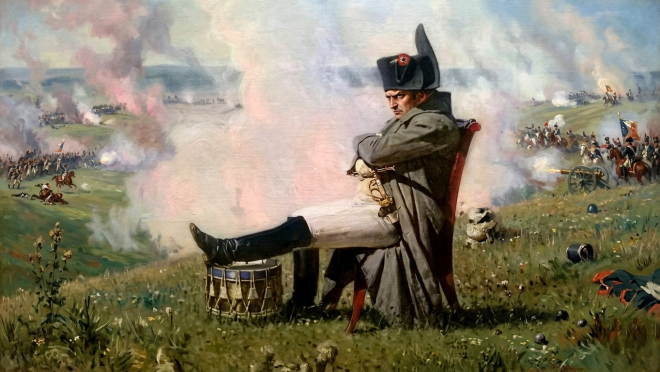
Miraculously, in historical terms, revolutions are somewhat the same. They start off aiming to turn the tables, to change the status quo, to rebuild a society from scratch, but what in retrospect we witness is that humanity turns around and reaches the same destination from where it started its journey in the first place.
The human being we’re honouring today is no exception to this rule and may embody the word revolution like no other.
The mighty Napoleon Bonaparte died on this day in 1812.
So then why do we remember him so fondly?
Maybe because he wasn’t a normal dictator who came, saw, and eventually vanished. We remember the dear general for not only his anointment as Emperor, but for the changes he brought us, the template he built, upon which future dictators after him lay their claim.
A self-proclaimed emperor, the embodiment of the stereotypical French. Today we celebrate Napoleon Bonaparte.
A humble beginning
Much like most of the greats, Napoleon paved his own way. Born outside of the French nobility, becoming a noble Frenchman, let alone a full-blown Emperor, was out of the question.
However, at a time when the whole of Europe was stuck in their own way, fearing the all-holy Catholic Church and the good-for-nothing monarchs from the Dark Ages, France was witness to the shining beacon of enlightenment.
It seemed France had cut its ties with the proverbial unholy alliance with the rest of Europe, as it cut the ties which literally had separated its monarchs’ heads and most of its nobility’s.
It is in that climate that Napoleon was able to shine. Acknowledged by the brilliance he had shown in the military academy, Napoleon quickly got promoted and became Brigadier General to the group directly under the French Committee for Public Safety, Le Comité de salut public.
A committee which hanged thousands of “enemies to the revolution” itself. But that’s a discussion for another time.
After all, Napoleon was believed to be trusted among its leadership, and as a token of that trust, he was sent to Egypt to fight off the British.
That he did quite well, and not only “liberated” Egypt but looted its most valuable artefacts. For many of you, it may be shocking to know that the General had declared himself a follower of Muhammad (S:) in order to curry favour with the Egyptian armed mercenaries.
It seemed the General was willing to do whatever it took to win, and pretending to adopt a newer faith was just a small pill of strategy he had no problem swallowing. Whatever the reason many historians provide otherwise, it was evident that the General was destined for greatness and retiring as the head of a brigade in the army was not in his plans.
je suis la révolution
Soon after, Napoleon had decided to march towards Paris, not as an invader, but a liberator who would restore order to the chaos.
The French government was in disarray at that time, and it appeared that most of the French welcomed him with open arms.
He soon declared himself lead Consul of the French – a term chosen from Latin, mimicking the Roman consuls. His power quickly grew, and in no time he declared himself supreme dictator and Emperor.
“I am the Revolution”, a disputed quote often attributed to him.
Whether true or not, it certainly was a revolution.
From deposing a monarch just a few years ago and now embracing another (better) one, France had made a 360° turn. Willingly or not, history had saved the Emperor once more.
The ruler
In the meantime, Napoleon was building his famous Napoleonic Codes, a set of rules which the French still abide by. Famously, the rights given to women through the revolution were scrapped. Having an “adventurous” wife, Napoleon seemingly had enough of seeing women’s freedom.
They were bound to their husbands, having stripped any and all property rights. The Emperor also reinstituted the Catholic Church, an institution which legitimised the previous Louis’s disastrous rule, and was once again ready to justify this newly found “Roman” pride in a Corsican general.
Not all things were bad.
The ‘stability’ which all dictators bring at the start constituted major scientific progress. It was evident that the French civil society found solace under their beloved oppressor, and much like the civil societies of South Asia (meaning our country), they had no problems going on with their scientific discoveries and poem recitations.
The famous metric system was also an introduction made by Napoleon, not to mention the thousands of military strategies he and his army formulated which are taught in military academies across the world today.
The reverse revolution was seemingly making the renaissance happen once again, and France was top of the world with the majority of Europe under her throne.
The legacy
Just like the French “Revolution” (360 one) deposed Louie and brought forth a better Louie named “Napoleon”, Napoleon’s rule had been reminding the French of the good old days of post-Louie times.
And after the loss to the Czar and to the British at Waterloo, our Emperor was sent to exile. Though he tried a coup once, ultimately even he had to admit defeat.
Napoleon to us is a reminder of the old saying, history does repeat itself. The playbook he laid out not only influences modern warfare, but influences how our leaders act today.
The proverbial gods our politicians believe themselves to be, the makers of change, which Napoleon first personified, at least in the pages of history. It was true that he loved France from the heart. Even his staunch enemies cannot deny that fact.
But that image of love only was to be cherished if the Emperor himself was leading France; otherwise, that image was not worthy of his love.
All modern dictators similarly love their countries as long as they are the ones at the centre stage, and as the world goes through yet another tumultuous age full of conflict and suffering, we must await the inevitable revolution, a change, yes, but a change that predictably may bring us back to the beginning.