Beton Kemon: Changing how Bangladesh talks salaries
For many job-seekers in Bangladesh, information regarding salaries and benefits has remained one of the most guarded secrets.
Beton Kemon: Changing how Bangladesh talks salaries
For many job-seekers in Bangladesh, information regarding salaries and benefits has remained one of the most guarded secrets.
The vacuum means candidates often spend weeks, even months, navigating interviews and offers, only to discover their expectations were far from reality.
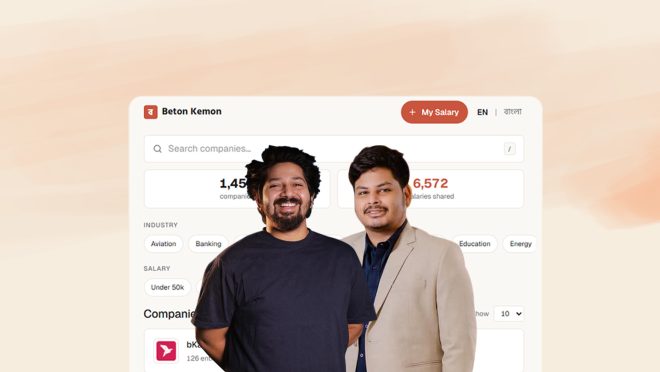
Two founders, Ishmam Chowdhury and Raiyaan Ehab Shams, have taken this challenge head-on with Beton Kemon, an anonymous salary transparency platform designed specifically for the Bangladeshi market.
Their goal is simple yet profound: to equip job-seekers with accurate information so they can make informed career decisions without relying on guesswork or awkward conversations.
The problem they set out to solve
Ishmam Chowdhury, currently Chief Operating Officer at Shikho, describes his role as applying pressure wherever the business needs it. From sales and marketing to HR, finance, and IT, he navigates all areas of the company while also mentoring early-career professionals and building small tools for recurring problems. Beton Kemon emerged from one of these side projects.
Raiyaan Ehab Shams, Head of Media Buying at Tyger Media, was simultaneously focused on building Grow Your Career, a platform guiding students and early professionals in career decisions. While advising individuals, Raiyaan noticed a persistent issue: a lack of visibility into salaries and market standards. Beton Kemon became a natural extension of this vision, aimed at solving that specific problem.
In Bangladesh, salary discussions are almost taboo. Job-seekers often discover their actual pay only at the offer stage. Ishmam emphasises that this is not just inconvenient, it has real consequences. “Months of someone’s career can be lost,” he explains. Raiyaan echoes this, noting that beyond salary ranges, details like take-home pay, payment delays, and consistency are rarely known. Culturally, discussing money is often seen as rude or boastful. Structurally, no centralised system exists to provide reliable information, so candidates rely on fragmented peer networks.
There is also fear: fear of judgement, workplace consequences, and losing negotiation leverage. Ishmam stresses that while culture plays a role, the silence is maintained because vague opacity benefits employers. The founders saw an opportunity to challenge this status quo by creating a platform that removes personal risk entirely.
Collaboration over competition
Interestingly, Beton Kemon is the product of collaboration rather than rivalry. When Ishmam shared his early prototype with Raiyaan, he discovered that Raiyaan had been planning a similar platform.
They quickly realised that competing would split the audience and dilute impact. Instead, they joined forces, combining networks and efforts to build one stronger system. Both describe this collaboration as remarkably straightforward, driven by alignment on purpose rather than negotiation over outcomes.
The unique selling point of Beton Kemon is full anonymity. No email, no IP tracking, no identifiers. Ishmam explains that the moment users fear being traced, they either lie or do not share at all. “There is nothing on our end that could ever link an entry to a person,” he adds.
This design choice introduces risk, such as deliberate misinformation, but it is manageable. Breaking user trust, however, would be catastrophic. Raiyaan reinforces this, pointing out that making salary submissions safe and anonymous is essential to collecting honest data in Bangladesh.
Maintaining accuracy
One of the biggest challenges for Beton Kemon is ensuring data reliability while keeping submissions fully anonymous. Ishmam is candid when asked about the platform’s vulnerability at this stage. “Honestly, vulnerable. Any anonymous public platform is. Anyone telling you otherwise is not being straight with you,” he admits.
To mitigate risks, Beton Kemon layers multiple safeguards. Every submission is manually reviewed before going live. Drawing on their industry experience and the Grow Your Career dataset, Ishmam notes, “We have rejected 1,112 entries so far for being clearly inaccurate.”
Data is presented as ranges and aggregates rather than single points, ensuring that no individual submission can skew a company’s profile. With over 3,600 entries across nearly 900 companies, volume itself helps filter out outliers.
“We don’t claim every data point is verified. We aim to be accurate enough, most of the time, to be useful,” he adds.
Raiyaan highlights the platform’s pragmatic approach. “At this stage, any open system will naturally have some noise, and that’s expected. But the focus right now is on scale and pattern consistency. When you have enough data, individual anomalies don’t distort the overall picture as much.” He adds that structured input and filtering logic help detect outliers and anomalies, with plans to evolve into more advanced statistical weighting and pattern-based detection over time. “The goal is not perfection, but ensuring the dataset remains directionally accurate and useful for real decision-making,” he explains.
Regarding verification, both founders see a potential role for optional credibility badges. Ishmam envisions a system where users could choose to confirm their employment, giving their data slightly more weight without compromising anonymity. “It can coexist, but only as an option, never as a requirement,” he stresses. Raiyaan adds, “A more realistic future is a hybrid model where anonymity stays at the core, but optional verification can add credibility signals without blocking participation.”
A community-driven, non-monetised platform (currently)
Beton Kemon operates fully on voluntary contributions. There is no paid tier, and monetisation is not part of the current plan. “From the very beginning, the focus has been purely on impact, creating something genuinely useful for people trying to understand salaries and make better career decisions in Bangladesh,” Raiyaan says.
Ishmam also talked about a similar approach: “if we ever introduce monetisation, it would have to come from the side of the market that benefits commercially – companies, recruiters, HR tooling.”
Beton Kemon only publishes data voluntarily shared by individuals, not internal company documents. Ethically, the platform avoids reviews or defamatory content, focusing solely on numbers. Both founders emphasise their commitment to fairness and open engagement with companies that may raise concerns.
Why Beton Kemon is different from others
Global platforms like Glassdoor exist, but they are ill-suited to Bangladesh. Ishmam structured out three major differences between both: registration requirements, friction in accessing data, and lack of local context often discouraging users. “Benefits like PF, GF, and WPPF are missing or generic. Pay-day reliability – which in Bangladesh is a huge concern – isn’t even a category. We built it specifically for these realities,” he added.
Beton Kemon requires no sign-up, uses local role titles and compensation structures, and includes factors such as pay-day reliability. Its launch through Grow Your Career networks and other local communities quickly generated thousands of entries, far surpassing what Glassdoor has achieved locally over a decade.
Lessons on trust and community
Both founders have been struck by the generosity of the Bangladeshi community. Ishmam recalls that the first community, shared with the IBA BBA cohort, generated 223 entries within a single day, despite the sensitive nature of salary data. Raiyaan observed that the community itself functions as the infrastructure for trust. These experiences reinforced the idea that people will contribute when given a safe, valuable opportunity.
Both Ishmam and Raiyaan are clear-eyed about Beton Kemon’s future. Their long-term vision is for the platform to become the default reference for compensation in Bangladesh, helping job-seekers negotiate better, make informed career choices, and encourage companies to calibrate pay fairly.
Ishmam outlines the immediate next steps: “The next big steps are search by department and role, year-on-year compensation views, and richer benefits data.” He is cautious about expanding into company culture or workplace reviews, noting the potential for legal exposure and bias. “Beton Kemon stands for one thing: pay transparency. If we expand, it will be in directions that strengthen that core, not move away from it,” he says.
Raiyaan echoes this measured approach, emphasising flexibility without distraction. “Right now, we are not locked into any specific format like an app or a web platform. If the platform grows significantly, then it could naturally evolve into a more structured product, possibly including an app or a more advanced platform. Every addition has to answer one question clearly: does this actually help someone in their career decision-making process? If the answer is yes, we build it. If not, we do not.”