Breaking news: Education board replaces books with dance trends to save students from reading!
Breaking news: Education board replaces books with dance trends to save students from reading!
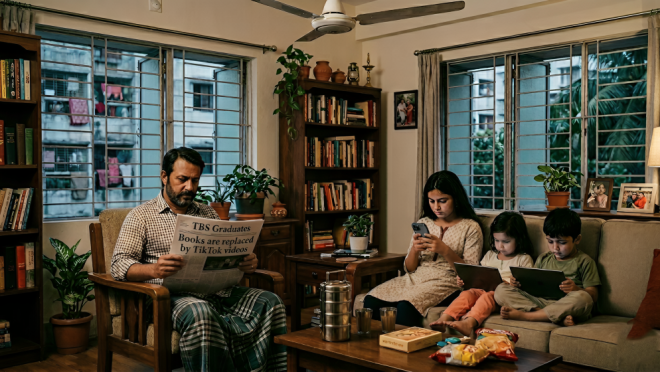
The crisis began, as all modern crises do, with a committee meeting and a slideshow.
Somewhere between Slide 12 (“Declining Attention Metrics”) and Slide 19 (“Why Reading Is the Problem”), it was agreed that education, as a concept, had simply failed to keep up. Books were heavy. Sentences were long. Paragraphs demanded commitment. Something had to be done.
And so, in a bold attempt to rescue learning from the fatal threat of reading, a revolutionary policy was unveiled: all classic literature and historical events would be translated into 15-second vertical dance trends.
Knowledge, officials explained, would no longer require sitting still, turning pages, or confronting ideas without background music.
The initiative promised to end centuries of unnecessary page-turning and finally align education with the natural attention span of the modern student, roughly the length of a kettle boil, provided the kettle is engaging and preferably sponsored.
Under the new system, War and Peace would no longer intimidate learners with its size. Instead, it would be condensed into a single interpretive dance move symbolising existential despair, followed by a dramatic shoulder shrug to represent Napoleon’s entire military career. This would loop indefinitely, ensuring full comprehension through repetition.
Hamlet would begin with a mournful lip-sync of “To be or not to be”, delivered directly into the camera for intimacy. The question itself would be resolved moments later through an aggressive hip thrust, universally understood to mean “not to be”. The remaining deaths would be implied through sudden exits from the frame. Shakespeare scholars expressed concern, but were reassured that the original texts would still exist somewhere, mostly to add gravitas to library interiors.
History, long criticised for involving dates, would finally become accessible. The French Revolution would be taught through a fast-paced routine featuring fake cake, exaggerated outrage, and a sudden drop to the floor to indicate the guillotine. The Industrial Revolution would appear as a looping video of students pretending to be machines until they emotionally shut down, which experts agreed was both accurate and immersive. Colonialism would be covered in a split-screen duet, though officials admitted it was still “a work in progress”.
Assessment, too, would enter the modern age. Essays would be retired, having failed to engage audiences under the age of 19. In their place, students would submit choreographed summaries. A well-timed spin would earn additional marks for “critical thinking”. Interpretive finger-pointing would replace footnotes. Plagiarism would be defined as performing the exact same dance as your mate, but with visibly less passion.
Teachers initially struggled to adapt. Many were seen attempting to explain causation through hand gestures and irony through facial expressions alone. Professional development sessions were introduced to help staff learn key competencies such as “historical twerking” and “allegorical side-eye”. Several departments reported morale improvements once staff accepted there was no going back.
Supporters of the reform insisted the policy simply met students where they already were: vertically scrolling, mildly bored, and deeply allergic to paragraphs. “Why force a child to read 400 pages,” asked one reformer earnestly, “when they can absorb the same information from a looped video they didn’t ask for but will watch seventeen times?”
Critics raised concerns about long-term consequences, such as graduates being unable to read contracts, novels, or warning signs. These worries were dismissed as elitist and nostalgic. “If the Magna Carta cannot be explained through a viral trend,” one official noted, “perhaps it does not deserve to survive.”
The pilot programme concluded with a carefully focus-tested slogan, projected onto a screen behind a group of dancing interns: Those who cannot remember the past are condemned to remix it.
The interns danced. The slogan trended. And somewhere, in a quiet corner, a book remained unread, but beautifully preserved nonetheless.