How pet ownership got easier for urban Bangladesh
The change is visible in the pet food sections of grocery stores, in the string of veterinary clinics that have opened in localities, and in the monthly budgets of young people who now quietly set aside money for an animal they treat like a family member
How pet ownership got easier for urban Bangladesh
The change is visible in the pet food sections of grocery stores, in the string of veterinary clinics that have opened in localities, and in the monthly budgets of young people who now quietly set aside money for an animal they treat like a family member
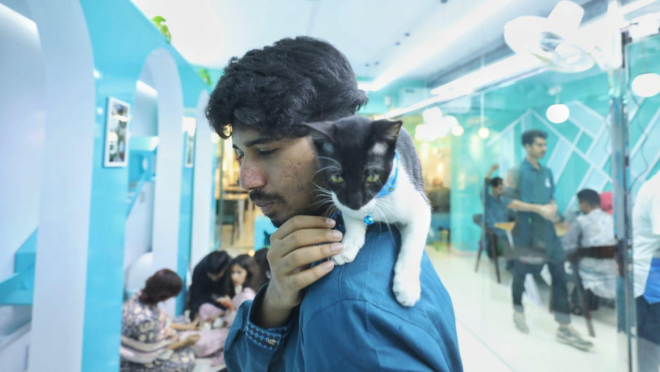
Before Nahian adopted his first cat, Jerry, his family was not welcoming to the idea. Animals belonged outside. Keeping one indoors, feeding it, taking it to a doctor, spending money on it — these were things that struck many Bangladeshi households as either a Western affectation or sheer impracticality. Only a small number of wealthy families opted to adopt cats.
When Nahian adopted Jerry, his mother was the most vocal against it. But eventually, she became the one who cared for Jerry the most. But the cat went outside one day and never returned.
Nahian later adopted Tuku. Now, the family has been doing this long enough that the learning curve — the food, the vaccines, the vet visits, the window nets for catproofing — feels like a part of life.
“Sometimes I manage the cost myself, sometimes I borrow from my cousin, and sometimes my parents help,” Nahian said. “But at the end of the day, when I return home and see the way she greets me and how adorable she acts, it makes all the adjustments and expenses worth it.”
Something has quietly shifted over the last few years. The change is visible in the pet food sections of grocery stores, in the string of veterinary clinics that have opened in localities, and in the monthly budgets of young people who now quietly set aside money for an animal they treat like a family member.
According to research by Mohammad Abdul Saleque of ACI Limited, the number of pet owners in Bangladesh has increased by 170% over the last three years. 90% of those pets are cats. A market that barely registered a few years ago is now one of the fastest-growing consumer categories in the country.
Veterinarian Sabrina Akter Chowdhury has watched the transformation from the other side of the table. She sees it in who walks through her clinic door and in how they talk about their animals.
“In recent years, veterinary clinics have increased in our country, especially in cities,” she noted. “Before, there were mostly government veterinary hospitals and only a few private clinics. Nowadays, private clinics have grown significantly in number.”
The economics of opening a clinic have made the expansion possible. A private practice requires a registered vet and a space; it does not require government clearance. With demand rising, it has become a genuinely profitable sector.

Photo: Courtesy
The country now has over 225 pet clinics, according to Saleque’s research, most of them private and many of them recently established. In Dhaka especially, owners who once had to travel considerable distances to find a vet now find they have options in their own neighbourhoods.
Sabrina attributes the surge in pet adoption to a combination of forces that have been building simultaneously.
“One of them is, of course, how much people are influenced by social media trends,” she said. “In recent years, adopting a cat has emerged as something cool or trendy. People post about their cats — lovey-dovey photos, cute videos — and then someone gets influenced and wishes to have a pet of their own.”
This scroll-and-desire loop has been remarkably effective at drawing in new pet owners from demographics that would never have considered it otherwise.
However, it is not just trend-chasing. “Another factor is that, in recent years, mental health issues and loneliness have also emerged as contributing factors, which I think have played a role in this trend.”

Photo: Courtesy
There is a more serious emotional underpinning to what, on the surface, looks like people simply posting cute photos. “With a pet, they kind of fill the lack of companionship and a sense of connection, and they become emotionally attached to the pet, which requires a lot of attention.”
The Covid-19 lockdowns during 2020 and 2021 pushed people indoors, disrupted social lives, and left many — particularly young people living alone or in small apartments — with a sense of isolation. For many of them, a cat was not so much a lifestyle choice as a response to an emotional need.
The third thread Sabrina pulls on is growing awareness about animal welfare. “People nowadays are more aware. They post about a lost kitten, a wounded dog, feeding strays — all of these have contributed to this shift together.”
Awareness of animals as creatures deserving care, rather than merely property or pests, has grown substantially, particularly on social media, where such posts circulate widely and generate strong emotional responses.
Bangladesh, Dhaka in particular, is one of the most densely populated urban environments on earth. Apartments are small. Families are tightly packed in. Dogs require space, outdoor access, and exercise that a sixth-floor flat simply cannot provide. Cats require none of that. They are, as Saleque’s research puts it, easier to keep in apartments. “Limited space is one of the key factors why people opt to have cats in Bangladesh,” the study notes.
That said, dog ownership has grown too, just not at the same pace. Those who have the space and can afford the upkeep are increasingly choosing to keep dogs as well. In Gulshan, where residents tend to have larger homes and more disposable income, the Gulshan Society Lake Park has started an initiative of providing a dedicated space for pet owners to bring their animals. It is allowing the registered members to walk their dogs inside the park during designated hours. Such an initiative, new as it is, points to something shifting in how society at large is beginning to make room for pets.

Photo: Courtesy
The Bangladeshi cat food market alone is currently estimated at Tk5 billion, or approximately $43 million, of which Tk4 billion is met through imports.
The numbers from the Department of Livestock put the trend in even starker terms: approximately 32,156 tonnes of cat food were imported into Bangladesh during the 2024–25 marketing year. China supplied the largest share, at 17,738 tonnes, followed by Thailand with 7,418 tonnes and Turkey with 6,740 tonnes. Smaller quantities arrived from France and India.
Bangladesh is, quietly, a substantial importer of cat food, and the numbers continue to rise gradually.
For context, pet food holds the largest single share of the pet market at 57%, followed by medicines at 19%, litter at 16%, vaccines at 7%, and miscellaneous products making up the remainder. There are now over 4,000 pet shops across the country, whereas pet supplies were once confined to a few import sections in upscale supermarkets.
The spending does not stop at food. Grooming has become a service that urban pet owners are increasingly willing to pay for. “Now people can afford to spend a lot on accessories and grooming for their pets,” Sabrina said. “One grooming session at a clinic can cost Tk2,000 to Tk5,000. That includes hair trimming, nail trimming, and things like that.”
The vaccine situation has also evolved. Core vaccines — rabies and the flu combination — are now considered standard by informed pet owners. “For core vaccines, rabies and the flu vaccine are kind of must-haves,” Sabrina mentioned. “The flu vaccine is a combination of five vaccines. These are given annually or biannually.”
A flu vaccine costs between Tk800 and Tk1,500, while a rabies vaccine costs Tk200 to Tk500. Government hospitals offer these at lower prices, though costs at private clinics vary considerably.
Neutering and spaying have also become more common. When a cat enters its heat cycle, it becomes agitated, aggressive, and often gets into fights. “It happens every month,” Sabrina said. Beyond behaviour, a cat can produce three to four kittens per pregnancy cycle, and the mother’s health deteriorates with repeated pregnancies. “So it is better to spay or neuter your cats if you do not want these conditions.”
Neutering a male cat at a private clinic costs between Tk1,000 and Tk3,000; spaying a female cat costs between Tk1,500 and Tk4,000, with the higher cost reflecting the greater surgical complexity. Government hospitals do not typically perform these procedures on cats, making private clinics the only option.
Deworming is another common reason people visit clinics. Since parasites are so common in cats, it is a crucial preventive veterinary care process that eliminates them. It ensures proper nutrient absorption, protects the cat’s health, and prevents the transmission of zoonotic parasites to humans.
The overall shift, as Sabrina sees it, is in how seriously people take an animal’s health as an ongoing responsibility rather than something to deal with only when there is a crisis. “It’s good that people now have enough knowledge about pet care and pet maintenance. They take care of their cats like their own children or family members,” she said.
On the food question specifically, Sabrina has a caution worth passing on.
“Cat food is not so healthy, especially if a cat is mostly dependent on cat food.” The dry, pea-sized pellets that dominate the market are calorie-dense and moisture-poor, which can create problems over time, such as obesity, constipation, and urinary tract issues.
“So it is important and suggested to feed normal foods, and cat food can be given occasionally.”