Govt drafting fresh service rules to protect private-sector employees
A senior official of one of the country’s leading business associations, requesting anonymity, said workers frequently approach them with complaints of arbitrary dismissals or unpaid dues after years of service
Govt drafting fresh service rules to protect private-sector employees
A senior official of one of the country’s leading business associations, requesting anonymity, said workers frequently approach them with complaints of arbitrary dismissals or unpaid dues after years of service

The government has taken an initiative to ensure job security and fair employment benefits for private-sector employees by formulating a modern and comprehensive set of “Private Service Rules”.
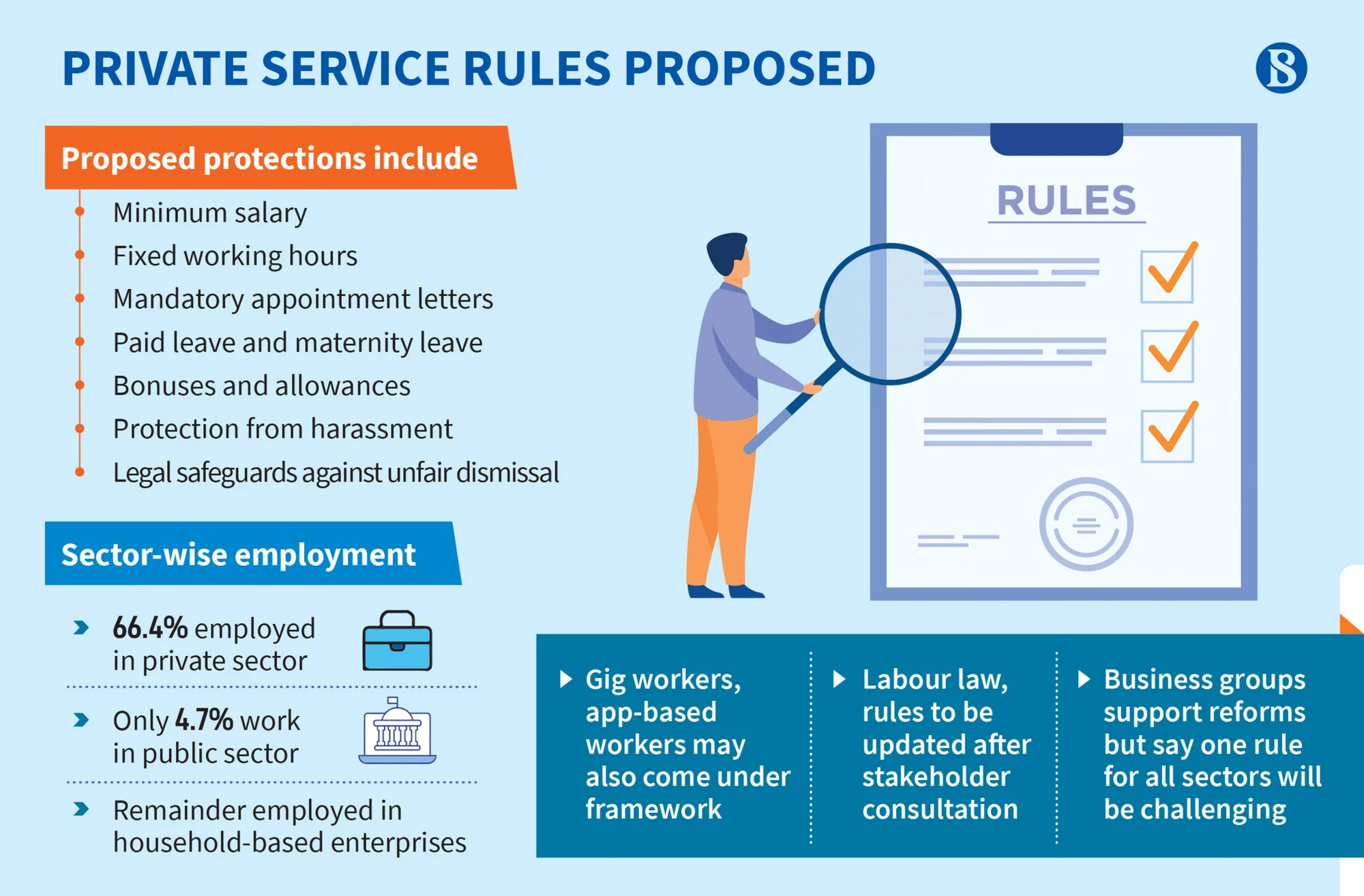
Officials said the proposed rules aim to establish a legal framework for minimum wages, working hours, different types of leaves, mandatory appointment letters, prevention of direct and indirect discrimination, prohibition of forced labour, protection against workplace harassment, job regularisation and other employee benefits.
A consultation meeting on the issue was held at the Secretariat on 10 May, chaired by Senior Secretary of the Ministry of Public Administration Md Ehsanul Haque.
At the meeting, it was decided that opinions would be sought from all ministries as well as chambers and associations representing the private sector. The public administration ministry has already sent letters, asking stakeholders to submit their feedback within 15 working days.
Based on the recommendations received, the government plans to amend or incorporate necessary provisions into the Bangladesh Labour Act 2006 and the Bangladesh Labour Rules 2015.
A committee headed by the public administration ministry’s additional secretary (regulation) Mostafa Zaman has also been formed to oversee the process.
Speaking to TBS yesterday, Mostafa Zaman said the initiative had been taken as part of the current government’s election manifesto commitments and to improve the living standards of private-sector employees.
“The government is giving the highest importance to job security in the private sector,” he said. “We often hear that institutions are laying off workers according to their own convenience. Many companies do not want to retain employees as they grow older. Female employees often do not receive proper maternity leave, and many institutions do not provide service benefits.”
According to him, while the existing labour laws already contain various protections, employees often fail to receive their rightful benefits in practice. The government therefore wants to introduce a unified framework to ensure fairness in private-sector employment.
He added that the labour ministry could eventually be given responsibility for implementing the rules because it already operates labour tribunals where employees can seek remedies if deprived of their rights.
The BNP’s election manifesto pledged to formulate private service rules so that private-sector employees are not deprived of their legitimate benefits.
Speaking to TBS yesterday, joint secretary of the labour and employment ministry Mohammad Kuddus Ali Sarker said the Labour Act 2006 and Labour Rules 2015 had already been ratified through the International Labour Organization (ILO), while several international conventions also support these frameworks.
“Despite this, proper implementation remains weak in many areas of the private sector,” he said. “Employers can still dismiss workers at will in many cases.”
He said the labour ministry had recommended updating the existing framework by adding new rules wherever there were gaps in employee protection.
He also noted that workers involved in app-based services such as Uber, Pathao and Foodpanda currently operate without any dedicated service rules. The same applies to gig workers, and discussions on these issues have only recently begun on a limited scale.
According to the Bangladesh Bureau of Statistics (BBS) Labour Force Survey 2024, the country has a workforce of 69.09 million people. Of them, 48.2% work in private, joint venture and business establishments, while another 18.2% are employed in private institutions, meaning a total of 66.4% are engaged in the private sector. Only 4.7% work in the public sector, while the remainder are employed in household-based enterprises.
At present, the government has declared minimum wages for 47 sectors. Although several other sectors have been recognised as formal industries, no visible government initiative has yet been taken regarding them.
A senior official of one of the country’s leading business associations, requesting anonymity, said workers frequently approach them with complaints of arbitrary dismissals or unpaid dues after years of service.
“Many companies never make employees permanent. In some organisations, workers receive only a fixed monthly salary without any additional benefits,” he said. “Even Eid bonuses are often given without any clear rules.”
He added that the existing labour law does not fully apply across all private sectors, and ambiguities surrounding employment conditions often deprive workers of fair treatment.
“That is why a unified service framework is necessary, so that workers across all sectors receive fair compensation for their labour,” he said.
Former Bangladesh Employers’ Federation president Fazlul Haque told TBS that introducing a coordinated service rule framework would be positive, but warned that the private sector is highly diverse.
“Different sectors have different structures and workforce requirements, so creating a single service rule for everyone will be quite challenging,” he said.
He stressed that all relevant private-sector stakeholders must be included in the consultation process before finalising any such framework.