Too arty to tell a story? The tragedy of Banalata Sen
In my view, poetry should make a human feel what the writer was feeling during writing. Movies, similarly, are an exclusive compound that should be available for every type of audience. Some may think this trait would make them too “commercial”, but one should not have to do homework before sitting down to be entertained; otherwise, it’s not entertaining at all.
Too arty to tell a story? The tragedy of Banalata Sen
In my view, poetry should make a human feel what the writer was feeling during writing. Movies, similarly, are an exclusive compound that should be available for every type of audience. Some may think this trait would make them too “commercial”, but one should not have to do homework before sitting down to be entertained; otherwise, it’s not entertaining at all.
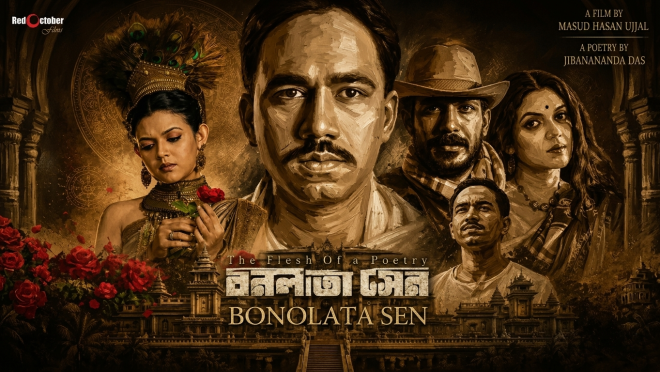
Banalata Sen is a movie based on a poem written by our beloved Jibanananda Das. He wrote this before his tragic death, as far as we know, and the film does reflect some scenes that take us back to the time when Mr. Das was trying to break through, creating a character named “Banalata”.
To be specific, this character was supposed to be idolised as a mysterious goddess of time and space or something else mimicking a supernatural entity. Well, people who read the piece might think it like that, but why should an art set a boundary around its character, right? That is where the filmmaker comes to the scene and decides to show the exploration behind the mysterious woman named Banalata Sen and her thought process. The concept of the film is not that complicated but also not easy to decode and serve to an audience.
The movie begins with the scene of a character who thinks of himself as a mind reader as he is searching for the goddess Banalata. In my opinion, this film had all the potential to reach the mass audience, but clearly the director had a better idea.
The cinematography, dialogue delivery, and acting were likeable, but some CGI scenes did not live up to expectations. I, as well as the average viewers, expected an ending that this poetic masterpiece deserved.
So when the film ended, people were left with no visible explanation or even dissatisfaction, for that matter. The very visible hue of confusion was evident. It was clear the story and the arc that were supposed to hold it together did not live up to expectations, 0/10 in my opinion. All the artistic touch and dialogues were not enough to cover the dumbfoundedness the audience clearly embodied.
This film was for a targeted audience, clearly, and I am not hesitant to say, this film was not even made for the average moviegoer. Throughout the screenplay, disillusioned dialogues with nonsensical callbacks to Greek mythology, this was a movie for the high-nosed aristocrat.
In an attempt to appreciate Bangla literature, the director inadvertently highlighted the most common critique of it, which is its distance from the common masses. The plight of the Brahman in the early 1900s may be understandable for this generation of the middle class, but in order to communicate it, one must not dilute or disrespect the intelligence of this generation’s taste.
A taste that demands a complex screenplay with excitement and a gripping tale. Too simplistic? Yes, it might be. But it is too lazy, in my view, to not be cognisant enough to deliver it because delivering it would actually require a skill set which many of the modern directors do not possess. Uttered disappointment was heard from people, but some still acted as if they were made to watch a masterpiece because not doing so would mean they were “not artsy enough” to get it.
The poem Banalata Sen has a really beautiful, simple yet artistic flow that echoes the final rest of a person’s soul, and Jibanananda Das may have written one of the best pieces of Bengali poetry.
Reading the poem, it answers and decodes the myth of Banalata. Technically, the film should have shown us the magical curtain closure by showing a proper death, life, or final salute of a soul while Banalata Sen’s words played in the background. But the film has nothing of it.
Films like this that are based on some prominent poet should have the capability of reading the room and should feel the eternal obligation of introducing a bygone era to the new generation.
Which Banalata Sen tried to capture by the teaser and trailer clip, but the movie it resulted in massively showed a different story. The film behaved like the very entitled Brahman which it clearly depicted as the enemy of creativity.
In this film industry, this kind of half-done work creates distrust among viewers who gave a shot to a different genre. Rather than being rewarded for it, they were made a fool, disrespected, disheartened, and for me at least, it was a total waste of the money I had spent.
Yes, the actors did try to portray their respective roles to the best of their abilities, but when the story arrangement is messy, the effort goes unnoticed under its majestic disaster.
Just visually pleasing videos are not enough to feed the taste. Banalata Sen was running well in the first half; the audience thought they would see the closure of Banalata Sen and her portrayal of the resting place, with Jibanananda Das showing his last days through her, but just like the upper-class Brahmans failing to uphold creative thought in Das’s time, the highly artistic mind of the creator failed to deliver what could have become a masterpiece in Bangla cinema.