UAP hosts dialogue on Bangladesh’s health budget priorities and gaps
UAP hosts dialogue on Bangladesh’s health budget priorities and gaps
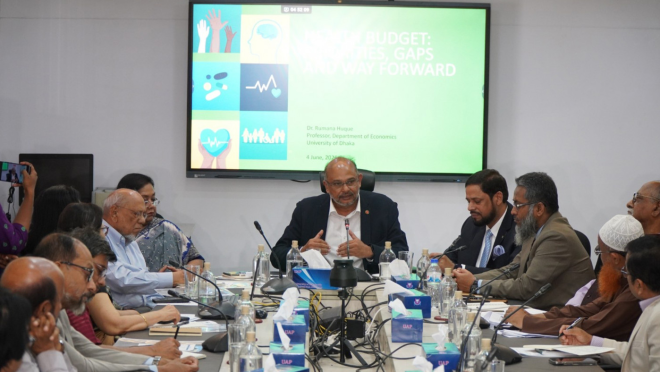
The Department of Business Administration of the University of Asia Pacific (UAP) organised a panel discussion titled “Bangladesh Health Budget Dialogue: Priorities, Gaps and Way Forward” on Thursday (4 June 2026), bringing together policymakers, academics, researchers, healthcare experts, development professionals and students to discuss ways to strengthen Bangladesh’s healthcare system.
The programme was held at the BOT Conference Room of the university.
The dialogue focused on the current state of Bangladesh’s health budget and explored practical pathways for strengthening the country’s healthcare system through improved financing, governance and collaboration.
Prof Dr Rashed Al Mahmud Titumir, Economic Advisor to the Prime Minister, attended the event as the chief guest.
He emphasised evidence-based policymaking, efficient use of public resources and increased investment in the health sector to ensure quality healthcare for all.
He also highlighted the need for a more equitable and holistic healthcare system with improved services and infrastructure.
K M Mozibul Hoque, Chairman of the Board of Trustees, UAP, attended the event as the guest of honour.
He stressed the need to give higher priority to the health sector in national development and underscored the importance of collaboration among academia, government, industry and development partners to ensure sustainable and inclusive healthcare financing.
Prof Dr Mohiuddin Ahmed Bhuiyan, Acting Vice Chancellor, UAP, attended the event as the special guest.
He emphasised adequate funding for the health sector, improved coordination among healthcare providers and efficient utilisation of allocated resources.
He also called for strengthening evidence-based policymaking and continuing policy dialogue to enhance the overall healthcare system.
Dr Rumana Huque, Professor, University of Dhaka, presented the keynote paper.
In her presentation, she outlined key challenges in Bangladesh’s health financing system, including resource constraints and service delivery gaps.
She also offered evidence-based recommendations to improve efficiency, equity, accessibility and the overall quality of healthcare services in the country.
The panel discussion was enriched by the presence of distinguished panellists: Prof Dr Md Selim Reza, Dean (Acting), Faculty of Pharmacy, University of Dhaka; Prof Dr Liaquat Ali, Honorary Chief Scientist and Advisor, Pothikrit Institute of Health Studies, Member of the Healthcare Reform Commission; Dr M H Choudhury Lelin, Chairman, Health and Hope Hospital; Dr Syed Abdul Hamid, Professor, Institute of Health Economics, University of Dhaka; Prof Dr Mohammad Shahriar, Dean, School of Pharmacy, UAP; Dr Shamsad Ahmed, Professor, Department of Business Administration, UAP; and Dr Nurul Amin Nahid, Additional Commissioner of Taxes, NBR.
The session was chaired by Professor Dr M A Baqui Khalily, Dean, School of Business, University of Asia Pacific, and moderated by Dr Nazma Begum, Professor, Department of Business Administration, UAP.
Sarwar R Chowdhury, Head, Department of Business Administration, UAP, along with faculty members and students, was also present at the programme.
Speakers and participants collectively emphasised the importance of research-driven policymaking and stronger partnerships among academic institutions, healthcare practitioners, policymakers and development organisations.
They said effective collaboration could generate relevant evidence, support policy reforms and contribute to building a more resilient and inclusive healthcare system in Bangladesh.
The discussion concluded with a shared commitment to strengthening policy dialogue, advancing research initiatives and fostering academia-industry-government collaboration for the development of a more efficient, equitable and sustainable healthcare system in the country.