Iran team wear '#168' pins to honour school strike victims ahead of World Cup
Previously, during a March friendly against Nigeria, the team held up school bags during the national anthem.
Iran team wear '#168' pins to honour school strike victims ahead of World Cup
Previously, during a March friendly against Nigeria, the team held up school bags during the national anthem.
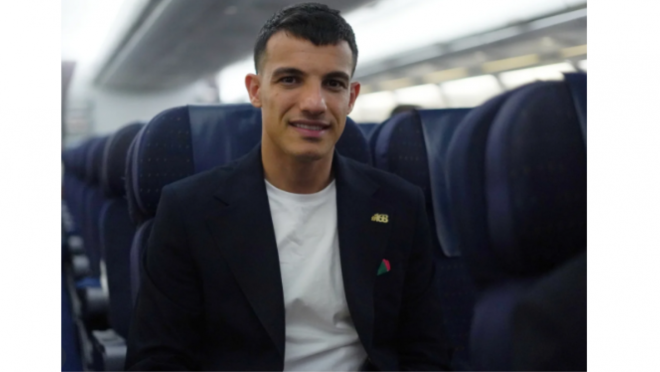
When Iran’s national team arrived in Tijuana, Mexico on Sunday morning (7 June), the players were seen wearing lapel pins marked with the hashtag “#168”.
According to Iran’s foreign ministry, the hashtag-style badge is meant to honour 168 children who were killed in an elementary school incident on 28 February 2026, the first day of the US–Iran conflict.

A Iran national football team player wearing the “#168” pin. Photo: teammellifootball/Instagram
The New York Times reported, citing US officials and individuals familiar with early assessments, that a military investigation has preliminarily concluded the United States was responsible for the missile strike. The claim has not been confirmed by President Donald Trump or US authorities.
The pins were not visible when the squad left their training base in Antalya, Turkey on Saturday.
They were reportedly added during the team’s journey to Mexico, including during a refuelling stop in Spain, and were seen when the players disembarked and headed to their hotel.
FIFA’s equipment regulations leave little room for ambiguity. Uniforms and related gear must not display political, religious, or personal messages, slogans, or imagery.
The rules extend beyond players to team officials and anyone in the technical area, with breaches potentially leading to disciplinary action.

Iran national football team players wearing the “#168” pin. Photo: teammellifootball/Instagram
However, the governing body also acknowledges that “political” expressions can be difficult to define in practice, while still explicitly banning references to individuals, whether living or deceased, and specific political events or actions.
Enforcement has often depended on interpretation and context, with FIFA typically reviewing such incidents under its disciplinary framework rather than issuing immediate penalties.
Iran has previously used symbolic gestures in matches to draw attention to similar themes.
During a March friendly against Nigeria, the team held up school bags during the national anthem.
In another match against Costa Rica shortly after, players displayed images of victims and damaged sites linked to bombing attacks.
Those earlier actions were also seen as potentially conflicting with FIFA’s rules, though no formal punishment was announced.

The Iran national football team players wearing the “#168” pin. Photo: teammellifootball/Instagram
FIFA President Gianni Infantino was present during the Costa Rica fixture, where the organisation’s flag was displayed in the stadium.
Before later friendlies against Gambia and Mali in Turkey, the Iranian squad opted for a different approach, standing during the anthem with their right hands placed over their chests before departing for Mexico.