Mimi Chocolate: The chocolate that was ours, until it wasn't
For nearly two decades, Mimi was the only chocolate an entire country had. Then the market changed, the machines got old, and something irreplaceable quietly disappeared.
Mimi Chocolate: The chocolate that was ours, until it wasn't
For nearly two decades, Mimi was the only chocolate an entire country had. Then the market changed, the machines got old, and something irreplaceable quietly disappeared.
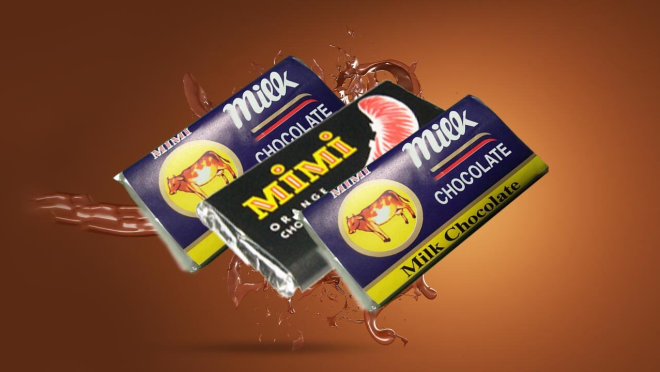
There is a quiet kind of grief that settles in when you realise something you took for granted has slipped away without warning, and for generations of Bangladeshis, Mimi Chocolate lives squarely in that space.
A recent YouTube video asking where the iconic brown-paper bar disappeared didn’t break any news, but it stirred something deeper, drawing hundreds of thousands of views and comment threads that read less like online debates and more like shared recollections. People traded stories of Eid mornings, of splitting a single bar between siblings, of jingles that still hum in their heads decades later, proving that collective memory rarely clings to something as simple as a chocolate bar unless it meant something far more personal.
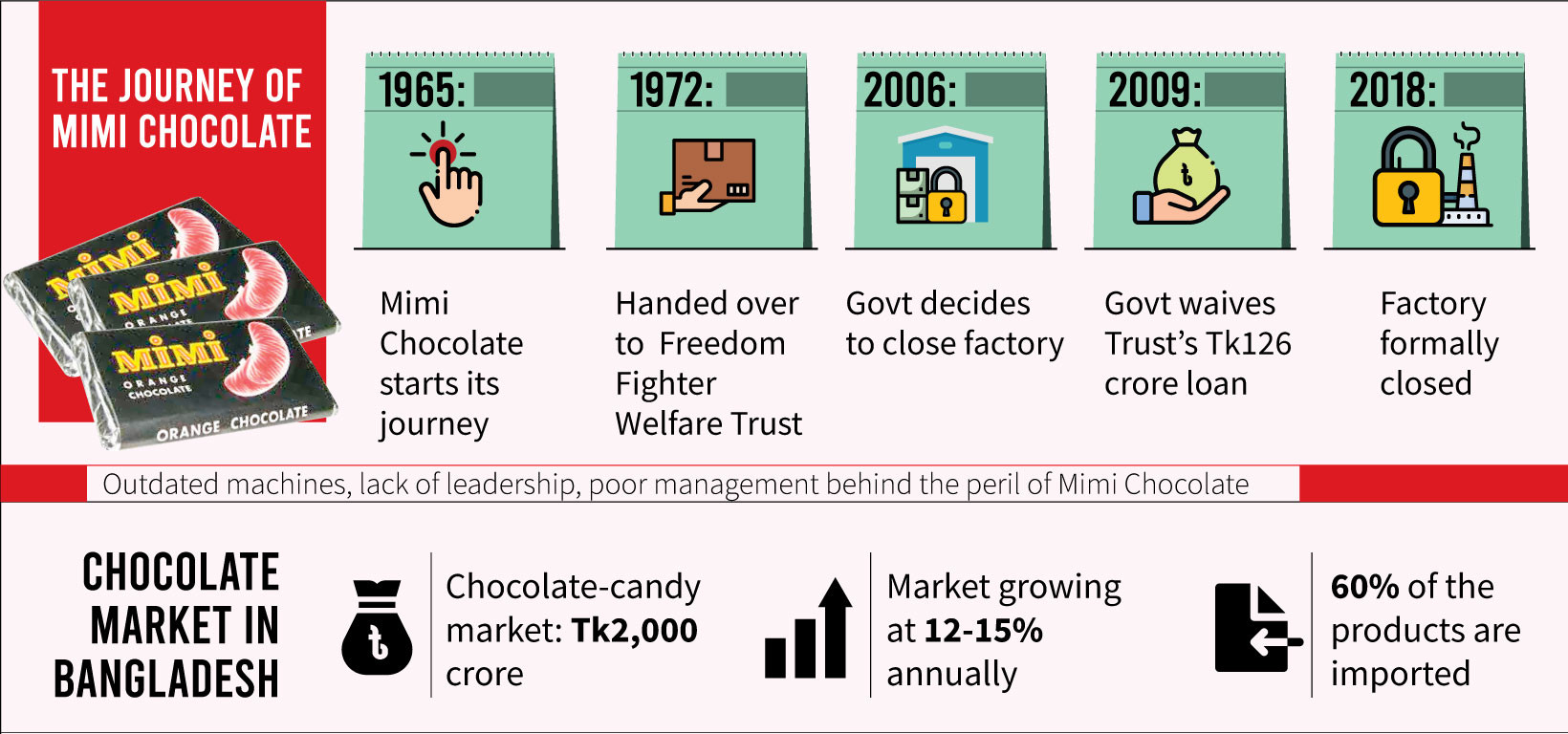
Mimi was never meant to be just another sweet. When the factory first opened in Tejgaon in 1965, still part of East Pakistan, it rolled out chocolate on German machinery that would, for nearly twenty years, define an entire nation’s idea of the treat. There was simply nothing else on the shelves to compare it to, and no real market to speak of beyond its own quiet dominance.
Infographics: TBS
After 1972, the company found its way into the Bangladesh Freedom Fighters’ Welfare Trust alongside several other nationalised industries, and it thrived on a straightforward reality: while global brands like KitKat or Mars existed across borders, they remained entirely out of reach for most, leaving Mimi as the only affordable answer. By the 1990s, the company was pulling in monthly sales of Tk 50 to 60 lakh, and its two signatures — the milk chocolate cow and the orange-wrapped variant — had woven themselves so deeply into everyday life that “chocolate” and “Mimi” became interchangeable in the minds of consumers who had never been given another option to remember.
What sustained Mimi for so long, however, was never a competitive edge but rather the absence of competition, and that distinction carries a heavy weight. When Bangladesh’s economy began to open and incomes slowly rose through the 1990s, imported brands finally started appearing in urban markets, while local manufacturers stepped in with fresher packaging, modern equipment and a sharper sense of what consumers actually wanted. Mimi, still humming along on the same mid-century German lines, had no strategy to meet the shift. There had been no meaningful investment in research, no serious market studies, no real attempt to anticipate where the brand needed to go, largely because for decades the market had simply arrived at its doorstep.
The managing director of the Muktijoddha Kalyan Trust later acknowledged this plainly, noting that government-run ventures rarely innovate without disciplined leadership, while policy analysts pointed to the revolving door of appointments that left no one truly accountable for long-term survival.
The factory first shuttered in 2006, reopened briefly in 2009 after a Tk 126 crore government loan, and finally closed for good in 2018, though the brand never formally disappeared from paper. Most people barely noticed the final closure because the chocolate had already been slipping off shelves for years, fading slowly enough that there was no single moment to mark its end.
Today, Bangladesh’s confectionery market hovers around Tk 2,000 crore and continues to grow steadily, with companies like Pran-RFL, Olympic Industries and Abul Khair dominating local production. The space Mimi once held has been thoroughly filled, and the new players operate with the machinery, marketing reach and innovation cycles that Mimi never bothered to build. Yet the longing for it has only deepened, precisely because it carries something no modern brand can replicate: the memory of being the first, the only, the quiet default for a country still learning what chocolate could be.
Conversations about bringing Mimi back have naturally followed, with rebranding ideas floating around that picture cleaner wrappers, updated flavours and a visual identity tailored to a generation that never unwrapped the original.
At least a recent YouTube video of revival of Mimi chocolate after almost 16 years, in small scale shows the mixed debate on this. The emotional and commercial appetite is undeniable, especially as younger consumers gravitate towards homegrown brands with real heritage, and a product carrying sixty years of national memory starts with a narrative advantage no advertising budget can easily buy. But heritage alone does not run a production line, and nostalgia cannot replace the kind of competitive discipline that today’s market demands.
A revived Mimi would need to prove it can stand beside companies that have spent the last two decades building exactly what it never did: infrastructure, agility and a genuine instinct for competition.
Some brands fade because the world simply moves on, but Mimi faded because the world kept turning while it stood still. Whether that gap can be bridged is an open question, but the fact that people still linger in YouTube comment sections, still argue over childhood memories, still feel a sudden tug when they picture a wrapper they haven’t held in decades, tells you everything you need to know. Whatever Mimi was, it hasn’t finished mattering yet, and whatever it becomes next will have to earn its place not by looking back, but by proving it still belongs in the present.