The road to MIT: How Fayez Ahmad built an MIT-worthy profile before HSC
For Fayez, the MIT admission was not a sudden stroke of luck. It was the result of years of academic excellence, Olympiad achievements, research, extracurricular activities and self-driven preparation
The road to MIT: How Fayez Ahmad built an MIT-worthy profile before HSC
For Fayez, the MIT admission was not a sudden stroke of luck. It was the result of years of academic excellence, Olympiad achievements, research, extracurricular activities and self-driven preparation
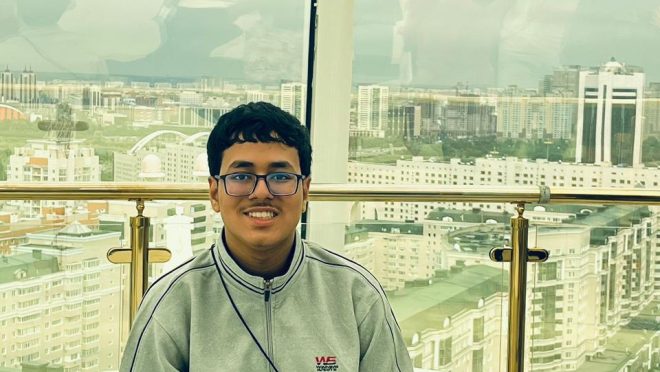
When most students his age were preparing to sit for their HSC exams, Fayez Ahmad was preparing for something big: starting classes at the Massachusetts Institute of Technology (MIT).
A 2026 HSC candidate at Notre Dame College, Fayez secured admission to one of the world’s most prestigious universities before completing his HSC. While his HSC exams were scheduled to begin in the middle of this year, his classes at MIT are set to start in September.
For Fayez, however, the MIT admission was not a sudden stroke of luck. It was the result of years of academic excellence, Olympiad achievements, research, extracurricular activities and self-driven preparation.
Fayez was born in Rajshahi in 2008. He grew up in a home where learning was not forced. He lived with his parents and three older siblings, and according to him, much of his interest in learning developed by following their lead.
He learned to play chess at the age of four with the help of his siblings. That early exposure gradually developed into a habit of exploring beyond academics.
“In Bangladesh, many parents discourage extracurricular activities out of concern for academics, but my parents never limited me in that way. Their support made my path smooth,” he said.
The journey began with Olympiads
In Class 1, Fayez participated in a national chess tournament. By Class 3, he had entered Olympiads and became a regional champion. In Class 6, he began debating, which he continues to this day.
The turning point came in 2021. In Class 8, he started competing in national camps in Biology and Physics, as well as the Junior Science Olympiad.
In 2025, Fayez founded OlyPara, a non-profit platform with members from 13 countries. Initially, it was created to address the resource gaps Fayez had faced himself. It aims to make Olympiad preparation more accessible.
“I built a website where students can search topic-wise questions, practice full-length tests, create customised exams, and read articles written by past Olympiad medallists. The goal is simple: to make quality resources freely available so that students, regardless of their economic background or country, can prepare effectively for Biology Olympiads,” he said.
Alongside this, he was also selected as the only high school intern for the GSA Bioinformatics Internship and later presented his research at the BSM International Conference 2025, again as the only high school presenter.
Building an MIT profile
MIT had always been part of Fayez’s dream, but it became a defined goal after a key moment: winning a bronze medal at the International Biology Olympiad (IBO) in 2023.
He quickly started acting on his ambition. Without relying on formal coaching, Fayez prepared for both the SAT and the Duolingo English Test independently. He scored 1550 on the SAT (790 in Math and 760 in Reading and Writing) and 140 on the Duolingo English Test, which is roughly equivalent to an IELTS score of 7.5.
His preparation was structured around self-study and consistency rather than shortcuts. Fayez mainly used Bluebook to prepare for the SAT. Alongside that, he used Khan Academy and standard SAT prep books, including Princeton Review Digital SAT Premium Prep, The Critical Reader: The Complete Guide to SAT Reading by Erica L Meltzer, and SAT Vocabulary: A New Approach by Erica L Meltzer.
For the Duolingo English Test, he did not have to put in much effort. “I do not think separate preparation is very necessary if someone already has a strong foundation in English.”
He started preparing his MIT application in late October 2025, beginning by carefully organising his achievements. For recommendation letters, he reached out to his teachers.
Fayez strongly recommends starting the process at least two months before the deadline.
After submitting his application, he was invited to an interview. “The interview was informal and more like a conversation. I discussed my research, non-profit work and other extracurricular activities in detail,” he said.
From HSC to MIT
Fayez has now completed his HSC and describes the experience as “surreal”. But he sees his admission before HSC as part of the standard US admissions timeline.
Many were confused about whether Fayez needed to complete his HSC. Fayez clarified, “In most cases, completing a high school diploma (HSC) is required. However, if it is not completed before classes begin, universities like MIT have previously made exceptions.”
What made his application stand out
Fayez stressed that strong academic grades alone are not enough.
“Academics are important, but many applicants already have strong academic records. What differentiates applicants is their extracurricular involvement.”
For Fayez, those extracurriculars were not last-minute additions; they were built over years, with direction, intention and consistency.
Fayez has just completed his HSC exams, and his visa was granted a few days ago.
For students aiming for similar paths, Fayez suggests exploring different extracurricular activities and trying to find something you are genuinely passionate about.
“Starting early helps, but it is never too late. Use online resources wisely, and do not hesitate to reach out to people who have already achieved what you aim for. Stay consistent in your efforts. You will fail many times, but that is part of the process.”
The key, he says, is to analyse mistakes, learn from them, and keep moving forward.
“Remember, students do not get into top universities because they are born geniuses. They get there by working hard and building meaningful achievements over time. So, it is important to believe in yourself.”