Six offer letters, and finally to Berkeley: The story of Abrar Rahman Abir
BUET’s final semester is supposed to be the busiest stretch of an undergraduate’s life. It was during the hectic convergence of four years of work when Abrar Rahman Abir’s inbox began filling up; one fully funded PhD offer at a time.
Six offer letters, and finally to Berkeley: The story of Abrar Rahman Abir
BUET’s final semester is supposed to be the busiest stretch of an undergraduate’s life. It was during the hectic convergence of four years of work when Abrar Rahman Abir’s inbox began filling up; one fully funded PhD offer at a time.
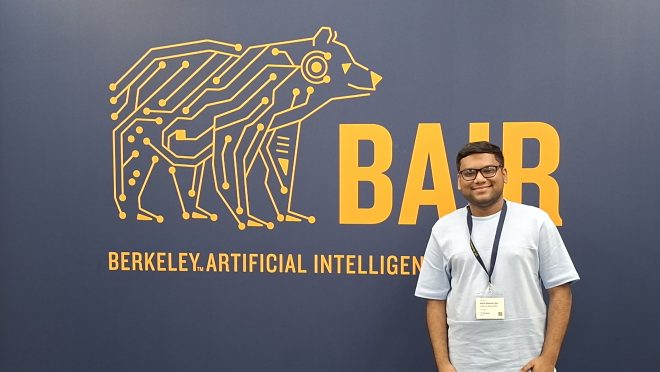
The University of Texas at Austin, Cornell University, UMD College Park, Virginia Tech, UC Berkeley and finally the University of Southern California (USC) – six acceptances in total, from six American research universities, all before finishing undergraduate studies.
The last offer, from USC, came when he was already holding five. The most competitive one – UC Berkeley, consistently ranked between first and second globally for CS – required the most to earn: five separate rounds of interviews, each probing deeper into who he was as a researcher. He cleared every single one.
This is not a story about a lucky break. Abir’s path was built across four years of deliberate, often solitary work, starting before his first class at BUET had even begun.
The Covid-19 gap before BUET’s admission test left most students in suspension – waiting, restless, and uncertain about when life would resume. Abir used the time differently. He spent that stretch working through multivariate calculus, linear algebra, and probability theory. Not for the entrance exam, not for any assignment as well. But because he found mathematics genuinely interesting and wanted to understand it properly. “I learnt it purely for my own liking,” he says simply.
It is a small detail, but it is also almost the whole story in miniature. The instinct that drove him to open a calculus textbook during a pandemic, unprompted and ungraded, is the same instinct that would carry him through four years of research at BUET and eventually to Berkeley.
When he was admitted to BUET’s Computer Science and Engineering department, he did not take the default path of competitive programming – the route most students entering CS in Bangladesh are expected to follow. He has thought about this carefully and arrived at a clear position.
“Competitions have nothing to do with pure science and have no meaningful contribution to science. The thing that matters in competition is how fast and accurate you are compared to others on already solved problems. I do not undermine competitions, but my point is that it has nothing to do with contributing to science. That is why CP has not been my choice,” he says.
Instead, even before his first semester started, he was teaching himself machine learning – Python first, then the libraries and algorithms, building upward from the mathematical base he had already laid. By the time an ordinary student starts adjusting their life at BUET, Abir was already looking for his first research opportunity. “I found out that AI and ML is nothing but purely mathematical, it deals with the advanced maths I already liked,” he says. “Since I had an understanding of advanced maths, I could start ML from the very foundations. And ML is naturally inclined towards research.”
Research opportunities for first-year undergraduates at any university are rare. At BUET, where formal research culture has traditionally been concentrated in the third or fourth year, finding one in your first year requires both preparation and timing. Abir had the preparation. The timing arrived in the form of a project from the Civil Engineering department.
The project involved ML modelling of pavement parameters. The project members needed someone from CS who knew machine learning. Abir knew machine learning. That was enough.
“I was in Level 1-Term 2, if I remember correctly,” he says. “There was an ongoing project in the Civil Department regarding ML modelling of some parameters of pavement. They were looking for someone who knew ML from CS. That is how I got involved.”
“That was my first exposure to formal research,” he says, “and my choice of pursuing research stemmed from the very start of my undergraduate studies.”
From that first-year project, Abir kept building himself steadily, year by year. By his third year, he was collaborating with professors at universities abroad, accumulating the kind of international research experience and recommendation letters that top PhD programmes look for and rarely find in undergraduate applicants.
The number requires context to fully land. Many PhD students graduate with fewer first-author publications than Abir accumulated as an undergraduate. First-authorship means leading the research; conceiving the study, driving the methodology, writing the paper. It is not a supporting credit. By graduation, Abir had thirteen of them, with seven published in Q1 journals, the highest tier of academic publishing in the scientific world. Three more, produced during his thesis, were under review at the time of his degree.
When asked how he balanced thesis, coursework, and publishing simultaneously, his answer is worth sitting with.
“Thesis has never been a burden to me, because by the start of fourth year, even before the thesis started, I had multiple top Q1 journal publications. So I had adequate research experience. I did my thesis with great enjoyment and pace. I actually did three separate publications in my thesis before my defence.”
As for coursework, he is disarmingly honest about it. Research was his first priority, coursework was secondary. He studied mostly before exams. He still graduated with a CGPA of 3.96 out of 4.00.
“Since I was already working with advanced stuff, coursework did not feel heavy to me naturally. I also had a very great peer group. They were always there to help.”
And then, on the subject of vacations: “I literally had no vacation. I am not promoting this. But personally, I always loved to invest my time in research, learning more advanced theories. There were times my friends insisted I go on a trip every term break. But I happily refused to go because I was busy with my research.”
He never felt pressured about academics, he says, because enjoyment was the engine. “I never felt burnt out, to be honest, because I greatly enjoyed what I was, and am, doing.”
UC Berkeley’s CS PhD programme is among the most selective in the world. Abir went through five separate interview rounds before receiving his offer. Each round was a deeper probe: into his research, his methodology, his capacity to articulate not just what he had done but why it mattered and where it was going.
He is emphatic on this for anyone considering the same path. “The application process is time consuming, but the most important step is the interview,” he says, “without a deep understanding of your own research it is very hard to survive that stage.”
On the subject of his six offer letters, and what each felt like, his answer is a very interesting one: “Out of my six offer letters, the last one was from the University of Southern California. Honestly, I was confident I could get in there. The happiest moments of my life would definitely be the acceptances from Cornell and UC Berkeley. These are so competitive that no one can ever be sure of them.”
He had prepared for TOEFL with strategic early planning rather than last-minute panic. He had studied the format and patterns months in advance, then sat for the actual exam in September with just ten to fifteen days of focused preparation. He scored 108 out of 120.
On whether a Q1 publication is achievable for an undergraduate who is starting out: “Q1 journal publication is very difficult, even for PhD students. If any undergraduate can do it, it will add a great value to their application for PhD or MS.”
Abir visited UC Berkeley last month for a pre-admission orientation. What he observed there stayed with him. He says, “CS at BUET, or any university in Bangladesh, has very low focus on advanced mathematics, but this is extremely needed for doing research. I visited UC Berkeley last month. I saw students had profound knowledge in maths because they learnt it from their university. For my case, I had to learn everything on my own. I wish my undergraduate university could provide better mathematical knowledge.”
And one thing he would admit was not an ideal strategy but worked anyway: studying for courses mostly right before exams while pouring the rest of his time into research. He says, “This is not the ideal way, obviously. The load becomes heavy. But my decision was correct. There is no point investing your entire time and effort for academic courses. But anyone following this must ensure that they can actually manage their academic studies in a short time.”
He believes his result is a very specific kind of commitment, of having the self-drive: “The only point one might fail is to keep consistency and to lead a very work-heavy life. Everyone cannot sit in front of a computer to run an experiment or draft equations on paper all day and night, regardless of vacation or the running semester. Someone following my exact path should have self-drive. I believe they will succeed.”
Abir will begin his PhD at UC Berkeley in Fall 2026. He already knows, with the same quiet certainty he has carried since his first year at BUET, that this too is not the destination. It is where the actual work begins.