The poet who never left
On the anniversary of Rabindranath Tagore’s death, Bangladesh remembers not a distant Nobel laureate but a poet who wrote its songs, walked its riverbanks and helped it find its own voice
The poet who never left
On the anniversary of Rabindranath Tagore’s death, Bangladesh remembers not a distant Nobel laureate but a poet who wrote its songs, walked its riverbanks and helped it find its own voice
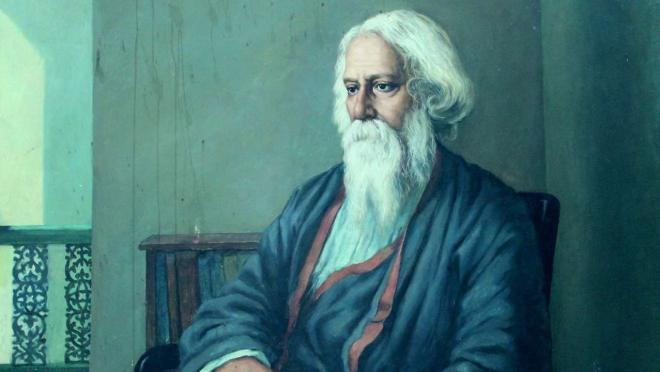
Rabindranath Tagore died on 7 August 1941, at the age of 80, in the Jorasanko mansion in Calcutta, where he had been born eight decades earlier. Bangladesh, following the Bangali calendar, marks the day on the 22nd of Sraban — a date that arrives every year with the monsoon, the season the poet loved most and wrote about endlessly. Eighty-five years later, the rains still come, and so does the remembering.
It is easy to reach for the honorifics. First non-European to win the Nobel Prize in Literature, in 1913. Author of eight novels, 84 short stories and poems beyond counting. Composer of more than 2,000 songs that became a genre of their own, Rabindra Sangeet. But in Bangladesh, Tagore has never really been a figure for the plinth. He is closer than that.
Consider the feat that no other can claim: two nations call his songs their national anthems.
Our national anthem, “Amar Sonar Bangla”, was composed in 1905, in grief and protest, when the British partitioned Bengal as part of their divide-and-rule policy. Tagore set his lyrics to the tune of a song by the baul mystic Gagan Harkara, “Ami Kothay Pabo Tare” — a reminder that his genius was as much about listening as composing.
In 1972, a newly independent Bangladesh made those opening lines its anthem. He also wrote India’s national anthem, “Jana Gana Mana.”
Much of what feels most intimate about Tagore in this country grew from the soil here. Between roughly 1891 and 1901, he lived at Shilaidaha, the family estate on the south bank of the Padma in Kushtia, managing the Tagore zamindari. The house — Shilaidaha Rabindra Kuthibari, now a museum under the Department of Archaeology — is where much of his most tender writing took shape.
It was on these rivers, among these boatmen and farmers, that he absorbed the baul songs and the rhythm of rural Bengal that would run through his work for the rest of his life. He also spent time at Shahjadpur and Patisar, other family estates that Bangladeshis still count as their own.
That closeness is why the affection here has never depended on the state to sustain it. In 1961, the Pakistani government tried to restrict the singing of Tagore’s songs in East Pakistan, sensing, correctly, that a Bengali cultural identity was hard to govern. Intellectuals and singers simply refused, marking his birthday in open defiance.
Chhayanaut began its now legendary Pahela Baishakh celebrations in 1963 with his song “Esho Esho He Baishakh.” The tributes this year carry the familiar shape. Bangla Academy, Shilpakala Academy, Chhayanaut and Bangladesh Udichi Shilpigoshthi mark the day with recitals, discussion and, above all, song. Television and radio give over their schedules. At Shilaidaha and Shahjadpur, people gather where he once lived. It is, by now, a ritual.
But perhaps that is not the truest measure of what Tagore means to Bangladesh. Not the wreaths or the televised concerts, but the ordinary Tuesday when someone hums a line about the mango groves in spring without thinking about where it came from. He wrote himself so deeply into the language that the country no longer notices it is quoting him. Eighty-five years on, the poet has not been remembered so much as never allowed to be forgotten.