Before nationalism had a flag, Bankim gave it a voice
Long before nationalism became a political slogan in the Indian subcontinent, it existed as an emotion that was fragmented and regional. Few writers shaped that emotion into literature more profoundly than Bankim Chandra Chattopadhyay, the Bengali novelist.
Before nationalism had a flag, Bankim gave it a voice
Long before nationalism became a political slogan in the Indian subcontinent, it existed as an emotion that was fragmented and regional. Few writers shaped that emotion into literature more profoundly than Bankim Chandra Chattopadhyay, the Bengali novelist.
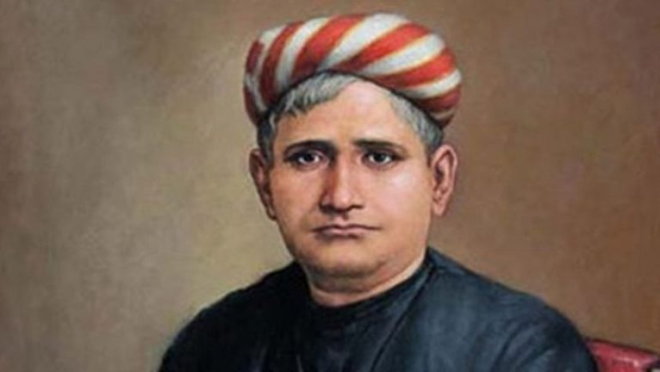
He was born on 26 June 1838, in Kathalpara near Naihati in present-day West Bengal. He was arguably one of the pillars of the Bengal Renaissance, an intellectual so profound that he sowed the seeds of literature, philosophy, theology, and reform under the colonial rule of the British.
He was among the earliest graduates of the University of Calcutta and later joined the British administration as a Deputy Magistrate and Deputy Collector. That duality, serving the British while simultaneously nurturing cultural nationalism through literature, would later define much of the complexity surrounding his legacy.
Bankim did not begin as a nationalist icon. In fact, his literary career initially reflected the romantic and historical tendencies common among Bengali writers of the time. His first major Bengali novel, Durgeshnandini (1865), is often credited with giving the Bengali novel a modern structure. It blended romance, history, and adventure in a way Bengali readers had not encountered before. This was followed by works like Kapalkundala (1866), Mrinalini (1869), Vishabriksha (The Poison Tree), Chandrasekhar, Krishnakanter Will, and Devi Chaudhurani. Through these novels, Bankim explored themes of morality, social hypocrisy, gender, spirituality, and duty.
But Bankim’s importance lies not merely in the fact that he wrote novels. It lies in how he changed what Bengali literature could discuss. Prior to him, much of Bengali prose was either heavily religious or simplistic in form. Bankim introduced psychological tension, moral ambiguity, and political imagination into mainstream Bengali fiction. He turned literature into an intellectual instrument.
Among his many contributions, perhaps none became more historically significant than Anandamath (1882), the novel that introduced the song Vande Mataram. Set against the backdrop of the Sannyasi Rebellion and the Bengal famine of 1770, the novel imagined a band of ascetic rebels fighting for the motherland. It was within this text that Bankim wrote “Vande Mataram”, meaning “I bow to thee, Mother”, a rhyme that would later become one of the most influential songs of the Indian freedom movement.
The nationalism in Bankim was heavily portrayed in Vande Mataram, as he transformed the nation of India into a sacred mother figure. This was a radical literary shift. Instead of asking people to fight merely for land, he asked them to emotionally revere the nation itself. During the anti-colonial movement, the song became a rallying cry for revolutionaries and nationalists alike. Rabindranath Tagore reportedly sang it at the 1896 session of the Indian National Congress, further cementing its place in political culture. Yet it is also here that Bankim’s legacy becomes controversial.
You see, many people regard him as one of India’s first nationalist intellectuals; critics argue that his work, Anandamath, also carried strong Hindu revivalist undertones. The novel depicts Muslim rulers as oppressive while portraying Hindu clergy as defenders of the motherland. However, modern interpretations differ, and his later contributions to nationalism have only put this notion to the test. The novel itself, to a certain degree, accepted British rule as a necessary evil and temporarily beneficial.
This complexity reflects the world Bankim inhabited. He was writing in 19th-century colonial Bengal, where identity itself was under reconstruction. Western rationalism, Hindu philosophy, anti-colonial sentiment, and colonial employment all coexisted uneasily within the same intellectual class. Bankim embodied those contradictions perhaps more than anyone else.
His philosophical interests stretched far beyond fiction. He wrote essays on religion, ethics, and social order, and was deeply interested in reconciling Hindu philosophical traditions with modernity, paving the way for later authors. Unlike purely devotional writers, Bankim often approached religion intellectually. His later works increasingly reflected this concern with civilisational revival and moral character.
In 1872, he founded the literary journal Bangadarshan, which became one of the most influential Bengali magazines of its time. Through it, he nurtured a generation of Bengali readers and writers and helped shape what would eventually become a modern Bengali cultural identity.
The juxtaposition of Bankim was fairly interesting, to say the least. He found himself at the very middle of multiple worlds. He himself was well versed in English, yet his love for Sanskritic roots and traditions is heavily reflected in his literary works. He admired aspects of Western thought but was a cynic of its fabled superiority.
When I read Bankim, I understood that I was reading a man who possessed an idea that was as solid as stone but as transparent as the cascades. His literature often had a question hidden deep inside it: “How can a society re-identify itself after being under colonial rule for so long?”