No embassy, no easy path: How an IUB graduate secured an Austrian Government Scholarship
Securing a fully-funded international Austrian govt. scholarship is tough enough under normal circumstances. But for Atul Tanzil Siddique from Noakhali, an alumnus of Independent University, Bangladesh (IUB), the journey to Europe wasn’t just academic standards, —it was a test of endurance against closed borders and diplomatic crises.
No embassy, no easy path: How an IUB graduate secured an Austrian Government Scholarship
Securing a fully-funded international Austrian govt. scholarship is tough enough under normal circumstances. But for Atul Tanzil Siddique from Noakhali, an alumnus of Independent University, Bangladesh (IUB), the journey to Europe wasn’t just academic standards, —it was a test of endurance against closed borders and diplomatic crises.
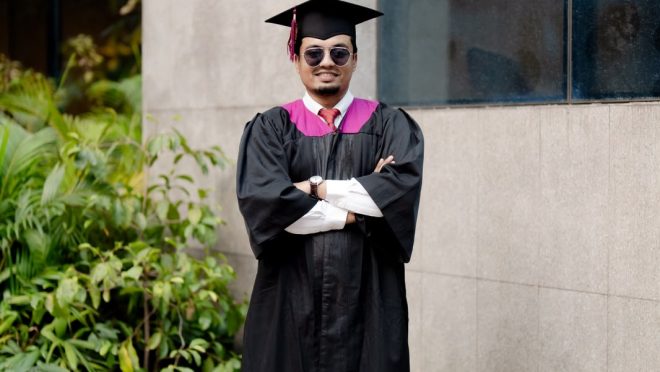
Graduating from IUB with a Bachelor of Science in Environmental Management (Major) and Environmental Science (Minor), Atul recently hit a massive milestone: winning the prestigious Austrian Government Scholarship to pursue a 2-year Master’s degree in Applied Geoinformatics which carries 120 ECT Programme and 2 semester per year ( Summer – March and Winter – October). Though he was offered admission into Austria’s top three elite institutions—the University of Vienna and the University of Graz—he chose his top preference, the Paris Lodron University of Salzburg.
I, being the campus delegate from IUB, contacted Atul to talk about his strategic shift to spatial technology, the nightmare of processing a visa with no local embassy, and the key practical advice he has for every European aspirant needs to know.
The move to Geoinformatics
TBS Graduates: Congratulations on the scholarship, Atul. Most Bangladeshi graduates head straight for common destinations like the USA, Canada or Australia. What made you choose Austria?
Atul: Thank you TBS Graduates.. For me, Austria was a very strategic choice. It has a booming, stable economy, a world-renowned education system, and a reputation for being safe with incredibly warm, friendly people. Additionally, if you’re looking to do any advanced research-—especially in a field like Geoinformatics—it’s a major global hub.
TBS Graduates: You come from an environmental management background. How difficult was it to make the jump toward spatial computing?
Atul: It was about leveraging what I already had. My undergraduate years at IUB gave me a very strong analytical foundation. I used that background to bridge the gap between environmental management and spatial technology. If you can show how those two fields connect, the transition becomes a natural next step of starting from scratch.
The visa Nnightmare
TBS Graduates: Your application coincided with a period of massive regional diplomatic tension. Walk us through what happened when you tried to get your visa.
Atul: That was easily the most stressful part of the entire journey. Austria doesn’t have an embassy in Bangladesh, so I have to go to India for visa processing. Right when I needed to go, regional political tensions flared up, and Indian visas for Bangladeshi citizens were almost completely suspended.
I was dealing with immense uncertainty. I had to make a pretty exhausting, high-stress journey through the Benapole land border in Jashore just to reach the embassy in India. It was a chaotic time, but giving up wasn’t an option.
The paperwork
TBS Graduates: For students hoping to follow your footprints for upcoming intakes, what is the process actually you want to share with us?
Atul: For applying to any kinda programme, there are steps which need to be followed accordingly.
Sort out the paperwork as soon as possible. Austrian universities need original certificate not provisional. For my paperwork, I used mygov.bd portal to get my transcripts and university documents without much trouble but you need to go to India to face Austrian embassy as we don’t have any embassy in our country. On the language side, I scored 6.5 on IELTS which meets the B2 level required for studying in Austria.
TBS Graduates: What are the financial realities students should prepare for, even on a scholarship?
Atul: You need to show a solid bank statement—around $1,800 to 2500 USD it may vary too in secondary financial security evaluation) to prove stability to the embassy. Once you arrive, your initial 4-month entry pass easily converts into a 1-year renewable Residence Permit (RP Card). Even if we have scholarships, we still need to pay a small mandatory govt. fee of about $40 to $50 USD per semester to the Austrian government.
Academic flexibility and Part-Time work
TBS Graduates: How is the academic system structured there? Is it difficult to balance your studies with personal life or work?
Atul: The best thing about this 2-year Master’s programme is that it operates on an open-credit course system. This gives you immense flexibility, meaning you can easily plan and complete everything comfortably within the 2 years. Your actual weekly workload depends entirely on how many courses you choose to take in a semester. On average, you only have classes for about 2 to 3 days a week minimum, which leaves you with plenty of open days.
TBS Graduates: Does that open schedule allow international students to work while studying?
Atul: Definitely. As the class timings are flexible, fitting into a part time job is pretty straightforward. Frankly speaking, any kinda job is suitable abroad which will cover our living expenses, supporting our studying. Once after graduating ,move into proper full time job as per your field requirements.
Regrets and reality checks
TBS Graduates: Now that you’re living in Europe, is there anything you wish you had done differently before living in Bangladesh?
Atul: I cannot stress this enough—learn how to drive and get your German language skills up to at least a B2 level before you leave Bangladesh.
As I didn’t focus on those early, I want to share some tips and techniques to the people who are planning for Austria must follow this.
Please make sure you have a driving licence. That means everyone needs to learn how to drive, which will definitely save time, money, and energy while residing abroad.
Learn basic skills computer, cooking, swimming etc which will help you getting academic research, campus jobs, and professional networking
Sorting this out in Bangladesh gives you a massive, plus point for a smoother life abroad.
The payoff
TBS Graduates: What makes the struggle worth it in terms of career growth in Austria?
Atul: The permanent residency (PR) pathway here is remarkably straightforward. After finishing your 2-year Master’s, the government offers a 12-month post-study work visa to find a job in your relevant field. While signing a relevant contract, we need to sign the Red-White-Red (RWR) Card, which is a work permit visa. This offer helps to have long term stability and future career growth right in the heart of Europe, a dream of crore people living around the world.
TBS Graduates: Your journey took a lot of resilience. Looking back, what kept you grounded when things felt completely hopeless?
Atul: Honestly, during the worst of the border crises and paperwork delays, I realised that I had to be dependent on myself as I’m a financially dependent man. I wrote down a sentiment that carried me through: “I was the only motivation.”
Besides that inner drive, I firstly expressed my heartfelt gratitude towards Allah when all of my doors were closed but suddenly showed me the path and also my mom was a great encourager in my entire journey. By figuring this out on my own way it taught me that we all need to be self-reliant and have genuine faith which will help us to push you past almost any barrier which I faced for my journey.