'A degree is not enough': Sanowar sir's production-oriented education
In 1993, Sanowar Hossain resigned from his position as a high school English teacher to pursue full-time agriculture.
'A degree is not enough': Sanowar sir's production-oriented education
In 1993, Sanowar Hossain resigned from his position as a high school English teacher to pursue full-time agriculture.
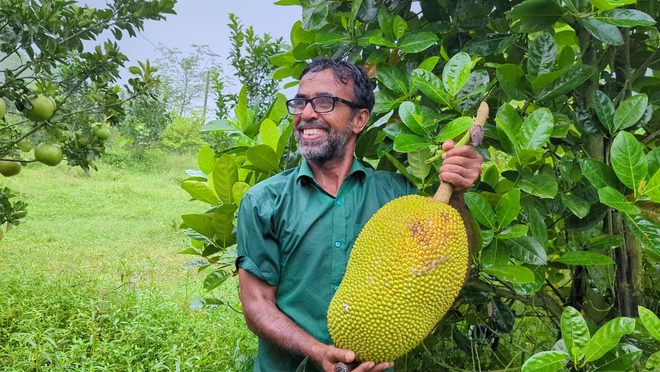
He went on to build a successful agricultural enterprise, earn a National Agriculture Award, and eventually donate 1.35 acres (around 4 bighas) of his family’s land to establish Mahishmara College in Tangail.
His goal was to bring practical agricultural work into the academic curriculum, combining traditional practices with modern, science-based methods so that students learn production techniques alongside their traditional studies.
Sanowar Hossain’s decision to leave the teaching profession stemmed from his perspective on the traditional education system. “I was born into a farming family in a remote village,” Sanowar Hossain says.
“Since childhood, I watched my mother handle household work and my father tirelessly work the fields with a wooden plough, rain or shine, using various techniques to grow different crops. A deep connection with agriculture developed from early childhood.”
Although his family initially guided him towards academic credentials to protect him from hard physical labour, working as a teacher in Sylhet changed his outlook. “In the beginning, I tried my best to develop every student’s hidden talents and shape them into capable, self-reliant citizens,” he explains.
“But most students, parents, the surrounding society, and the state itself were focused on one thing: obtaining a certificate by any means and joining the race to chase the mirage called ‘a job.’ Unable to reconcile myself with this job-oriented education system, I left teaching and devoted myself to the independent, self-reliant profession of agriculture.”
The move drew scepticism from those around him. “At first, society did not take my decision lightly; many mocked me as crazy,” Sanowar Hossain says. “But I firmly believed that as long as living beings exist on this earth, agriculture will exist, and so success in agriculture was inevitable.”
Founding Mahishmara College
After achieving commercial success in agriculture, Sanowar Hossain turned his attention back to his home region in Tangail, where access to higher education was limited.
“I understood firsthand, watching my father, how painful and difficult it is for a poor farmer to educate a child sent far away,” Sanowar Hossain says. “It’s true that I personally succeeded economically and socially through farming, but my community had not progressed in the same way; so what was the value of my success?”
With his parents’ consent, Sanowar Hossain donated 1.35 acres (around 4 bighas) of land to help establish Mahishmara College, aiming to make higher education accessible locally.
At Mahishmara College, Sanowar Hossain introduced a model he terms “production-oriented education”, which pairs traditional academic coursework with hands-on training in both traditional agricultural techniques and modern, science-based practices.
“The recurring realisation was this: the main purpose of conventional education has become obtaining a certificate by any means, confining oneself within four walls, and working under someone else, where physical labour is treated as something shameful,” Sanowar Hossain says.
“The real purpose of education should be to develop one’s latent talents and become a productive citizen, and our youth are largely failing at that.”
Under this model, students receive practical training in cultivating seasonal vegetables, applying these methods at home to assist their families. “Alongside their studies, students are directly learning, hands-on, the techniques for safely growing various seasonal daily-need vegetables, and are applying these at home,” Sanowar Hossain notes.
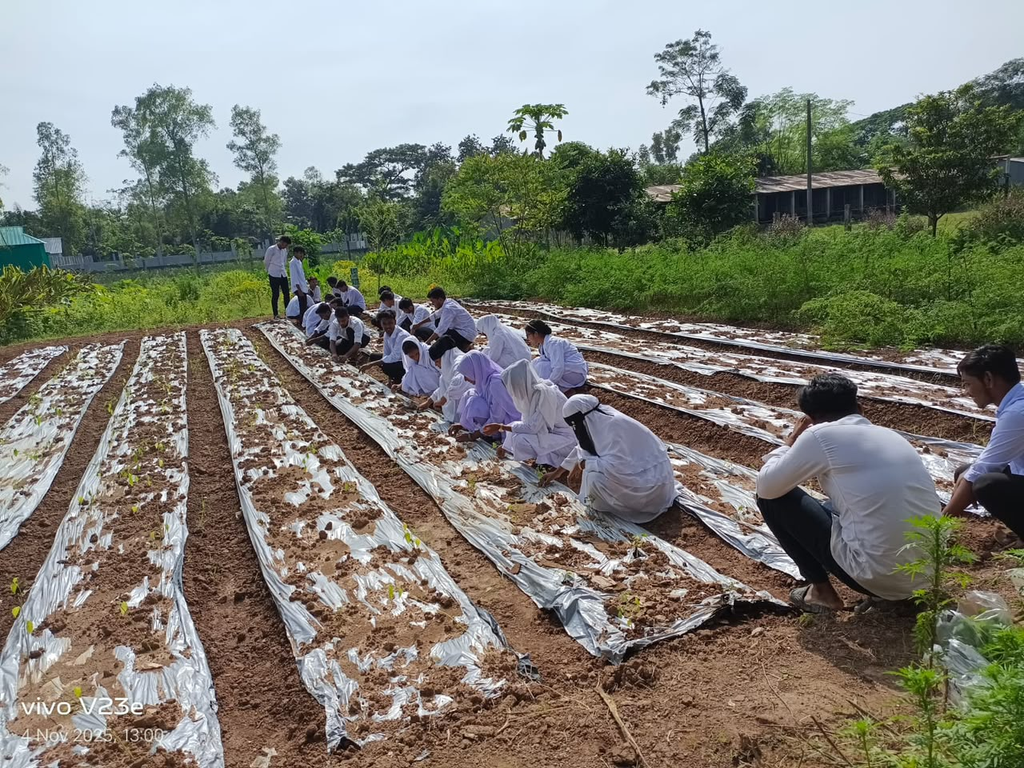
Photo: Courtesy
“By growing various vegetables and fruits, they are helping, even if modestly, to meet their families’ needs. Most importantly, this is paving the way for independent livelihoods in the future.”
Crops produced on the campus are used to prepare daily meals for teachers, and the college periodically organises shared meals for students made from campus-grown harvests.
Initial reactions and smooth implementation
The introduction of farm work on campus initially met with varied responses from the local community. “Initially, there was a mixed reaction among students, parents, and people in the surrounding area,” Sanowar Hossain states. “Many felt that children had been sent to college to study, not to do farm work; others said whatever the teachers thought best, they would go along with.
Overall, there wasn’t much response at first.” Over time, active participation increased as students began applying the agricultural methods at home.
“Later, encouraged by the teachers, most students began participating enthusiastically,” Sanowar Hossain says. “Now, many believe that even without a job after finishing their studies, one can make a living through farming. The same society that once called me crazy now encourages me for my work.”
Institutionally, no obstacles were encountered in implementing the programme, and the initiative has continued with informal cooperation from government, non-government, and private entities.
National agriculture and the education system
Sanowar Hossain views the current structure of national education as disconnected from the country’s economic reality. “Today’s youth are not particularly interested in farming. I believe this isn’t the fault of young people; it’s the fault of our education system,” Sanowar Hossain states.
“Governments change, but the education system established under British rule has hardly changed. About 60% of the country’s population finds employment directly or indirectly through agriculture, yet agriculture remains a neglected subject in our education system.”
He points to national household figures to illustrate the potential impact of practical agricultural training. According to a survey, there are about 1.75 crore (17.5 million) households in our country where planned cultivation could meet year-round vegetable and fruit needs, yet only about 10–12% of households currently engage in cultivation.
Meanwhile, the country has roughly 3.5 crore (35 million) young people.
“If these young people are trained in production-oriented education to grow various crops, it would create some employment for youth on one hand and meet the demand for safe vegetables and fruits for most of the country’s population on the other.”
Perspective on self-reliance
For Sanowar Hossain, the primary goal of education should be practical self-reliance rather than the simple acquisition of academic certificates. “No work in this world is small, and yet no single person can do everything alone,” Sanowar Hossain reflects.
“But our education system is so disordered that agricultural graduates end up as police officers wielding batons, doctors end up working in administration, engineers end up doing matchmaking work, and people with the highest degrees in social work sit in banks counting stacks of money. In short, the experience gained during education and the actual trajectory of one’s career are completely disconnected.”
His advice to young people centres on aligning personal goals with practical productivity.
“My call to the younger generation is this,” Sanowar Hossain says.
“Stop chasing certificates aimlessly, and instead set your life goals according to your own ability and talent, making the right decision to become a productive, self-reliant citizen.”