Can AI make life easier for Bangladesh's teachers? ShikkhaSathi is testing how
Can AI make life easier for Bangladesh's teachers? ShikkhaSathi is testing how
Teaching does not begin when a teacher walks into a classroom. Before the lesson starts, there are plans to prepare, questions to write, worksheets to organise and classroom activities to design. For teachers managing multiple classes and subjects, this preparation can take up a substantial part of their time outside the classroom.
ShikkhaSathi, an AI-powered teaching companion developed for Bangladesh’s education system, aims to make that process easier.
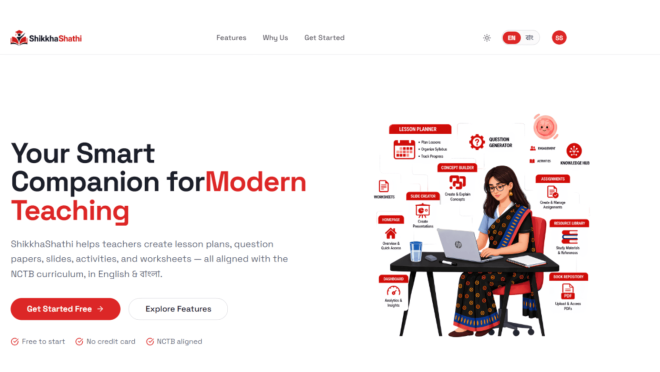
Designed around the National Curriculum and Textbook Board (NCTB) curriculum, the platform offers a range of tools to help teachers prepare educational materials in Bangla and English. These include lesson plans, question papers, presentations, homework assignments, worksheets, concept explanations and interactive classroom activities.
The idea is to reduce repetitive preparation work while allowing teachers to retain control over what they teach.
“When we think about teaching, we usually focus on what happens inside the classroom. But a significant part of a teacher’s work happens before the class even begins,” the ShikkhaSathi team said in an interview with TBS Graduates.
“We created ShikkhaSathi to make this preparation process easier.”
The platform is built on a straightforward principle: AI can generate an initial draft, but teachers must review the material, correct inaccuracies and adapt it to their students’ needs.
Much of the discussion around educational technology focuses on helping students access learning materials, practise skills or receive personalised instruction. ShikkhaSathi takes a different, complementary approach by focusing on the people responsible for delivering those lessons.
The team believes that supporting teachers can be an effective way to improve students’ learning experiences.
With ShikkhaSathi, teachers can use AI-generated drafts as a starting point for preparing classroom resources rather than creating every document from scratch.
“Our guiding principle is: ‘AI generates drafts. Teachers review, adapt, and decide’,” the team said.
The distinction is particularly important in education, where a well-written answer is not necessarily an accurate or curriculum-appropriate one.
A question paper, for example, needs to reflect the relevant subject matter and grade level. A lesson plan must correspond to learning objectives, while a worksheet should be appropriate for the students expected to complete it.
ShikkhaSathi’s focus on the NCTB curriculum is intended to address these requirements. However, ensuring that AI-generated materials are consistently accurate and suitable for classroom use remains one of the team’s stated development priorities.
ShikkhaSathi’s website presents the platform as a broader teaching-preparation toolkit rather than a single-purpose lesson generator.
Its listed features include tools for creating question papers, presentations, homework assignments and worksheets, alongside concept explanations, interactive activities and curriculum tracking. The website also highlights bilingual support and mobile-first access.
Together, these features aim to support teachers across different stages of lesson preparation, from organising content to developing activities and assessing students’ understanding.
The platform’s usefulness, however, will depend on more than the number of tools it offers. Teachers need materials that are accurate, clearly presented and easy to modify before using them in class.
The team has identified three major challenges in developing the platform: maintaining curriculum relevance and factual accuracy, generating high-quality materials in Bangla and English, and making the interface accessible to teachers with different levels of digital confidence.
General-purpose AI models can produce convincing explanations while making factual errors or generating content that does not match a specific grade or curriculum. Language quality presents another challenge, particularly when materials involve subject-specific terminology, mathematical expressions and structured questions.
Usability is equally important. A tool intended to reduce teachers’ workload must fit into their existing routines without requiring extensive technical knowledge.
“Our focus is not simply on adding more AI features. It is on improving the complete experience, from requesting a teaching resource to reviewing, editing, and using it,” the team said.
The developers have completed initial soft testing of the platform’s basic functionality. The next stage will involve testing it with teachers in school settings.
ShikkhaSathi’s immediate plan is an eight-week pilot involving 20 Class 6 teachers from five schools. The pilot will cover Bangla, English, Mathematics and Science.
The team hopes to use the programme to understand which features teachers find most useful, how reliable the generated materials are and whether the platform becomes a regular part of their preparation routines.
The pilot will also help the developers identify technical and practical problems that may not emerge during initial testing.
Rather than assuming that teachers will adopt the platform because it offers AI-powered features, the team wants to assess whether they find it useful enough to continue using independently.
The results could help determine how the project develops and whether it is ready for a broader rollout.
Based on the pilot findings, the team plans to explore expansion from 2027. Its long-term planning target is to reach 1,000 schools and 20,000 teachers by 2030.
Achieving that scale will depend on teacher feedback, product quality, institutional partnerships, funding and the ability to provide reliable support.
The team also hopes to expand beyond the initial Class 6 pilot to additional grades, subjects and teaching needs, while keeping the platform accessible to teachers in rural and underserved communities.
The idea behind ShikkhaSathi emerged from a broader interest in using technology to improve education.
The team is associated with Progress through Innovation Society (PI), which works in association with Computer Literacy Program (CLP) USA. Through initiatives such as Computer Literacy Centers, Smart Classrooms and Global Classroom, PI and CLP have worked to expand access to computer literacy and technology-aided education in Bangladesh, particularly in underserved communities.
That experience helped shape the team’s thinking about the role of technology in education.
Providing digital infrastructure and learning opportunities is important, but teachers also need practical tools and support to use technology effectively. The emergence of generative AI presented an opportunity to explore how those tools could assist with the everyday work of teaching.
The resulting idea was to develop a platform shaped around the Bangladeshi curriculum and the preparation tasks teachers regularly undertake.
For the team, the technology itself is not the ultimate goal. Its value will depend on whether it addresses a genuine need in schools.
That makes teacher feedback central to ShikkhaSathi’s development, particularly as the project moves from initial testing towards its planned pilot.
The ambitions for ShikkhaSathi are substantial, but the project remains at an early stage of development. Its upcoming pilot will be an important test of whether the platform can translate its proposed benefits into practical value for teachers.
Reaching thousands of schools may be a long-term objective, but adoption alone will not establish whether the platform is helping educators.
The more immediate questions concern whether teachers can trust the generated materials, whether the tools save meaningful preparation time and whether the platform works across different subjects, languages and classroom contexts.
For the team, success means developing a product that teachers find genuinely helpful and choose to use in their everyday work.
The broader ambition is to demonstrate how AI can be integrated into Bangladesh’s education system responsibly, with teachers retaining control over the materials they bring into their classrooms.
If ShikkhaSathi can deliver on that ambition, its contribution may not be about replacing any part of a teacher’s role, but about making some of the work behind that role a little easier.