Bangladesh’s unofficial oil boom
Well, if I got the title right, I got your attention. You caught me. I’m not talking about the actual oil industry of Bangladesh, but rather the omnipresent flattery in the job and club sectors we all face.
Bangladesh’s unofficial oil boom
Well, if I got the title right, I got your attention. You caught me. I’m not talking about the actual oil industry of Bangladesh, but rather the omnipresent flattery in the job and club sectors we all face.
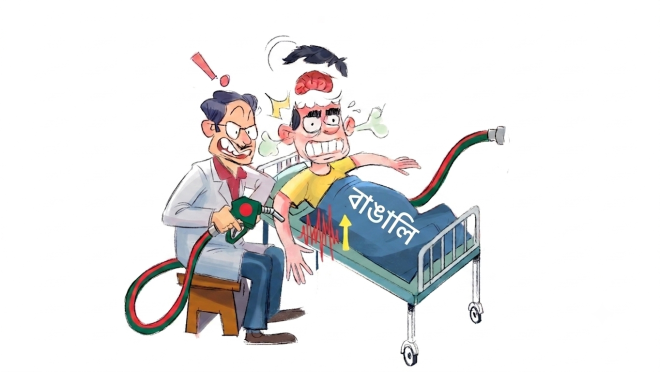
After publishing this article, I might not get a job, but I need to extract this fabric of reality anyway.
The rise of the “Oil Industry”
A reputed Human Resource professional in corporate affairs at a reputed company located in Uttara once told me directly: “If you grow (get promoted) due to oiling, it might as well be good for you. At least you are moving up.” Though now he barely picks up my calls or replies to my texts, I found his insight solemnly close to my heart.
It was a profound moment of corporate honesty. In that single sentence, this HR guru laid bare the unspoken GDP of the Bangladeshi job market: the “Oil Industry.”
That conversation changed how I looked at the office. While global analysts stress over prices, I realised our corporate sector is quietly celebrating an unprecedented boom in a different kind of liquid asset.
This isn’t the extraction of fossil fuels from Sylhet or any other prehistoric area. It is the refined, premium-grade flattery flowing freely through the cubicles of Gulshan, Uttara, Motijheel, or wherever you may be working now.
I’ve come to realise that despite a massive talent surplus, the highest-yielding asset in the country remains the strategic, daily application of ‘Tel’.
The classifications of crude
In my time in university clubs and the corporate trenches, I’ve watched clubmates and colleagues master various grades of this commodity, respectively. First, there is “Crude Oil”. This is the raw, unrefined flattery used by desperate amateurs.
I’ve watched people tell a president or manager, dead in the eye, and say, ‘Bhaiya, ei ektu agey apnar kothay bhabchilam!’ or praise his ‘impeccable leadership style’ despite that so-called manager/president completely lacking leadership.
Then I watched the masters of ‘Refined Lubricant’. This is the professional level. It is the art of laughing at a boss’s terrible joke exactly two seconds before anyone else in the meeting room does, just so they notice you.
Finally, every time I open my phone (this is the modern version, found completely on LinkedIn), I see that when a top manager posts a cringey, meaningless video or post mocking other people’s CVs, offering altruistic guidance, or shares a long, robotic text clearly written by ChatGPT, the online oilers rush to the comment section anyway.
The post makes absolutely no sense, but they write things like, “So true, Boss!”, “Learning from the master!”, “Great learning”, etc., under a post the boss copied and pasted without even reading.
The extraction hierarchy
I quickly learned that the corporate ladder is no longer climbed by merit (which is very limited in our corporate or club culture); it is drilled by eye-wash.
At the bottom are the fresh graduates who spend most of their day tracking down the exact brand of tong-er cha or special paan the bosses like. They do the manual labour. They would even waste their time lingering in the rooms hour after hour just to be ‘visible’.
Above them are the “Middlemen”. These are the mid-level managers who take all the credit for their juniors’ hard work, pack it up nicely, and gift-wrap it for the directors to secure their own promotions.
At the very top sits the “Syndicate” (the upper management), who run the whole show. They do not care about your actual work; they just want a steady, daily supply of ego-massaging.
The profit and loss
The profit margin here is completely real. Giving your president/boss three simple compliments a day gives you a much better chance of getting your leave approved than actually hitting your monthly targets.
But the market can change fast. Panic hits the office when a younger, newer employee (or batchmate) joins the team with modern tricks.
This new rival doesn’t even bother talking to the boss at work. They just get the work done on merit. It hits the insecure part of those big mouths. So, they either try to mock them by saying, “Areh vai, ar koto kaj korben” or “Tmi to 10 e 10”. But if the situation goes sideways (unfavourable to them), they go to great lengths to conspire against the newbies.
A renewable future
If what I am seeing continues, Bangladesh may soon shift its primary export from RMG to sycophancy.
Traditionalists might warn that this industry is built on a bubble of hot air, but from what I’ve lived through, corporate insiders remain highly optimistic. After all, actual talent is finite and exhausting to maintain. But the human capacity to nod vigorously and say, “Rightly said, Sir,” is a completely infinite, renewable resource.
So, I’ve decided to pay heed to the HR professional’s advice. Invest early, grease well, and may your performance reviews be entirely frictionless.