How a Criminology graduate earned her place at Edinburgh with a Commonwealth Scholarship
Era Robbani grew up watching other people’s success stories and wondering how they got there. She would find them online, study their paths, sometimes even message them and ask for a meeting.
How a Criminology graduate earned her place at Edinburgh with a Commonwealth Scholarship
Era Robbani grew up watching other people’s success stories and wondering how they got there. She would find them online, study their paths, sometimes even message them and ask for a meeting.
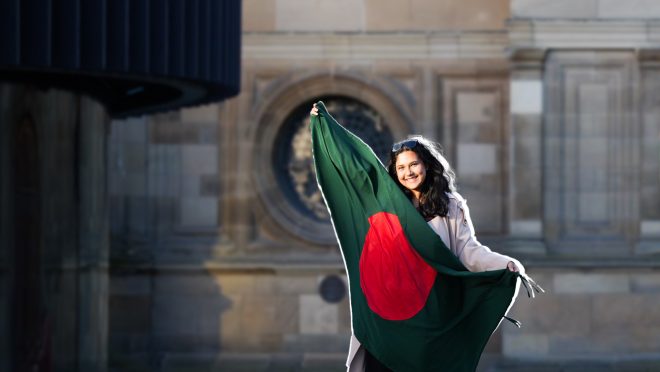
Years later, holding offers from Oxford, Cambridge and the University of Edinburgh, funded by a fully funded Commonwealth Scholarship from the UK government, she has become one of those stories herself.
Her academic path started at the University of Dhaka, where she completed both Bachelor’s and Master’s in Criminology. While researching justice, peace, security and borderland communities, she began to see her subject differently.
The problems she was studying were not local at all, they were part of something far larger, and she felt there was a real gap for voices from the Global South in that conversation. A conference in Kenya sharpened that feeling into a plan, after she saw how much she still had to learn simply by being in a room with researchers from other parts of the world.
That realisation pushed her to apply to some of the most competitive scholarships and universities around. Era spent close to nine months preparing, starting with an Excel sheet comparing universities on entry requirements, funding and alumni networks.
She reached out to graduates on LinkedIn and over email, asking for their honest opinion about what the process really demanded. Around six months out, she began drafting her personal statement, going through draft after draft, most of which she now admits were not very good at all.
What she refused to do was follow a template. She focused on what genuinely interested her, how she thought about problems, and what had motivated her, rather than guessing what admissions committees wanted to hear.
She believes that is what made her application stand out, though it came at a cost. The hardest part, she says, was psychological rather than logistical, learning to hold an honest sense of her own strengths alongside an honest sense of where she still had room to grow, without sliding into self-doubt or overconfidence.
The scholarship was a different scale of competition altogether, drawing applicants from 56 countries with an acceptance rate of around half a percent. To stay sane through that, Era leaned on a small mental trick, swapping “what if I don’t get it” for “even if I don’t get it, what will I still walk away with?” That shift kept her focused on the parts of the process she could actually control.
She chose Edinburgh over Oxford and Cambridge for reasons both practical and personal. The course, Global Crime, Justice and Security, felt closer to her existing research than the more traditional criminology programmes at Oxbridge, the funding was better, and, only half joking, she shared that her shortlisting criteria included whether a university city had a nearby beach. A legal researcher role at the Edinburgh International Justice Initiative, secured alongside her studies, sealed the decision.
Life in Edinburgh has reshaped how she sees the world, she says. Conversations with friends from Germany, Gaza, Iran and Pakistan have given her new angles on histories she only used to read about in books. The adjustment has not been easy, learning to sit with discomfort, handling her own finances and time, and getting used to a classroom culture built around discussion rather than memorisation. But she calls it one of the most rewarding stretches of her life, one that has made her world bigger academically, culturally and personally.
Looking back, she wishes someone had told her she did not need every piece of the puzzle in place before starting. The application itself, she says, is a chance to show potential and curiosity, not proof that you have already arrived.
Her advice to Bangladeshi students eyeing similar opportunities is simple. Do not wait to feel completely ready, do not leave referees and documents until the last minute, and do not underestimate what a Bangladeshi perspective brings to a room where South Asian voices are so often dominated by one country alone. Being from Bangladesh, she says, is a strength, not something to work around.
She also credits the people who backed her along the way, former colleagues who first put the idea of Oxford in her head, mentors found through cold emails and Zoom calls, and parents whose encouragement gave her the confidence to even try.
She is now looking towards a PhD and hopes to eventually bring what she has learned back to students outside Dhaka who may never have imagined a life like this for themselves. Even helping a handful of them see wider possibilities would feel like a meaningful return on everything she has been given.
As she puts it herself, dreams are supposed to sound a little unreasonable. That is the whole point of calling them dreams, and having one already means you have stepped onto the ladder that leads to the reality.