Saturn’s giant moon could be humanity’s next big adventure
After the Moon and Mars, where should humanity venture next? A growing number of scientists believe the answer may lie more than a billion kilometres away on Titan, Saturn’s largest moon.
Saturn’s giant moon could be humanity’s next big adventure
After the Moon and Mars, where should humanity venture next? A growing number of scientists believe the answer may lie more than a billion kilometres away on Titan, Saturn’s largest moon.
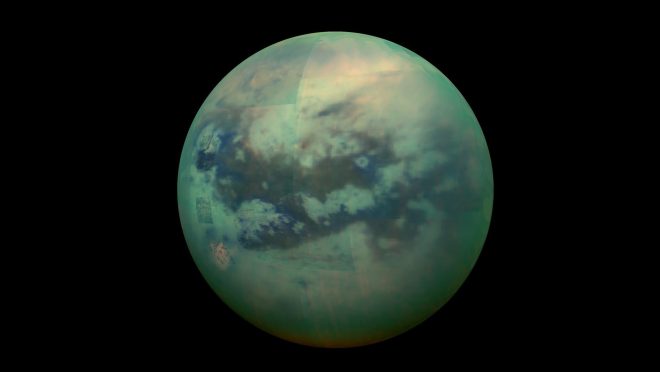
According to space.com, the idea took centre stage at the inaugural Humans to Titan Summit 2026, held in Boulder, Colorado, where researchers, engineers and planetary scientists gathered to examine the long-term possibility of sending humans to Titan. While such a mission remains decades away, participants argued that the moon offers unique advantages that could make it one of the most viable destinations for future human exploration.
Amanda Hendrix, director of the Planetary Science Institute and president of the advocacy group Explore Titan, described the summit as an important step towards treating Titan as a serious exploration target.
“Everyone recognises that the reality of this is a long way off, but normalising the idea that Titan is actually a very reasonable destination for humans is important,” Hendrix said.
Titan stands apart from other worlds in the Solar System due to its dense, nitrogen-rich atmosphere, which provides natural protection against harmful space radiation. Scientists believe this atmospheric shielding could make long-term human presence more feasible than on many other planetary bodies.
The summit explored a wide range of practical considerations, including habitat design, spacesuits, transportation systems, airlocks and methods for coping with Titan’s unusual weather patterns. Unlike Earth, Titan’s climate is driven by hydrocarbons such as methane and ethane rather than water, creating rivers, lakes and rainfall unlike anything found elsewhere in the Solar System.
Researchers also discussed the moon’s potential strategic value. Titan could serve as a hub for future exploration missions across the Saturn system, including sample-return missions from Enceladus, another moon considered one of the most promising locations in the search for extraterrestrial life.
The moon’s abundance of resources, including methane, nitrogen and oxygen, was highlighted as another significant advantage. These materials could potentially support fuel production and sustain deeper exploration missions beyond Titan itself.
One of the major challenges remains the journey. Travelling to Titan would currently require several years, meaning scientists must either develop faster propulsion technologies or find ways to minimise the physical and psychological impacts of long-duration space travel on astronauts.
Much of what is known about Titan today comes from the European Space Agency’s Huygens probe, which successfully landed on the moon in 2005 as part of the joint NASA-ESA Cassini-Huygens mission. The next major step in Titan exploration will come through NASA’s Dragonfly mission, a nuclear-powered rotorcraft scheduled for launch no earlier than 2028.
Dragonfly will spend more than three years exploring Titan’s surface, flying between locations and analysing samples collected from different environments. Scientists hope the mission will provide crucial data that could inform future human exploration efforts.
Among those attending the summit was Scot Rafkin, Director of the Department of Space Studies at the Southwest Research Institute. He described the prospect of sending humans to Titan as “extraordinarily ambitious” but argued that history shows major breakthroughs often begin with goals that initially appear beyond reach.
“Human exploration of Titan is not a question of physics,” Rafkin said. “It is a question of time, technology and commitment.”
According to Rafkin, advances in propulsion systems, robotics, manufacturing, life-support technologies and communications are steadily moving humanity closer to making such missions possible. While many technological challenges remain unresolved, he believes the pathway towards Titan is becoming increasingly clear.
Importantly, organisers stressed that the summit was not about planning an immediate mission. Rather, it was intended to spark a broader conversation about humanity’s long-term future in space and encourage the development of technologies that could benefit exploration throughout the Solar System.
“The challenge is immense, but it is achievable,” Rafkin said.
A second Humans to Titan Summit is expected to be held around the launch of NASA’s Dragonfly mission in 2028, continuing discussions on what could eventually become one of humanity’s most ambitious exploration goals.
For now, Titan remains a distant dream. Yet for a growing community of scientists, it is no longer viewed as science fiction but as a potential destination for future generations of explorers.