Dhaka’s 416th celebration by Dhaka South: What are we celebrating exactly?
Dhaka’s 416th celebration by Dhaka South: What are we celebrating exactly?
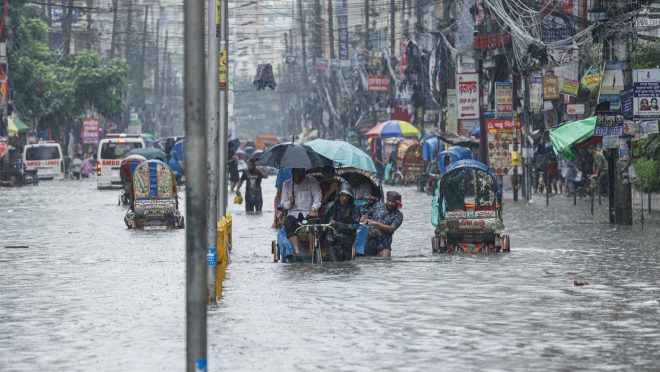
The city corporation wants elephants, a marathon and a heritage cruise on the Buriganga. The world’s third least liveable city might first explain why it thinks it deserves a parade.
“Ahen Moji Furtitey.”
Come and enjoy.
This was the official slogan for the three-year-long festivities to celebrate the 400th anniversary of Dhaka city, which began in November 2008. On 29 November, a daylong programme included area and ward-based processions with elephants and horses, a boat race, kite flying, Dhakaiya food and Bakarkhwani festival, old car display, children’s painting exhibition, a puppet show and a cultural function.
This year, on 13 July, letters signed by Dhaka South Administrator Md Abdus Salam went out to nearly four dozen commercial banks and mobile financial service providers. The letters did not name a figure. At a meeting later, the banks were told to donate between Tk50 lakh and Tk3 crore each, drawn from their corporate social responsibility budgets, to finance a week of celebrations marking the capital’s 416th anniversary.
The request landed barely a few weeks after the Economist Intelligence Unit (EIU) ranked Dhaka the third least liveable city on earth. It landed the same week that a hundred millimetres of rain shut down the city and sank it to waist depth sewage water.
One managing director of a bank, requesting anonymity, said, “Bank deposits belong to depositors and shareholders. We cannot simply hand over that money because an administrator wants us to. There are clear guidelines requiring CSR funds to be used for public welfare. There is no legal provision for spending those funds on a seven-day fair or concert.”
So, with the monsoon already through the door, the rankings where they are and the bill in the banks’ mail box, the fair question to put to the organisers is what are we supposed to celebrate exactly?
We have been here before
The multi-year festivities back in 2008-2010 were largely sustained through decentralised corporate social responsibility (CSR) sponsorships from the private banking sector rather than a singular, massive state budget.
This independent funding championed an exhaustive historical reclamation project, most notably bankrolling the Asiatic Society of Bangladesh’s multi-volume publications, archaeological digs, and international seminars detailing the city’s economic and urban evolution.
The then unified Dhaka City Corporation and various alumni associations funded their own distinct structural and cultural projects.
A notable example of this expenditure was the commissioning of the “Rajasik Bihar” sculpture (the horse carriage monument), which was installed in front of the Sheraton Hotel (now InterContinental) in January 2008 specifically to mark the 400-year milestone.
This year’s plan
On 1 August 2026, the Dhaka South City Corporation will begin a week-long rally of horse carriages, palanquins and heritage cycle, along with a marathon and what it is calling a ‘heritage cruise’ down the Buriganga, all staged under the banner “Hridoye Dhaka” or Dhaka in Our Hearts.
Prime Minister Tarique Rahman is set to inaugurate the celebration of the capital’s 416th year at Lalbagh Fort.
It will be followed by a kite festival, “Dhaka Adda” and qawwali on 2 August, and a boat race on the Buriganga on 3 August. Running through 7 August are film screenings, stage plays, an art camp, a painting competition, and The Great Dhaka Sale.
It is a handsome programme for a city whose residents spent the middle of July wading through what was essentially a citywide lake.
The numbers aren’t as celebratory
In the EIU’s Global Liveability Index 2026, released in July, Dhaka ranks 171st out of 173 cities with an overall score of 42 out of 100 — the world’s third least liveable city, a position it has now held for two consecutive years.
The detail that should end the party is the company Dhaka keeps at the bottom. The only two cities ranked below it are Tripoli, fractured by the long aftermath of civil war, and Damascus, ruined by more than a decade of continuous conflict. This year’s bottom 10 also welcomed Tehran, which fell into the group only after the February war.
This year, on 13 July, letters signed by Dhaka South Administrator Md Abdus Salam went out to nearly four dozen commercial banks and mobile financial service providers. The letters did not name a figure. At a meeting later, the banks were told to donate between Tk50 lakh and Tk3 crore each, drawn from their corporate social responsibility budgets, to finance a week of celebrations.
Dhaka reached the bottom without a single shell falling on it. Its infrastructure score of 27 is the lowest of any city in that bottom 10, on the EIU’s own metric, worse than the infrastructure of cities that have been bombed.
The slide is a straight line. By 2012, the Economist Intelligence Unit had ranked the city the least liveable on earth, 140th of 140. It was 166th in 2023, 168th in 2024, 171st in 2025, and 171st again in 2026. Where conflict-hit cities can at least point to a war, Dhaka’s decline is entirely structural — the compounding interest on decades of planning failure.
Md Abdus Salam, administrator of Dhaka South, said, “Dhaka is older than many cities in the world. It has a unique culture and history; and we must celebrate that culture and history. Yes, we do have issues which we will strive to fix. At the same time, we will celebrate our beloved city.”
When asked about collecting funds from financial institutions, Salam responded, “It is not an obligation in any way. Those who want to contribute may join. It is completely up to them.”
A city that cannot drain a monsoon
The two Dhaka city corporations spent more than Tk262 crore between 2021 and 2024 laying 334 kilometres of drains and box culverts, after taking the drainage mandate away from Wasa at the end of 2020. In April, they mapped 141 waterlogging hotspots across the capital. The money was spent; the water still rises.
The Bangladesh Institute of Planners has found that Dhaka lost 3,440 acres of designated flood-flow zones, retention ponds and water bodies after the 2010 area plan. Central Dhaka’s water bodies shrank from 20.57% of its area in 1995 to 2.9% by 2023. Green cover fell from 22% to 9% over the same period. A city cannot pave over its rivers and canals and then be surprised when the rain has nowhere to go.
Urban planner Professor Adil Mohammed Khan, executive director of the Institute for Planning and Development (IPD), said improving drainage and water discharge systems in southern Dhaka should be the city’s immediate priority.
“Dhaka South City Corporation still has a great deal of work to do to improve the city. Roads in southern Dhaka go under water whenever it rains,” he said.
There is a grim comedy in Dhaka South now advertising a “heritage cruise” on the Buriganga — a river system it has largely choked — and a “Clean City, Green City” cleanliness drive on a river whose tributaries it has filled in.
A city earns a celebration by becoming more liveable, not by declaring itself so.