BRAC honours 31 students for essays on human trafficking, safe migration
BRAC honours 31 students for essays on human trafficking, safe migration
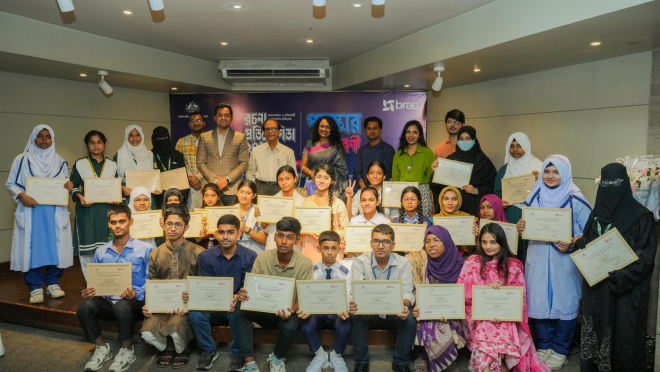
Thirty-one students from across Bangladesh have received awards and certificates for essays examining human trafficking, migrant smuggling and the dangers of irregular migration by sea.
Six students secured the top positions in two categories of the nationwide competition, which drew submissions from 870 school, college and university students.
“People are not for sale.” Though brief, the message carries profound meaning. Nusrat Jahan, a ninth-grade student from Narayanganj, used the line in her essay and message on human trafficking and migrant smuggling.
Literary researcher and essayist Professor Dr Syed Azizul Haque and National Book Centre Director Afsana Begum presented the awards at a ceremony held at BRAC Centre in Mohakhali on Thursday (23 July).
Writer, researcher and migration expert Afsan Chowdhury, journalist Rajib Nur and fiction writer Kazi Tahnin served as judges.
The competition sought to help students identify the signs of human trafficking and migrant smuggling, raise awareness of the dangers of irregular journeys by sea, and highlight the importance of safe, regular and legal migration.
Entries were assessed in two categories: students from Class VIII to college level and university students.
In the senior category, Niloy Biswas of Chittagong University of Engineering and Technology became champion, while Mohammad Fahad Hossain Fahim of Bangladesh Agricultural University was runner-up.
In the junior category, Nadratun Naim Taqwa, a ninth-grade student at Khurushkul High School in Cox’s Bazar, became champion.
Sadia Salma, a tenth-grade student at Shaheed Azizul Haque Girls’ Madrasa in Teknaf, and Arafat Shahin Kamal, a tenth-grade student at Sabrang High School in Teknaf, were named joint first runners-up.
Sejuti Akter Ayesha, a ninth-grade student at Pirujali Adarsha Bidyalaya in Gazipur, secured third place.
Professor Dr Syed Azizul Haque, the chief guest, said traffickers succeeded in Bangladesh because the country suffered more from educational deprivation than financial poverty.
“The suffering of trafficking victims is not theirs alone; it concerns the entire nation. Preventing trafficking is everyone’s responsibility,” he said.
“The participants in this essay competition can help spread these messages. It is an excellent initiative.”
Afsana Begum, Director of the National Book Centre and a fiction writer, attended as special guest. Drawing on the hardships she had witnessed among Bangladeshis while living in Malaysia, she said greater awareness could protect many people from danger.
Safi Rahman Khan, Director of BRAC’s Education, Skills Development and Migration programmes, said the fight against human trafficking and migrant smuggling was ultimately a struggle to ensure people’s right to safe and dignified migration.
“We have worked with students for many years and have seen that their involvement brings positive change,” he said.
“The competition was organised to build awareness among young students.”
Shariful Islam Hasan, Associate Director of BRAC, said Bangladesh ranked sixth globally among migrant-sending countries, but the lives and contributions of migrant workers received little attention in textbooks.
“We call those who go abroad ‘kamla’, or labourers, even though Bangladesh’s economy rests on their work,” he said.
“We wanted to hear students’ views and engage them in the issue. This was not merely a competition or an award programme; our objective was to place this important subject firmly in their minds.”
Junior-category runner-up Arafat Shahin Kamal described the alarming prevalence of human trafficking and abduction in Teknaf.
“Human trafficking and abduction have become very common in Teknaf. People are abducted and money is demanded from their families. Victims are trafficked and tortured, and videos of the abuse are sent to their families to demand ransom,” he said.
“Unable to bear it, families sell their property to send the money. Such crimes appear to have become normal in Teknaf. The problem urgently needs to be addressed.”
Mobasshira Anjum, a participant from YWCA Higher Secondary Girls’ School in Dhaka, said researching her essay helped her understand the scale and severity of human trafficking and migrant smuggling for the first time.
Mannan Chhaiyal, who returned from a cyber-scam centre in Cambodia, and Cox’s Bazar trafficking survivors Ang Ang and Jewel also shared their experiences and urged people to become more vigilant.
Brac Migration Programme conducted awareness activities at educational institutions across the country as part of a public campaign against human trafficking and migrant smuggling.
The Australian Border Force and Brac Migration Programme jointly organised the event, attended by students, teachers and guardians.