Was not cancelling HSC the right answer?
Bangladesh’s 2026 Higher Secondary Certificate examinations have become one of the defining controversies of this government’s short tenure, and it is worth saying plainly at the outset that the ministry’s core judgement call held up better than the loudest slogans on Dhaka’s streets suggested.
Was not cancelling HSC the right answer?
Bangladesh’s 2026 Higher Secondary Certificate examinations have become one of the defining controversies of this government’s short tenure, and it is worth saying plainly at the outset that the ministry’s core judgement call held up better than the loudest slogans on Dhaka’s streets suggested.
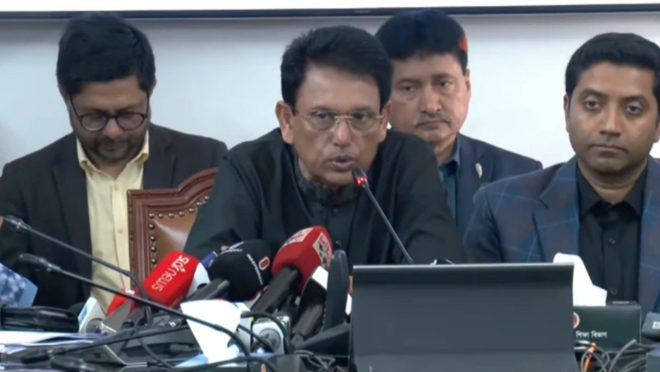
Over 1.27 million candidates were registered this year, more than the previous year, sitting examinations at 2,697 centres under a genuinely reformed system. For the first time, all nine general education boards used a single uniform question paper. Every centre was placed under CCTV monitoring, with invigilating police wearing body cameras, changes designed specifically to make this year’s examinations fairer and more transparent than any before them.
That was the system the floods crashed into: more than fifty deaths nationwide, over a million people affected across seven districts, and an intensified monsoon compounded by a strong El Niño that dumped rain with little warning. Cancelling a national examination of that scale is not a light administrative switch to flip. Bangladesh had already lived through what happens when it is: the 2024 HSC cancellations left results determined by subject-mapping formulas rather than students’ own papers, a process that authorities deliberately kept off transcripts to preserve foreign university acceptance, but which some educators still felt left that cohort with learning gaps and a lingering credibility question. A ministry that had just watched that experience unfold was reasonable, not callous, to treat wholesale cancellation as a last resort rather than a first response.
It is also simply inaccurate to describe what happened as the ministry stubbornly refusing to cancel examinations and leaving students to fend for themselves. The record shows a series of differentiated, evolving decisions rather than one blanket refusal. Days before the crisis peaked nationally, the Inter-Education Board Coordination Committee had already postponed every HSC examination across the entire Chattogram Board – Chattogram, Cox’s Bazar, Khagrachhari, Rangamati and Bandarban – precisely because flooding there was most severe.
Prime Minister’s Adviser Mahdi Amin stated publicly that the decision to continue examinations elsewhere on 13 July was made only after consulting divisional commissioners, deputy commissioners, police superintendents, education board chairmen, teachers, students and guardians across the country, which is a far more consultative process than the “one minister’s stubbornness” narrative that fuelled the initial resignation demand. District administrations also retained standing authority to postpone locally where conditions demanded it, which is exactly why individual centres such as the one in Cumilla relocated candidates rather than forcing them into unsafe buildings.
None of this excuses what went wrong on 13 July, but it does mean the ministry cannot fairly be accused of simply not caring, or of treating the examination calendar as more important than student safety, when its own structure was built to allow local correction.
That said, 13 July is the day that defines this controversy, and it deserves to be examined on its own terms rather than folded into a broader defence. Heavy rain flooded roads and examination centres simultaneously across much of the country during the Physics Second Paper, Accounting and Logic tests; students in Dhaka and Cumilla were ferried to centres by boat; a Bangladesh Student Federation official later claimed that roughly 11,000 candidates could not sit the examination at all that day, though this figure came from the protest movement rather than an official ministry count.
Two questions on the Physics First Paper also turned out to contain outright errors. Here is where the ministry’s response should be judged not by what it said in the moment but by what it actually did afterwards, because the corrective measures were substantive rather than cosmetic. Every candidate was awarded full marks for the two flawed Physics questions, and the officials responsible for preparing that paper were suspended.
The minister told Parliament that any candidate who missed a paper because of the weather would be allowed to sit it later, alongside the rescheduled Chattogram Board examinations. After further negotiation, the ministry specifically confirmed that students absent on 13 July due to flooding would be allowed to retake those exact papers once registered. The minister also apologised in Parliament for a leaked private remark comparing anxious examinees to “farm chickens”, explicitly telling the chamber that students are “our future” and that the government would not deprive them of their rights. A ministry genuinely indifferent to student suffering does not suspend its own officials, rewrite marking schemes overnight, and build a dedicated retake pathway for the exact group that was harmed.
It is worth testing that response against what the protesters themselves eventually asked for, because their demands shifted meaningfully over the course of the crisis, and that shift matters. What began as a three-point demand that included the education minister’s resignation, and at one stage hardened into a single-minded call for his resignation alone, was, within days, replaced by a negotiated six-point charter focused on concrete reforms, a sign that even the protest movement’s own leadership judged reform, not removal, to be the more serious and achievable goal.
Measured against that charter rather than the more inflammatory street rhetoric that preceded it, the ministry’s record looks considerably stronger than its critics allow. On the demand that any weather-affected candidate be allowed an optional retake, with the higher of two scores counted, the ministry granted the substance of this to the specific group it could verify had been harmed; those absent on 13 July, rather than opening it to any candidate who simply felt they had underperformed. That narrower remedy is defensible on its own merits: an open-ended retake option, available to anyone who wanted a second attempt at a better score, would have invited strategic re-sitting on a mass scale and undermined the examination’s basic function as a measure of a single, comparable sitting for over a million candidates.
Targeting the fix at verified absentees addresses the actual harm without opening that door. On the demand that full marks be awarded for question paper errors, the ministry conceded this completely, and paired it with the suspension of the responsible officials, arguably the clearest and most complete win the protest movement secured. On the demand for adequate preparation time before any retake, the rescheduled papers were folded into the already-adjusted Chattogram Board timeline rather than rushed through within days, giving affected students a defined runway rather than a hastily arranged make-up test. The remaining two points in the charter, accounting for sudden changes in question patterns during evaluation, and building more student-friendly examination centres, are longer-term, structural asks about evaluation policy and physical infrastructure that no ministry could plausibly resolve inside a two-week national crisis; their unresolved status reflects the real limits of what can be fixed mid-examination, not a refusal to take them seriously.
None of this is to say the ministry has a clean record, and a persuasive case for its decisions has to concede that openly rather than paper over it, because the counterarguments raised by students and opposition MPs were not manufactured out of nothing. Independent analysis, including a widely read piece in The Business Standard, argued that the government’s handling of this year’s examinations exposed genuine failures in planning, communication and crisis management, and that the ministry’s own explanation, that forecasts suggested conditions would improve, and that district administrations had the authority to postpone locally if needed, does not fully answer what students actually experienced wading through waist-deep water with their admit cards held over their heads.
That gap between official process and lived experience is real, and it is the strongest single argument the opposition has. The minister’s remark about “farm chickens”, whatever its intent, was a serious misjudgement for someone whose words carry weight for well over a million anxious teenagers and their families, and it is telling that it took a leaked private phone call, rather than any proactive gesture of empathy, to produce an apology.
Critics are also correct that the government’s fuller explanation of its consultative process came only after the protests forced the issue into Parliament, rather than being offered up front, a communications failure that let a defensible decision look, for several days, like an indefensible one. And the same independent commentary that credited the ministry’s corrective measures also observed that, as the protest movement wore on, some legitimate grievances curdled into road blockades, vandalism and demands that no ministry could grant on the spot, which complicates any simple story in which one side was entirely right and the other entirely wrong.
Judged against the six concrete demands the protesters themselves ultimately settled on, rather than the resignation call that was later withdrawn, the ministry’s response holds up well: full marks for question paper errors, suspensions of the officials responsible, a genuine retake pathway for the students who were actually affected, and a preserved examination calendar for the large majority of the 1.27 million candidates whose sittings were not disrupted, sparing the country the kind of prolonged, credibility-damaging limbo that followed the 2024 cancellations. But that should not be mistaken for a claim that nothing went wrong.
This was a crisis substantially of the ministry’s own making, insufficiently anticipated, poorly communicated in the moment it mattered most, and needlessly inflamed by a minister’s careless words, and the corrections that eventually arrived, however substantive, came under the pressure of the streets rather than ahead of it. A ministry that had gotten this fully right would not have needed a six-point charter, a viral audio clip, and a week of blocked highways to arrive at the response it should have offered from the start.