Why does Murakami make us trust a giant frog?
Imagine returning home after a long day, only to find a six-foot giant frog sitting comfortably at your dining table. Two cups of tea have been poured, one for him, one for you.
Why does Murakami make us trust a giant frog?
Imagine returning home after a long day, only to find a six-foot giant frog sitting comfortably at your dining table. Two cups of tea have been poured, one for him, one for you.
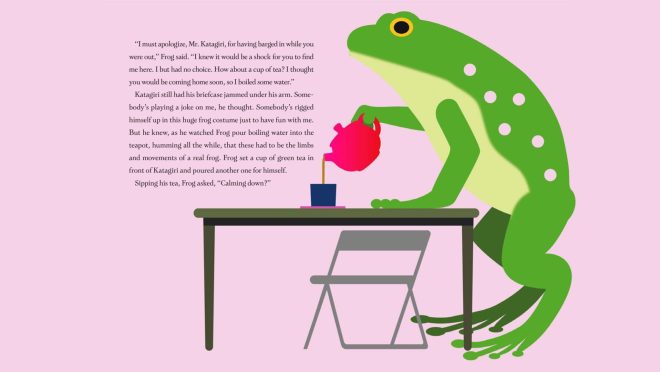
He tells you that you must fight a giant worm sleeping underground, one that will trigger a massive earthquake, and that you’re the only one who can stop it. You’re probably already feeling puzzled and creeped out.
That’s the opening of Haruki Murakami’s short story Super Frog Saves Tokyo, and it left me speechless, staying in my mind for days after I finished it.
It belongs to After the Quake, Murakami’s collection written in the aftermath of the 1995 Kobe earthquake. None of the stories in the collection are directly about the earthquake itself. A newly illustrated edition of Super Frog Saves Tokyo was published in 2025, quickly drawing attention 25 years after the story’s original publication.
Back to the story, its protagonist is Katagiri, a loan officer at Tokyo Security Trust Bank. In the middle of his own quiet midlife crisis, Katagiri is unremarkable by every measure the world uses to notice someone. Few would guess how risky his job actually is; dealing with defaulters and unpaid loans brings him more danger than his ordinary appearance suggests. Then, one evening, in the middle of this mundane life, he comes home from the office to find a giant frog sitting at his table. On top of that, the frog tells him that only Katagiri can help fight the giant worm, stop the earthquake, and save Tokyo.
What struck me was how calm Katagiri stayed through all of it. The frog returns several times, and each time, Katagiri responds with patience, asking careful questions about the fight ahead rather than panicking. There’s a lot more worth discussing here, but I won’t go into it as I don’t want to give away a spoiler. I tried to go beneath the story and tried to find out the true meaning of it. And I discovered that the story wasn’t about the giant frog or the worm, or the earthquake. Murakami never explains whether any of it actually happened.
That’s because the story was never really about them. It’s about our own deep, buried emotions, and how we deal with them. The way I read it, the Worm stands in for anger, jealousy, and pain, all the darker emotions Katagiri carries, while Frog stands in for hope and willingness, the more hopeful parts of him. The earthquake, in that reading, is the outburst of everything Katagiri has been carrying quietly within himself, and the fight between Frog and Worm isn’t really about stopping a disaster. It’s about those two opposing emotions finally coming to a head. At one point, Frog tells Katagiri that their fight takes place entirely in the realm of imagination, and that this is exactly where real battles are won or lost. In one line, Murakami says, “What you see with your eyes is not necessarily real.”
I was personally stunned and unsettled after finishing the story. I reread it immediately and found things I’d completely missed the first time. I did this a few more times, and each read turned up new connections and interpretations. Murakami is one of my favourite authors, and he never fails to amaze me, and this time, it was mesmerising. I’d recommend this story to anyone who wants a way into Murakami’s world without committing to a full novel, or to anyone who wants something that will stay with them long after they’ve put it down.
Lastly, if you’re someone who moves from one stressful day to the next without much of a break, I’d ask you to carve out a little time for yourself, and give some of it to this story. I hope you do.