Before you quote "Cogito, Ergo Sum", know what it actually means
Any chronically online teenager would know what the average performative being looks like. The quintessential post of such a person includes a book, perhaps Atomic Habits, a cup of matcha that tastes like the breath of a cow who feasted on the freshest grass it could find, and a pair of wired earphones.
Before you quote "Cogito, Ergo Sum", know what it actually means
Any chronically online teenager would know what the average performative being looks like. The quintessential post of such a person includes a book, perhaps Atomic Habits, a cup of matcha that tastes like the breath of a cow who feasted on the freshest grass it could find, and a pair of wired earphones.
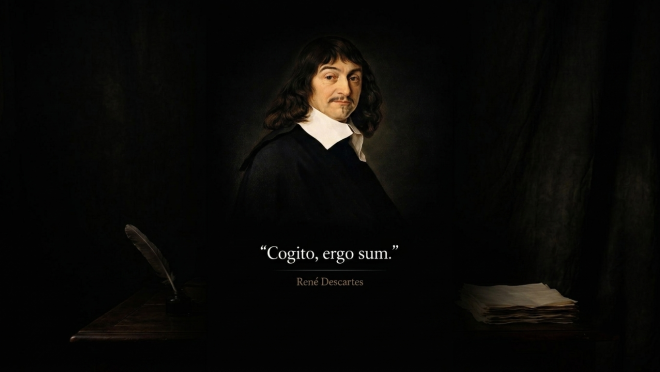
The last nail in the coffin, perhaps one that makes Descartes roll in his grave, is an Instagram bio that goes “Cogito, Ergo Sum”, without the comma in the middle, of course. The famous Descartes quote has always seemed like a beacon of intellectuality, one you could borrow and use in places to make an impression.
The simple interpretation of the quote could easily be that one thinks, so they are important enough to exist, highlighting how important they perceive intellect to be as a trait. However, the actual context behind it could not be further away.
To begin, the centuries before Descartes were plagued with darkness, where philosophy did not thrive much. The darkness was followed by a period that saw incredible development in thought, rejecting old dogmatism and myths. Different branches of thought were established that argued about the true sources of knowledge, such as rationalism, empiricism, pragmatism, etc.
Considered the father of modern philosophy, René Descartes was the founder of rationalism and believed that true knowledge was to be obtained through reason and not by other sources like the senses or experience. He argued that there must be a form of knowledge that was completely certain, one that could not be challenged.
Thus, he went on a journey, doubting everything he had known, questioning every possible thing he could think of in an attempt to reach that certain knowledge. The idea was that, similar to mathematics, there must exist a starting point. When one solves maths, they do it using the things they have learnt before. If you dig deeper, you figure that it is number theory, or the ability to count, that fundamentally builds maths. Life too must have some inherent knowledge which would be its most fundamental element.
The sequence of doubt first started from man himself, or more particularly the senses. While we do use the senses every day in our lives, they do deceive us quite often. The concept of a mirage in a desert or the bending of a stick under water, or perhaps hearing noises that are not really there, are all instances of the senses not showing the truth. Therefore, one could reasonably doubt their senses.
Building on it, his second doubt said that even when the senses are accurate, there could be doubt about the state of being of a person, i.e. he could be dreaming. Sometimes our perceptions are true, such as experiencing interactions with a family member, but it may be that the interaction is taking place in a dream which the person cannot distinguish at that particular moment. We experience our senses correctly, even when we meet someone dead in our dreams, but at the end of the day it is still a dream that we are not aware of.
His last claim was the most bizarre one, which even he understood was bizarre. In his final doubt, Descartes proposes a thought experiment. He argues an extremely artificial hypothesis, saying, what if everything we understood or knew was influenced by an “evil demon”? The essence of this doubt is that if we were to take the idea of deception and take it to an extreme (through the means of a hypothetical evil demon), we could figure that perhaps everything in the world can be doubted. The senses are the most common way one could get deceived, the dream state was a bit rarer and more uncanny, while the evil demon was at the absolute end of the spectrum. This final doubt meant that almost everything seemed uncertain, and no knowledge was really concrete. But was it really as such?
Descartes realised that if everything could be doubted, the only thing that remained was the doubt itself. But for the doubt to exist, there must be a doubter too. The act of doubting needs someone in action. The way the act of speaking needs a speaker, writing needs a writer, doubt needs a doubter. This led to the quote “Dubito, ergo cogito, ergo sum”, translating to “I doubt, therefore I think, therefore I am.”.
This first part is often omitted, but what is left behind holds immense importance in the context. Debates remain on whether René Descartes and his rationalism are the ultimate source of knowledge or not, but it is beyond debate that his theory and the particular quote are absolutely, and quite certainly, timeless. Lastly, I hope this piece contributes to a world where the performative would actually be informed about their performances, instead of wearing their “niche” as jewellery.