How not to behave on a Bangladeshi bus
Bangladesh’s bus transport system is less a mode of travel and more a living, breathing theatre of urban sociology. It is where economics, urgency, improvisation, and human endurance converge under conditions that would challenge even the most disciplined commuter.
How not to behave on a Bangladeshi bus
Bangladesh’s bus transport system is less a mode of travel and more a living, breathing theatre of urban sociology. It is where economics, urgency, improvisation, and human endurance converge under conditions that would challenge even the most disciplined commuter.
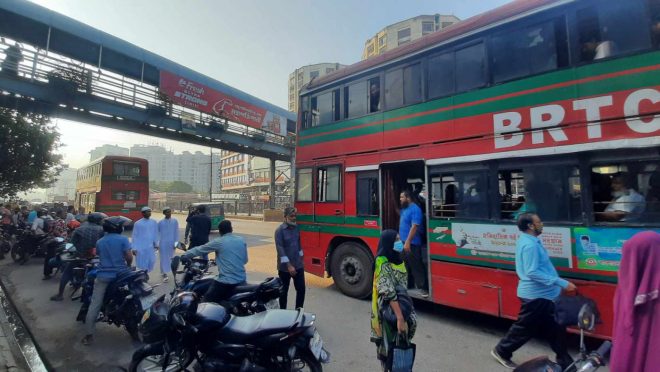
Unlike structured systems such as the Dhaka Metro Rail, the bus network thrives in a space where formal rules exist but are often treated as flexible suggestions. In this dynamic environment, understanding what not to do becomes essential, not merely for personal comfort, but for the collective survival of order in a system perpetually on the edge of chaos.
What follows is a professional yet satirical exploration of the top ten things one must avoid while navigating Bangladesh’s bus transport system.
1. Do not attempt to board with the expectation of personal space
Entering a bus in Bangladesh with the assumption that you are entitled to a defined personal boundary is an early and avoidable mistake.
The concept of personal space, while theoretically acknowledged, is practically suspended at the bus door. The satire here lies in the quiet negotiation that occurs with an unspoken agreement that human geometry is flexible.
Attempting to resist this compression only delays boarding and invites collective impatience. Adaptability, not resistance, is the currency of entry.
2. Do not expect the bus to stop fully before boarding or alighting
A complete halt is often considered an optional luxury rather than a procedural necessity. Waiting for the bus to stop entirely reflects a commendable commitment to safety, but may also result in missing it altogether.
Conversely, attempting to board or disembark without situational awareness can transform routine travel into a high-risk manoeuvre. The deeper irony is that a system designed for movement often demands acrobatic stillness from its passengers.
3. Do not engage in fare negotiation as if it were a diplomatic summit
The interaction between passenger and conductor over fare is a microcosm of informal economics. While clarification is reasonable, prolonged negotiation over minimal differences risks delaying the entire system.
The satire emerges in the disproportionate intensity of these exchanges, where a few takas become a matter of principle. In a moving vehicle with limited patience, efficiency must outweigh rhetorical victory.
4. Do not treat the conductor as an adversary
The conductor operates under constraints that are often invisible to passengers. Pressure to maximise occupancy, maintain speed, and manage payments simultaneously.
Viewing them as an opponent in a transactional battle only escalates tension. While accountability is important, recognising the systemic pressures at play introduces a degree of empathy often absent in these interactions. The bus is not a courtroom, and the conductor is not on trial.
5. Do not block the entrance while contemplating your next move
The bus entrance is a zone of continuous flow, not a space for strategic reflection. Pausing at the doorway to decide whether to proceed, adjust belongings, or survey seating options disrupts the entire boarding process.
This behaviour, though seemingly minor, creates a ripple effect of delay and frustration. In a system where time is compressed, hesitation becomes a collective inconvenience.
6. Do not convert the bus into a platform for acoustic dominance
Loud conversations, phone calls, or unsolicited commentary transform an already dense environment into an auditory battleground. The satire lies in the assumption that one’s narrative deserves universal attention.
In reality, the bus is a shared acoustic space where restraint is both rare and necessary. Volume control is not merely a personal choice. It is a public responsibility.
7. Do not litter under the assumption of anonymity
Discarding waste within the bus reflects a broader cultural detachment from shared ownership. The enclosed nature of the vehicle amplifies the impact of such behaviour, turning minor negligence into a collective burden.
The irony is that passengers often express dissatisfaction with cleanliness while simultaneously contributing to its decline. Responsibility, in this context, is both individual and immediate.
8. Do not occupy more space than your physical presence requires
Placing bags on seats, extending limbs into shared areas, or otherwise expanding one’s spatial footprint disrupts the fragile balance of accommodation. In a system defined by scarcity, equitable distribution of space becomes critical. Generosity is measured not by what one gives, but by what one refrains from taking.
9. Do not assume predictability in routes or timing
Bus transport in Bangladesh operates within a fluid framework where schedules are aspirational rather than fixed. Expecting strict adherence to timing or route precision can lead to frustration. Instead, adaptability becomes a strategic advantage.
The deeper commentary is on the coexistence of structure and improvisation, where uncertainty is not an exception but a defining feature.
10. The bus is not a social institution
Perhaps the most significant mistake is viewing the bus purely as a means of transportation. It is, in effect, a condensed version of society where class, urgency, patience, and resilience intersect. Ignoring this dimension limits one’s understanding of the system. The bus is not merely a vehicle. It is an ongoing negotiation of coexistence.
Bangladesh’s bus transport system may appear chaotic, but it operates within an internal logic shaped by necessity and adaptation. The absence of rigid enforcement does not imply the absence of structure; rather, it reflects a different kind of order, one that emerges from collective behaviour rather than imposed regulation.
In contrast to the engineered precision of systems like the Dhaka Metro Rail, the bus network relies heavily on human judgement and informal coordination. This makes individual conduct not just relevant, but central to its functionality.
By understanding what not to do, passengers contribute, however incrementally, to a more navigable system. Ultimately, the bus asks its users to embrace a paradox, to find discipline within disorder, to exercise restraint in a space defined by excess, and to recognise that even in the absence of formal structure, responsibility remains a shared obligation.