When you find yourself stuck in a tiger’s mouth
They said the test would not last all 5 days. It didn’t. On what could be called the greatest day in our cricketing history, Bangladesh have gone on to not only win, but dominate Australia in their own backyard.
When you find yourself stuck in a tiger’s mouth
They said the test would not last all 5 days. It didn’t. On what could be called the greatest day in our cricketing history, Bangladesh have gone on to not only win, but dominate Australia in their own backyard.
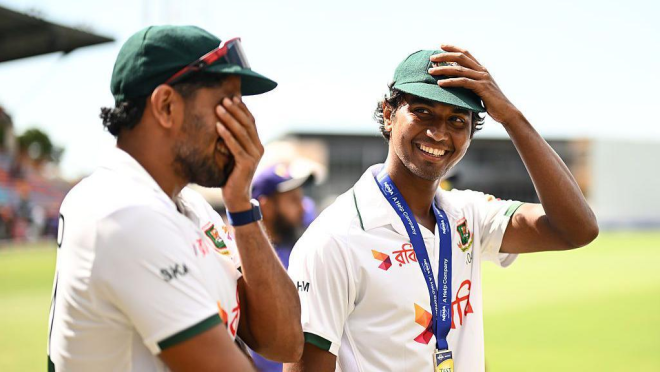
Becoming the fastest Asian team to get their first victory down under, the Tigers had taken the fight to the 5-time World Champions.
For as long as I can remember, one regret that most fans had was never getting to see Bangladesh play in Australia, especially in the whites.
The 23-year wait
An assumption that Bangladesh would not last more than 2 days, maybe the boredom of us playing unattractive cricket, or perhaps the sheer lack of commercial incentive, Bangladesh had not been invited to Australia for the last 23 years. To put it into perspective, Facebook, YouTube, and all of social media, who are currently in awe of this win, by the way, had no existence. That is exactly how long ago the last tour had happened. What is not a part of the traditional Aussie Test summer, the series against Bangladesh is being played in Darwin, a venue which also has not seen Test cricket for 23 years.
The pace bowling battery delivered yet again
One particular aspect of every major Test win for Bangladesh in recent times has been the sheer heart with which the fast bowlers have bowled. Unlike the typical turning tracks back home, the foreign conditions in places like New Zealand, West Indies, Pakistan, and Australia offer rewards for great fast bowling line-ups.
In previous times, it was a sad sight whenever Bangladesh would go for a Test tour overseas, as the opposition batters would toy with them in such conditions. The sights have changed, and the Tigers’ pace unit deserves due credit. It was that initial first-session mayhem by the pace trio that brought the Aussies down to 84/4 at lunch, something they could never recover from. When Pat Cummins was asked where they lost the game, he said, ‘probably that day one’.
Back in June, when Bangladesh whitewashed Pakistan, it was the likes of Nahid Rana and Taskin Ahmed causing havoc late on day 5 of the second Test. When Rana got injured before this tour, the general perception was that Bangladesh had lost their only hope of ‘seeing some entertainment’, not even considering the notion that Bangladesh could dream of winning. But it speaks volumes about the sheer depth of this line-up when a certain Hasan Mahmud comes in from out of the typical XI and takes a nine-fer in his first game down under.
‘O Captain, my Captain’
These lines from the Dead Poets Society echoed in my mind every time I saw Nazmul Hossain Shanto post-win. I still remember that Facebook post in 2023, when he wrote, “These comments are tough for me to digest, but they are even tougher for my family members. They don’t understand these things much, but they get hurt.” But that was in 2023. Now, in 2026, he’s the first captain to beat Australia in Australia, New Zealand at home, and take series wins twice against Pakistan, both away and at home.
No captain in history has achieved 9 Test wins for Bangladesh; none of them have ever scored hundreds in both innings of a Test match either. His crucial 84 settled the innings, putting Bangladesh ahead early on. His decisions have been immaculate too. Despite the availability of veteran Taijul Ahmed, Shanto stuck to the variations of Mehidy Hasan Miraz, who eventually got a fifer.
During the batting innings, Hasan Mahmud was sent ahead in the order for his height and solidity, showing the presence of mind Shanto and the entire team management have shown. Now, he averages 77 in the current WTC cycle, ranking number one in a list that includes Joe Root, Shubman Gill, and Harry Brook. Argue about his game as much as you want, but the stats speak a story.
The Tanzid Tamim and Miraz Show
One recalls the flamboyance of Tanzid Hasan Tamim in limited overs, with those cuts and pick-up shots on the leg side. But Test matches are not a place for flamboyance, or sixes, or your down-the-ground aggression. Tests preach solidity, patience, and most of all, grit. Tanzid had all of it. Batting for 5 hours, his 197-ball hundred was a show of class, a glimpse into the immense talent he possesses. One simply cannot remember a stroke of misjudgement in that innings, except for the delivery he got out to after the hundred.
Having been knocked over for 54 in the warm-up game, the team needed someone to stick right through and lay a foundation, both in runs and confidence. Tanzid dug deep, took blows, and came off with a hundred to his name in only his second Test. The innings was not without his typical flamboyance, though, with majestic down-the-wicket shots over cover against some of Australia’s premium bowlers. That control over his natural instinct to play for the team was remarkable.
Having lost the One-Day captaincy, it was a poor patch for Miraz of late. Amidst growing criticism from fans, Miraz struck a hundred in the warm-up game. What got thought of as a fluke was not really one. The typical Aussie pitch bounces much more than here, which plays into the hands of Miraz, who is a lovely slicer and puller of the ball.
On the telecast, the commentators too spoke of it, how Miraz kept slicing the ball above point, getting boundaries with ease. With the ball, Miraz was consistently hitting the stumps, never letting the batters settle. What was truly noteworthy was the wicket of Steve Smith. The top scorer of the first innings, Smith looked well set and danger loomed above Bangladesh. But Miraz and Co were plotting something completely different. The plan was to bowl at his stumps, and have a silly mid-on and short mid-wicket in place.
With a gap down the ground on the leg side, Smith kept pushing the ball into that leg-side region, stealing singles. It had seemingly become a habit to tap it into that leg-side region. Even the balls pitched slightly wide were being pushed towards the on-side. Only on two instances did Smith play Miraz on the off side, the third ball of over 33 and the fourth ball of over 35.
This reluctance to play on the off side, or the rather comfort of the leg side, led to his eventual demise in the 37th over, when he dragged a wide-ish ball towards the on side again, but never getting the necessary wrists into play, hitting it straight into Miraz’s hand. And that was where we won the game.