Hiring for today is not a strategy. It is a gamble.
There is a particular frustration in the current job market that recent graduates are realising but failing to address properly.
Hiring for today is not a strategy. It is a gamble.
There is a particular frustration in the current job market that recent graduates are realising but failing to address properly.
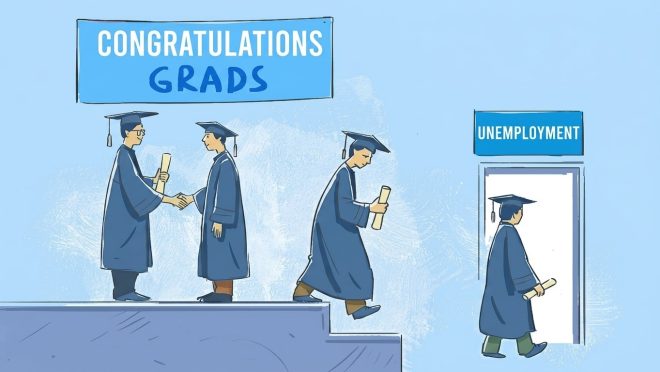
Bangladesh produces millions of graduates and non-graduates every year. Industries need talent too! Yet the rate of unemployment raises many questions that are too severe to ignore now.
The problem is not insufficiency of talent. It is the growing disconnection between industry demands and the skills that our available workforce supplies, which is an inevitable factor in paralysing our national growth in the long run.
For years, this problem has been treated as a secondary concern. Increasing numbers of organisations and new employment opportunities were seen as either an excuse or a ray of hope to shadow the issue. But now, the rise of wasted talent is an open secret. Millions of young Bangladeshis with degrees are now sitting idle with no direction or options.
While industries are evolving faster, our people and policymakers are reacting slower than both. Bangladesh has an immense base of millions of active blue- and white-collar workers in workplaces. The scale of the informal sector is astonishing. The Labour Force Survey 2022 published that 70.47 million were in the active labour force, with 84.9% engaged in informal employment.
But the real problem is that millions of blue-collar workers entered the field without a coherent mechanism to predict what the market will need. This creates a miscalculation for both human capital and organisations. The irony of addressing it as a simple education or training issue from the government is not enough anymore. The rooted fundamental failure of forecasting and nurturing these markets with the right workforce will only delay the inevitable growth Bangladesh expects.
Looking back, Bangladesh functions with a workforce planning system that still reflects the needs of an economy from two decades back. Industries are evolving rapidly. With AI integration, digitisation and data-driven solutions being trendy, the expectations from talent are also changing.
While a new skill demand becomes obvious in industry, universities and training institutions take months after months to align, verify, do pilot projects and then redesign the already proven curriculum. This attempt to play it safe often takes years to adapt to new changes; hence, the talent produced is already late and facing extreme backlashes from industries. Hence, frequent reports of not finding talents ready for jobs became the talk of the town for many industries.
At the heart of the issue lies a simple but consequential question: how well do we understand the future of work?
Planning without a forecast is a little more than an educated guess. Advanced economies regularly collect and analyse the market based on the growth and decline of occupations, skills in demand for the next five years and many more. The process is also known as Labour Market Intelligence (LMI), a practice not quite established in Bangladesh.
Such forecasting answers questions that should already be central to Bangladesh’s development agenda. How many data analysts will Bangladesh need by 2030? How many logistics specialists? How many RMG talents? How many skilled technicians? A good forecast gives both institutions and students clarity. It favours both career decisions for students and investment decisions for institutions.
Bangladesh cannot become resilient by building roads, ports and bridges only. It becomes resilient when the workforce possesses the skills required to maximise the value of those investments. Human capital is every bit as strategic as physical infrastructure, and it deserves the same degree of planning and foresight.
The question is no longer whether Bangladesh can produce enough graduates. The more pressing question is whether it can produce the right graduates for the economy it hopes to build.
The modern-day economy notices the fact that thousands of unemployed graduates exist alongside thousands of vacant positions. The reason is mismatch. Without a stronger connection between Labour Market Intelligence, educational planning and industrial policy, unemployment and talent shortages will continue to coexist. And in an era defined by rapid change, hiring for today’s needs while ignoring tomorrow’s realities is not a strategy. It is a gamble.