The brain was never built to read
You have probably read more words today than your parents used to read in a week. Texts, captions, group chat chaos, a headline you scrolled past twice, a caption under a reel you did not finish watching because another reel was already loading underneath it. By pure volume, you are the most literate person your family has ever produced.
The brain was never built to read
You have probably read more words today than your parents used to read in a week. Texts, captions, group chat chaos, a headline you scrolled past twice, a caption under a reel you did not finish watching because another reel was already loading underneath it. By pure volume, you are the most literate person your family has ever produced.
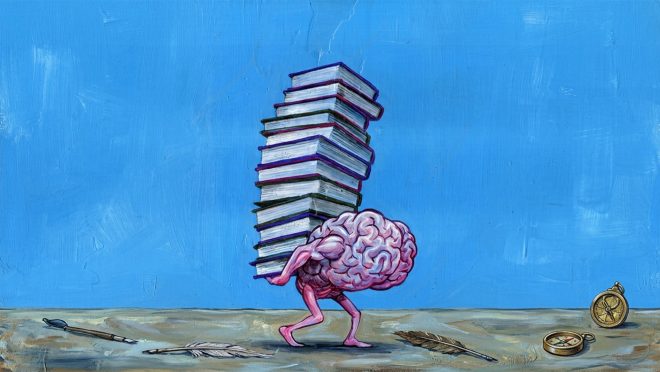
And yet, ask yourself honestly how long you last on a page with only texts and no picture or video before your thumb starts twitching toward something else. Your urge to scroll is not the result of you training your brain to always be on the search for the next possible entertainment. It is your brain doing exactly what it was built to do.
For most of human history, staring at one fixed point for too long was a good way to get eaten. Survival needed scanning, noticing the grass moving, a shadow that should not be there. The brain that kept our ancestors alive was a brain built for constant low-grade vigilance, not for sitting still with a paragraph.
Reading, when you actually think about it, is a strange and unnatural demand we place on that brain. Biologically, there is no reading gene. No dedicated reading organ waiting patiently inside us for the day someone invents the alphabet.
According to the neuroscientist Stanislas Dehaene, what actually happens is closer to a hijack. The brain takes circuits that evolved for spotting prey and recognising shapes in the wild, and it repurposes them, awkwardly, to recognise the shape of letters instead. Every time you read a sentence, you are running old software on a task it was never designed for.
For most of human history, this trick was rare. A skill for scribes and monks and the occasional obsessive. Then it was not optional anymore. And when an entire species was made to run that borrowed circuitry daily, the circuitry changed what the species could do.
For roughly a hundred years, average IQ scores around the world climbed. We sort of became smarter. Not because human genes suddenly improved. Because the environment changed. Mass schooling, mandatory literacy, books, newspapers, and later, dense text-based media, forced entire populations to run that borrowed circuitry every single day, for years, from childhood onward.
The researcher who first tracked this properly was a political scientist named James Flynn, and the trend now carries his name. The Flynn Effect. Roughly three points of IQ gained per decade throughout the twentieth century, driven almost entirely by gains in abstract reasoning, the kind of thinking that has nothing to do with memorising facts and everything to do with holding an idea in your head long enough to turn it over.
Deep reading, in other words, was not just a nice hobby people did before television. It was a century-long workout for a part of the brain that does not build itself.
But then, somewhere in the last twenty years, the bar chart bent the other way.
Researchers in Norway, Denmark, Britain, and the United States have all documented the same pattern. The century of rising scores has stalled. In several places, it has started sliding backwards. This is now being called the Reverse Flynn Effect.
Here is the part that surprises even the researchers who study it. The reversal did not start with TikTok, or even with smartphones. In Norway, where one of the largest studies tracked more than 700,000 conscripts, the decline shows up in men born after 1975, tested in the early nineties, back when the internet was still a dial-up tone and a warning from your phone bill. So whatever broke first, it was not the algorithm. The algorithm just arrived on a slope that had already started tilting.
What has changed more recently, and much faster, is what we do with our reading time once we sit down to it. Americans went from reading for pleasure twenty-eight per cent of days in 2004 to sixteen per cent by 2023, according to a Bureau of Labor Statistics time-use analysis cited by The Atlantic.
The timeline happens to overlap with the rise of the smartphone and algorithmic feed, though the decline itself is a separate story from the one Norway’s conscripts tell. So the honest version of this story is not one straight line. It is two: a slow erosion in the deep-reasoning muscle that started before any of us were born, and a much faster, much newer collapse in the habit of reading itself, one that is very much ours.
This is where the media theorist N. Katherine Hayles offers a useful pair of words. She distinguishes between deep attention, the ability to stay with one thing for a long stretch, and hyper-attention, the habit of jumping rapidly between many things and needing constant novelty to stay interested. Deep attention is what built the Flynn Effect. Hyper-attention is what social platforms are extremely good at feeding, because a brain that never settles is a brain that keeps opening the app.
Notice here how nobody had to teach you hyper-attention? It is a default setting in your brain, something your brain was actually made for. The scroll does not train you into a new skill. It stops asking you to override the old one.
This is not really about how many books are on your shelf. The parts of the brain most dependent on sustained focus, working memory, impulse control, the ability to hold two conflicting ideas at once without collapsing them, are exactly the parts that atrophy when they stop getting exercised. You do not lose them dramatically. You lose them the way you lose the ability to run five kilometres after a year of not running.
So the next time a long article feels unreasonably heavy, or a dense paragraph makes you want to check your notifications halfway through, know that this is not proof you’ve lost your intelligence. It’s just a sign of which circuit you’ve been feeding, and which one you’ve been starving.
Nobody is asking you to throw your phone into the Buriganga and read books only. That is not realistic and it is not the point. The point is smaller and much more manageable: the brain and IQ you have right now are shaped by what you feed them daily, and that shaping is still happening, this week, this scroll, this article, this paragraph.
A hundred years of collective effort pushed human minds toward deeper, slower, more abstract thought. It happened because enough people, enough of the time, chose the harder thing over the easier one.
The hardware inside your skull has not changed in tens of thousands of years. What you choose to run on it, today, is still entirely up to you.