Research on cockroach milk, dirty underwear wins Ig Nobel prizes
Research on cockroach milk, dirty underwear wins Ig Nobel prizes
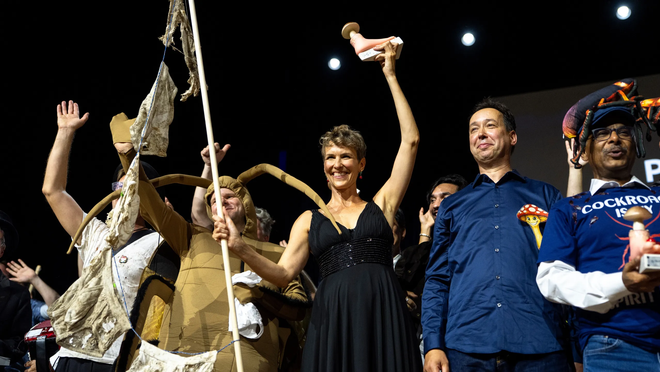
Scientists behind some of the world’s most unusual research have been recognised at this year’s Ig Nobel Prizes, with 10 research teams honoured at a ceremony held in Zurich, Switzerland.
The awards celebrate scientific work that is often humorous or surprising but can still offer meaningful insights. This year’s ceremony was held outside the US for the first time in the event’s 35-year history, amid concerns over travel and visa restrictions.
Among the winning studies was research into cockroach milk, while another team investigated soil health by burying underwear and observing how quickly it decomposed.
Organised by the Annals of Improbable Research, a digital magazine dedicated to unusual scientific discoveries, the ceremony brought researchers together at a convention centre in Zurich. Winners received a distinctive trophy designed to resemble a combination of a mushroom and a human foot.
Researchers from the University of Oxford and the Florida Institute of Technology were among those honoured. Matilda Brindle and Stuart West of Oxford, along with Catherine F. Talbot of the Florida Institute of Technology, reconstructed the evolutionary history of kissing.
The late Dr Tokuji Unno was also recognised for research examining the science behind blowing one’s nose.
Another team took a decidedly unconventional approach to studying soil ecosystems, burying 1,000 pairs of underwear across more than 25 countries. The researchers used the rate at which the garments broke down to investigate the organisms living in the soil and their role in decomposition.
The awards are expected to remain in Europe for the foreseeable future. Organisers plan to alternate future ceremonies between Zurich and other European cities, with Antwerp in Belgium scheduled to host the 2027 event.
The Ig Nobel ceremony was previously held at institutions including Harvard University, the Massachusetts Institute of Technology and Boston University. There are currently no plans to bring the event back to the US.
“During the past year, it has become unsafe for our guests to visit the country,” Marc Abrahams, the ceremony’s master of ceremonies and editor of the Annals of Improbable Research, told The Associated Press in an email in March.
Despite their similar names, the Ig Nobel Prizes have no connection to the Nobel Prizes, which recognise major achievements in science, literature and other fields. The 2026 Nobel Prize announcements are due to begin in early October.