Rare clouded leopard spotted in Cox’s Bazar’s Inani forest, 21 other wildlife species recorded
Rare clouded leopard spotted in Cox’s Bazar’s Inani forest, 21 other wildlife species recorded
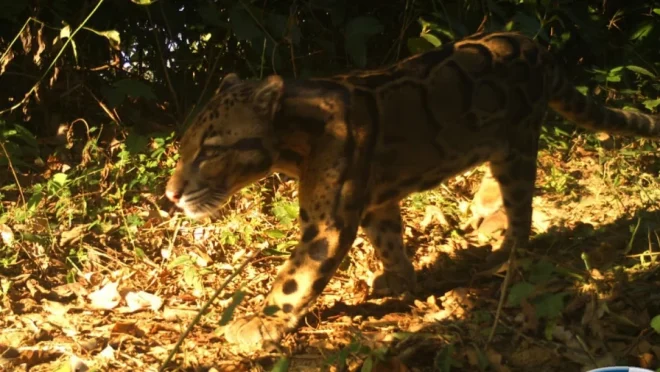
A rare clouded leopard has been captured on camera in the Inani National Park in Cox’s Bazar, marking the first photographic record of the elusive species in a protected forest in the district.
The finding was made during a 13-month wildlife survey conducted from November 2022 to November 2023. Researchers also recorded 21 other species of wildlife in the forest.
The findings were published earlier this month in the international scientific journal Global Ecology and Conservation.
Although clouded leopards have occasionally been reported in the forests of the Chittagong Hill Tracts, they had never previously been photographed in any protected forest in Cox’s Bazar, according to the study.
The International Union for Conservation of Nature (IUCN) considers the clouded leopard critically endangered in Bangladesh and lists the species as vulnerable globally.
Researchers say the discovery offers fresh hope for wildlife conservation in Inani, where forest habitats have come under increasing pressure from human settlements, railway construction and encroachment.
Clouded leopard confirmed
Bipul Krishna Das, director of the Bangladesh Wildlife Center of the Forest Department, said Inani National Park covers 7,085 hectares, with 32 locations monitored using 15 camera traps.
Five images of a clouded leopard were captured by three cameras. Its presence was also confirmed through footprints and faecal samples.
According to the study, wildlife numbers were higher around water bodies and streams.
Researchers estimated that about 3,000 hectares, or 44% of the park, provide suitable habitat for clouded leopards. Dense vegetation was particularly favourable for the species, with about 2,887 hectares of such forest identified in the park.
A clouded leopard rescued from traffickers in Rangamati in 2023 is currently being kept at Dulahazara Safari Park in Chakaria.
21 other species recorded
Besides the clouded leopard, the survey recorded Asian elephants, Assamese macaques, langurs, rhesus macaques, jackals, wild cats, leopard cats, wild boars, crab-eating mongooses, squirrels, deer, bats and several other species.
The research involved the Forest Department, the Department of Zoology at Dhaka University, the Institute of Forestry and Environmental Sciences at Chittagong University, the Department of Zoology at Jahangirnagar University and the University of Göttingen in Germany.
Habitat under pressure
Cox’s Bazar’s forests were once considered important wildlife habitats, but researchers say their condition has deteriorated over the past decade.
Human settlements, the expansion of Rohingya camps, fuelwood collection, illegal logging and agricultural encroachment have put increasing pressure on wildlife habitats.
The study found that areas with heavy human activity or agricultural use had significantly lower wildlife abundance and diversity.
Wildlife researcher Reza Khan said the presence of clouded leopards indicates that parts of Inani National Park still retain a functioning ecosystem.
“The clouded leopard is extremely rare. Its presence in the Inani forest has created new possibilities for conservation,” he said, urging authorities to identify and protect its habitat and halt timber extraction.
He said the forests of Chittagong, Cox’s Bazar and the three hill districts were once connected but became fragmented over time.
As clouded leopards are highly adapted to hunting in trees and rarely descend to the ground, Khan said protecting forest canopies and suitable habitat is particularly important.
The researchers have recommended stopping illegal forest encroachment, protecting streams and canals, establishing buffer zones around the park and involving local communities in conservation efforts.
They warned that without urgent action, the biodiversity and rare mammal species of the coastal forest could face further decline.