China might beat Nasa to return first Mars samples by 2031
According to Hou, microscopic, molecular and isotopic analyses of the samples could provide important insights into Mars’ geology and help determine whether the planet was ever habitable.
China might beat Nasa to return first Mars samples by 2031
According to Hou, microscopic, molecular and isotopic analyses of the samples could provide important insights into Mars’ geology and help determine whether the planet was ever habitable.
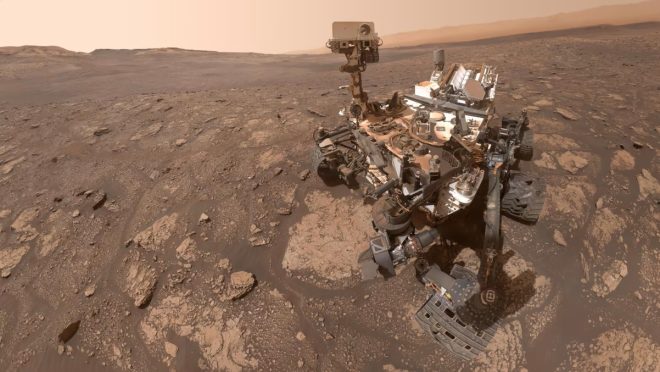
China is aiming to bring about 500 grams of Martian material back to Earth by 2031, potentially beating Nasa in the race to return the first samples from Mars, as the US space agency currently has no clear plan or funding to match the timeline.
The China National Space Administration (CNSA) plans to launch its Tianwen-3 Mars sample-return mission around 2028 using two Long March 5 heavy-lift rockets, the workhorse launch vehicle that has already been used for both of China’s Chang’e lunar sample-return missions.
The rockets are scheduled to lift off from the Wenchang Space Launch Site in Hainan, China’s southernmost province.
The timing is crucial because launch windows to Mars open only once every 26 months. Tianwen-3 is targeting the window from December 2028 to January 2029, leaving little room for delays if China is to achieve its goal of returning samples by 2031.
Five-part mission
The Tianwen-3 spacecraft will consist of five major components: a lander, an ascender, a service capsule, an orbiter and an Earth reentry module.
Finding evidence of life is a key priority of the mission.
Hou Zengqian, chief scientist of Tianwen-3, told state-run news agency Xinhua that scientists will examine the returned samples for microbial traces resembling early life on Earth, while also keeping open the possibility of discovering something more unusual.
Hou made the remarks on the sidelines of the International Deep Space Exploration Conference, an annual gathering in Hefei organised by China’s Deep Space Exploration Laboratory, also known as the Tiandu Laboratory. The conference drew participants from more than 40 countries this year.
Even if the mission finds no signs of life, the samples would still have immense scientific value, Hou said.
“Regardless of whether signs of life are found, the returned Martian samples will have irreplaceable scientific value,” he said.
According to Hou, microscopic, molecular and isotopic analyses of the samples could provide important insights into Mars’ geology and help determine whether the planet was ever habitable.
The mission’s hardware has already entered the prototype development stage.
Hou told state broadcaster CCTV that work on the mission is progressing, with teams across China working to address the various technical challenges involved.
Landing site under consideration
Selecting an appropriate landing site remains another major challenge.
China expects to finalise the site by the end of 2026. In preparation, researchers are developing a next-generation geological map covering the entire planet.
Potential landing sites are being assessed based on several factors, including geological age, evidence of past water, habitability and the likelihood that geological conditions would preserve possible biosignatures.
Bringing Martian material back to Earth will also create a separate and highly complex challenge: ensuring the samples are safely contained.
China plans to establish a planetary protection laboratory during the first phase of Hefei’s Deep-Space Science City, the flagship campus of the Tiandu Laboratory that is currently under construction.
The facility will handle the sterilisation, unsealing and processing of the returned samples, as well as biological risk assessments.
Scientists say the laboratory will follow protocols established by the Committee on Space Research (COSPAR), the international scientific body whose planetary protection guidelines serve as the standard for spacefaring nations.
The protocols are designed to work in both directions — preventing Earth-based microbes from contaminating Mars while also ensuring that any potentially hazardous material returned from Mars remains safely contained.