Watching opportunity pass
Watching opportunity pass
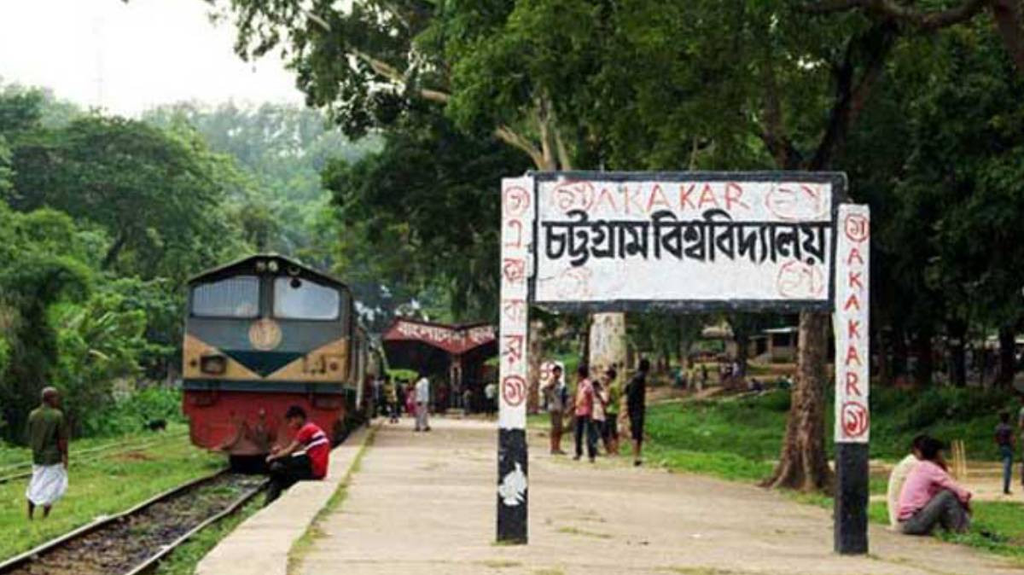
“I see the university train go by here every day, and every time I look at the students through the train window, I can’t help but think: what if I got the chance to study at your university too?” said Rahela after learning that I studied at the University of Chittagong.
She lives in the Jhaotola railway station settlement area, in the heart of Chittagong city. At just 17, Rahela has two children and lacks a stable income to cover her basic needs. She shared how one day she gathered the courage, got on the Chittagong University train, and visited the campus.
Despite never getting a chance to even finish middle school, her eyes sparkled when she described which areas she roamed around on campus. When she said, “I feel good watching your university train going by and sometimes wish I too were on board as a student,” I could not be completely sure what emotions she meant: regret, sadness, or hope flickering deep within those words.
The majority of the girls living in that slum area never had the chance to return to school, were forced to marry early, bear children, take on the responsibility of supporting the whole family, and sometimes face domestic violence. While working with internally displaced people in Bangladesh, we often consider how much their lifestyle has changed from an economic view, and most of the time, in search of a better livelihood, the man of the family moves to the urban area, along with their family.
Of course, they face immense pressure to find a livelihood, and the jobs they later do in urban areas are not sufficient to afford their basic needs; however, women’s struggle in an alien setting remains hidden.
I had a long conversation with her after that. She described how unsafe their lives are in those slum areas. After sundown, when most urban houses prepare for evening snacks, a different kind of evening rush begins for the families down the narrow lanes of the slum. Mothers call out to their young girls, “Inside quickly, before the dark settles,” to protect them from the creeping darkness outside.
Since they do not live in any community setting but are adjacent to a rail line, the area is completely vulnerable to girls’ safety. Women living in that area feel unsafe to go outside at night, as they have no means to protect themselves from an assailant outside. They live in such a condition that fits more like an episode of a survival thriller than a normal, mundane life where living space feels like a home.
A study by Young Power in Action in Chittagong revealed that 25–30 percent of people living in slum areas are climate refugees. One would think that once climate-displaced families relocate to urban areas, they no longer have to worry about being trapped by floodwater. However, this is not always the case.
Most slum settlements lack proper drainage systems, and houses are often built at ground level rather than on raised foundations. As a result, water accumulates during the rainy season, leaving residents at risk of temporary waterlogging and restricted mobility. Despite these conditions, they still have to leave their homes for work and daily household responsibilities. Children are particularly vulnerable, as prolonged exposure to stagnant and contaminated water increases the risk of waterborne and skin diseases during the rainy season.
Rahela is one of thousands whose displacement has taken place without an international border. Bangladesh is one of the countries most exposed to climate-related displacement. Rising sea levels, river erosion, cyclones, floods, salinity intrusion, and increasingly unpredictable weather are pushing families to abandon places where generations have lived. For many, the journey ends not in another country but in the crowded margins of cities such as Chattogram and Dhaka. The city becomes a refuge of sorts but not necessarily a safe one.
This is the paradox of climate displacement within the country. People can lose their homes without crossing a border. They remain citizens of the same country, speak the same language, and live under the same laws, yet losing their land, livelihood, and community can transform their lives as profoundly as any international migration. Their displacement may be invisible on a map, but its consequences are deeply visible in the settlements where they eventually arrive.
In response, our displacement strategy calls for durable solutions, including housing, land rights, livelihood recovery, and protection from arbitrary eviction. The 2021 National Strategy on Internal Displacement Management promises employment support and skills training for people forced from their homes by disaster. The National Adaptation Plan 2050 sets urban resilience for climate migrants as one of its stated priorities.
The Delta Plan 2100 and the newly adopted Population Policy both build climate-driven migration into the country’s long-term thinking. In Mongla, the government has set up a model town, and in Khurushkul, the largest climate rehabilitation centre for climate migrants. NGOs and INGOs are also working towards reintegration by teaching them new skills. However, such initiatives have yet to reach most climate migrants living in slums in the country’s two biggest cities, Dhaka and Chittagong.
Currently, nearly 5 million people in Bangladesh are displaced by climate-related disasters, as revealed by IOM displacement tracking, a figure the World Bank projects could rise to 13.3 million by 2050. Roughly 2,000 new migrants enter the capital city daily, and many of them are climate migrants. A recent joint study by the Bangladesh Women Workers Center and Change Initiative found that half of the people now living in Dhaka’s slums had come there after losing their homes or livelihoods in cyclone-battered districts like Barisal, Noakhali, Bhola, Khulna, and Satkhira. Ninety-three percent lost their livelihood entirely, and only one in ten has managed to find formal work since.
The rest get by on what the city’s informal economy offers on any given day: a rickshaw fare, a day’s labour, a few hours of domestic work. In Dhaka’s Kalyanpur slum, families live in tin-roofed rooms barely fifteen feet across, five or six people to a room, the heat pressing down through metal walls that turn each afternoon into something close to an oven. Water runs when it runs. Gas is more rumour than utility.
It is not so different from the settlement where Rahela lives, back in Chattogram: the narrow lanes, the makeshift shops, the sense of a life built entirely out of what was left over after everything else was lost. This is the space where the policy and the person stop meeting. The Strategy speaks of employment creation. The Plan speaks of urban resilience. But Kalyanpur was not built by a government resettlement scheme, and neither was Rahela’s rail-line settlement in Chattogram. Both grew, instead, out of what researchers dryly call the “informal housing market”, a term for what happens when a family arrives in a city with nothing, and no one is there to meet them.
As I left Jhaotola, the University train passed by the settlement. For the people living beside the tracks, the sound of its arrival has become part of everyday life, one more reminder of a world moving forward while they remain where displacement left them. Rahela will probably continue to watch it pass. She may never know whether what she felt that day was regret for the education she lost, sadness for the life she never had, or hope that somehow survived everything she had been through.
But perhaps that uncertainty is what displacement looks like in Bangladesh. Losing a home does not always mean crossing a border. Sometimes it means arriving in a city without a place to belong, finding work without security, renting a room without knowing how long you can stay, and watching opportunities pass by from the other side of a window.
The train keeps moving, and so does Rahela.