Does language matter?
Does language matter?

Symbolic interaction is a theoretical approach given by George Herbert Mead that specifically identifies the role of symbols and language as fundamentals of all human interaction. It focuses on a limited-scale context of interactions between individuals.
Mead believed individuals tend to change according to their interactions with objects, events, ideas, and other people, and they begin to allocate diverse meanings to things so as to decide how they act. Language is not only about alphabets and grammar. It is about means of life, viewing the world through our own linguistics. It passes the self-consciousness to uphold individuality.
One’s mother language shapes confidence, a sense of self, as at the end of the day that particular language is how we understand the world and its components. The Ministry of Religious Affairs of Bangladesh leveraged language and attempted a socio-religious intervention in 2015, where Arabic calligraphy of anti-urination quotes was written on public walls. Afterwards, where it was seen that urinating on the walls was frequent throughout the day, those same people halted on the spot before urinating in that place after noticing the Arabic letters. This initiative was only helpful to some extent in pausing this public nuisance.
We, as students of SOC101 at BRAC University, have been working as a group to use language, specifically Arabic, to observe how it modifies people’s behaviour. The problem we’re targeting here is public urination. Now to get into it, we need to provide some context behind the root causes of this issue.
The context
For such a densely populated area, Dhaka does not have enough public toilets, as for the pre-existing ones, they are not located near areas where people spend most of their time, for instance, major commuting routes, markets, workplaces and so on. Moreover, poor maintenance and unhygienic conditions often discourage people from using them. Our team interviewed a few rickshaw pullers who were just observed urinating on the streets, and their main issue that they pointed out is accessibility.
Walking long distances is particularly more inconvenient for people who work outside, for example, street vendors, transport workers and such. When our research team asked two rickshaw pullers, Mr Mokhles and Mr Billal, about public toilets around them in Mohammadpur, the first person noted how there are public toilets indeed, but the number is so small and sometimes, because of that, the location of public toilets can be far from him, and the latter said the number of public toilets is zero around him. He also said that the last public toilet he saw was five years ago, and that public toilet’s condition was not hygienic enough to use.
They both mentioned that the lack of public toilets results in, for some, the location not being convenient or not having the chance to use one. It was said by the Executive Director of the Institute for Planning and Development that 200 public toilets are not enough for a megacity like Dhaka. Whereas, those which are available are also lacking in facilities. As a result, in a lot of cases it was seen that in a public toilet that was already built, later there was no surveillance about whether it is working properly or not. For example, public tissues and hand soaps or hand washes are not available for use in almost all public toilets. Additionally, those available public toilets’ water taps, doors, windows, mirrors and other commodes are broken, and there are no facilities for those with special needs.
What’s causing this
Moving forward to economic barriers, public toilets have a service fee which usually ranges from Tk5 to Tk15. Such a fee is often a huge amount for those with a low income, in which case they prefer the streets over a formal toilet. Moreover, the middle-class worker has more access to toilets through malls, workplace toilets, private buildings, etc., which is more than a low-income commuter who has little to zero options. It is not that people merely choose to pee outside; they often have access to less safe and hygienic toilets.
This issue has a gendered dimension as well, as women experience additional difficulties due to privacy, harassment, inadequate female-specific facilities such as menstrual products, lack of female attendants and poor lighting. Women’s access to public sanitation is limited, along with their freedom of movement within the city. Public urination in Bangladesh is the visible consequence of overpopulation, capitalist neglect and decades of poor urban planning converging on a population that lacks the infrastructure to do otherwise.
In the current state of Dhaka, the behaviour persists despite widespread public awareness of its health risks. NGO interventions through WASH campaigns have proven largely ineffective, as constructed facilities are abandoned once project funding ends and no systems exist to maintain water connections or operational budgets. Hygiene education cannot function as a solution when the structural and economic conditions required to act on that education simply do not exist, and the capitalist framework that benefits from an impoverished working class offers no meaningful incentive to change this reality. Normalisation of public urination is one of the most critical behavioural issues.
They can become accustomed to the behaviour if it is repeated without strong consequences. The sequence of normalising follows repeated exposure to public urination which people get into the habit of seeing. Because of that exposure, social reaction decreases, leading to conditions of informal social pressure declining.
The existence of a law does not automatically guarantee compliance. Even when public urination is legally prohibited and penalties exist, the effectiveness of the law depends on whether it is actually enforced. Law exists and it is enforced. People perceive a realistic possibility of punishment, leading to the expected cost of violating the law increasing. Thus, such behaviour may decrease. If enforcement is inconsistent or rare, people may perceive the probability of punishment as extremely low. Consequently, the law loses some of its deterrent effect. Therefore, the problem is not simply whether a law exists, but whether there is sufficient institutional capacity and willingness to enforce it.
However, the question is who should be held responsible for clearing the streets of trash. It could be the responsibility of city corporations, local government, sanitation authorities, facility operators, private contractors and other institutions. Building a toilet is just the initial process. The facility needs to then be cleaned, supplied with water, illuminated, repaired, monitored and kept safe. These responsibilities, if not delegated and managed, can lead to gradual unfitness of facilities. Hence, the public urination issue may be perceived as an institutional accountability and governance issue.
Public serving
We wanted to look into how language plays a role in this particular issue through our very own short film. With a brief meeting, we decided our location, Mohammadpur, on the walls of Dhaka Residential Model College. We observed multiple walls not just near DRMC but also around Kishaloy Girls School near DRMC. A lot of these walls contained symbols, not just religious ones such as verses from the Bhagavad Gita and the Quran, but also the inspiring murals of the July uprising. Despite the symbols, a lot of these walls were worn down from urination and waste disposal.
Within a week, we got to buying painting supplies, and with our media and videography crew, we shot some scenes, interviews of the locals and how the calligraphy went down. Some interactions with locals showed valid concern, expressing how the area remains chronically unclean in spite of multiple symbols and how our work here might go to waste. On the other hand, the writing crew were discussing whether our work here would have a real impact or not. Is this an absolute solution or rather one with many limitations?
We would be lying if it was said that Bangladesh isn’t a country with the majority of the population dominated by Islam; however, it can be noted that the majority is definitely not literate when it comes to Arabic. Therefore, the Arabic signage may be resented or misinterpreted as being inappropriate, especially when used on such worn-down walls.
Such public display can possibly lead to greater controversies surrounding religion and cultural identity. One noteworthy limitation, which has been observed not just on the wall we’ve written on but also on other public property, is that the problem seems to have been relocated elsewhere. A study in Dhaka found that individuals would strip off the paint and would still be using some of the sites. As seen with the Arabic calligraphy on trees near Shongshod Bhobon, people have since erased the messages to continue their misdoings. Similarly, people have been observed avoiding our marked wall, only to urinate on a different spot.
Therefore, we can say that this approach is merely a symbolic deterrence strategy to change individual behaviour; nonetheless, it most definitely has not directly solved the underlying causes of the issue in the first place, such as lack of public toilets, poor maintenance, inadequate water supply, weak enforcement and so on.
Solution?
Obviously, the most basic solution for the problem is simply to build more toilets, not just install a number of toilets and sanitation centres but install them where people genuinely need them, for example, in clusters around heavily visited public places such as bus stops, markets, transportation hubs, etc., making it not just available, but also usable, with proper facilities and utilities (soaps, lighting, ventilation, etc.) for the benefit of the people.
Access for the people should be affordable or likely free, as low-income workers shouldn’t be devoid of the facilities because of the sewerage costs, and installations should be gender-inclusive, ensuring a proper, secure and clean environment for women with provisions set for menstrual hygiene products. User behaviour in the areas should be studied to make informed decisions about the establishments, such as opening hours, locations, cleanliness standards, and maintenance. For the writings, clear Bengali messages should be used instead of Arabic or other languages, to communicate with the public, not to manipulate them, and for the public coordination and the establishment of the system, the promised infrastructure should be present, not just the fines.
Laws and fines may be helpful, but they should follow reasonable alternatives. If it is a fine, it should be done for the correct reasons. The public urination problem in Bangladesh shows that it is not possible to change social behaviour by altering signs and enforcing rules. The government’s campaign of Arabic signage is a good illustration of the power of a symbol; it tried to change the meaning of a wall and in doing so it tried to change their behaviour.
The campaign is also an example of the possibilities of symbolic intervention; however, sanitation systems continue to be far away, costly and unavailable or in disrepair, and social norms remain the same. From a symbolic interactionist point of view, sustainable change not only needs to be accompanied by the reconstruction of social meanings but also by the transformation of the social context in which these meanings are created, namely the everyday environment.
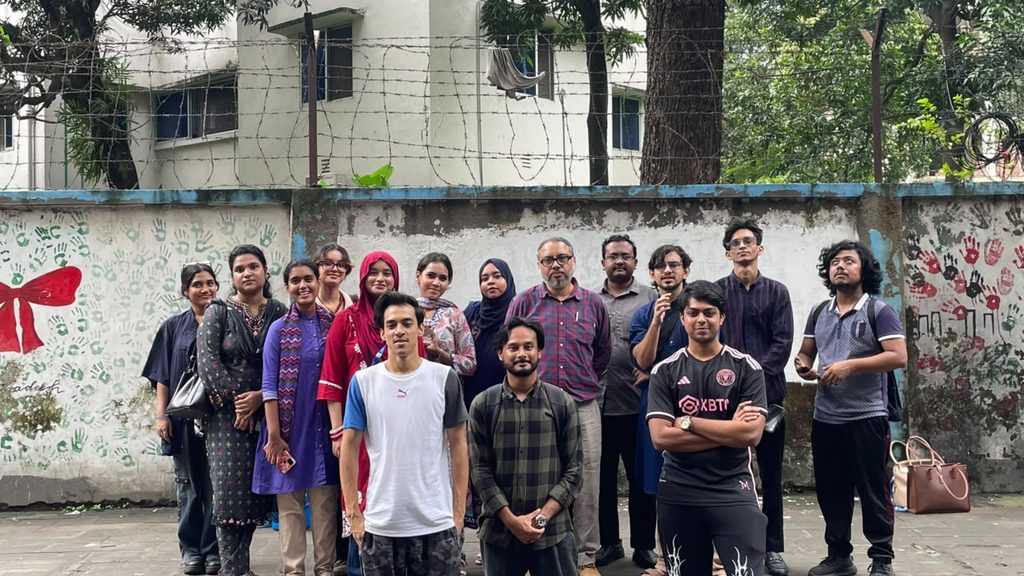
The piece was written and researched by Anisha Nawar Reaz, Apurbo Chakrabarty, Ayman Aiden, Fabliya Jannat, Jawid Pazhwak, Muhammad Shamsuzzoha Ifthi, Nabiha Tahsin, Raihan Rahman, Sara Taskin and Yasmin M.