Rethinking Bangladesh’s growth story: Labour market challenges and the future of work
Despite decades of economic growth and improvements in human development, Bangladesh continues to struggle to create enough productive and formal jobs, leaving much of its workforce in informal employment and limiting the gains from its demographic dividend
Rethinking Bangladesh’s growth story: Labour market challenges and the future of work
Despite decades of economic growth and improvements in human development, Bangladesh continues to struggle to create enough productive and formal jobs, leaving much of its workforce in informal employment and limiting the gains from its demographic dividend
Bangladesh’s development story presents a striking paradox: steady economic growth has not been translated into equally strong labour market outcomes.
Persistent skills shortages, widespread informal employment, child labour, and rising underemployment point to a disconnect between economic growth and the creation of productive and decent jobs.
These challenges also raise concerns about the country’s preparedness for the future of work and its ability to translate economic progress into inclusive and sustainable development.
The broader development record has nevertheless been remarkable. Since the early 1990s, the economy has grown by an average of about 5.6% annually, alongside substantial reductions in poverty and improvements in human capital and living standards. Between 2010 and 2022, extreme poverty fell from 12.2% to 5.6% and moderate poverty from 37.1% to 18.7%.
Health and education outcomes also improved considerably, with life expectancy rising from 62.05 to 74.27 years, infant mortality declining from 59.8 to 24.4 per 1,000 live births, and primary and lower-secondary completion rates reaching nearly 97% and 76.53%, respectively. This progress has coincided with a favourable demographic transition.
In 2023, Bangladesh had a population of 171.7 million, of whom 120.62 million were of working age. The working-age population is projected to reach nearly 70% of the total population by 2030, after which the dependency ratio is expected to rise. Bangladesh therefore has a narrowing window to realise its demographic dividend.
Several labour market challenges constrain Bangladesh’s ability to capitalise on this demographic potential. In 2023, nearly 39% of the working-age population remains outside the labour force. Female labour force participation was only 41.55%, compared with 80.67% for men. Youth unemployment has averaged around 8% over the past decade, while 18.9% of young people are not in education, employment or training.
Significant gender and spatial disparities also persist; male youth unemployment is more than twice the female rate, while rural youth unemployment is more than twice the urban rate. Together with weak migration governance, rising child labour, and limited preparedness for the Fourth Industrial Revolution (4IR), these patterns indicate substantial underutilization of Bangladesh’s human resources. Unless addressed, they could increase the risk of Bangladesh falling into a middle-income-country trap.
These labour market outcomes reflect both demand- and supply-side constraints. On the demand side, structural transformation has not generated sufficient productive and formal employment, contrary to the conventional expectation that workers gradually shift from low-productivity agriculture to higher-productivity industry and services.
Although agriculture’s share of GDP fell from 30.5% in 1990 to 11.2% in 2024, the sector still accounted for 44.42% of total employment. More than 70% of the population and about 87% of the rural population depend directly or indirectly on agriculture for their livelihoods.
Meanwhile, formal employment increased only marginally in services and declined in industry, while informal employment accounted for 84.1% of total employment in 2023. This suggests that structural transformation has not been accompanied by a corresponding transition towards formal and high-productivity employment.
This pattern is particularly striking for women. Contrary to the prediction of the feminisation U hypothesis (a country’s female labour force participation follows a U-shaped curve as its economy develops), structural transformation in Bangladesh has increasingly shifted female employment towards agriculture rather than industry and services. Between 2013 and 2023, female agricultural employment grew by an average of 3.9% annually, while female employment declined annually by 6.3% in industry and 2.5% in services.
Women now constitute nearly 75% of agricultural employment, but only 8.86% of industrial and about 17% of service-sector employment. Female self-employment also increased more than fivefold over the decade, while male self-employment declined. This growing feminisation of agriculture and self-employment partly reflects limited formal opportunities, alongside skill mismatches, child and elder care responsibilities, workplace discrimination, inadequate transportation, and persistent social norms.
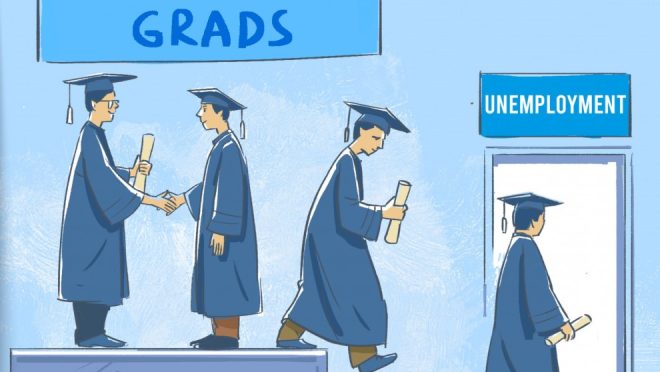
On the supply side, the mismatch between education, skills and labour demand compounds these structural weaknesses. More education does not necessarily improve employment prospects in Bangladesh. In 2023, unemployment was highest among tertiary graduates (13.11%) and lowest among those with primary or no education (2.61%), with the disparity particularly pronounced among women.
The simultaneous rise in graduate unemployment and decline in unemployment among the least educated points to an education-employment paradox: education expansion has not been matched by either sufficient skilled-job creation or the development of market-relevant skills.
The RMG sector illustrates this paradox. Bangladesh’s largest manufacturing industry and leading source of export earnings continues to rely heavily on low-skilled workers while facing shortages in mid-level managerial and technical skills. Similar skill constraints could weaken the competitiveness of international migration, the country’s second-largest source of foreign exchange earnings. With around 2.4 million new entrants joining the workforce each year, aligning skills with labour-market demand is becoming increasingly urgent.
This skill mismatch has roots throughout the education system. MICS 2019 found that more than half of surveyed children aged 7-14 lacked basic reading and related foundational skills, and inadequate facilities further weaken job readiness. These supply-side weaknesses are reinforced by demand-side constraints, including slow formal job creation and limited employer investment in training and apprenticeships.
Access to such opportunities is particularly limited for women and economically disadvantaged groups. Addressing the mismatch therefore required improving the quality and labour-market relevance of education rather than simply expanding access.
Stronger foundational learning and cognitive development at primary and secondary levels must be complemented by tertiary education that develops technical, higher-order cognitive and sociobehavioural skills. Preparing workers for the future of work requires an integrated approach linking education, skills development, employer demands, and changing patterns of labour demand.
Bangladesh’s central labour market challenge is therefore not simply creating more jobs, but creating productive, formal, inclusive, and future-ready employment. Greater coherence between education and skills policies, labour market institutions, migration governance, social policies, and the country’s broader development strategy will be essential to translate Bangladesh’s economic progress and demographic dividend into sustainable and inclusive development.
Farzana Munshi is Professor of Economics at BRAC University, Bangladesh, and Professorial Research Fellow at the Global Development Institute (GDI), University of Manchester.