The students who keep coming back to the streets
Every year on 17 September, Bangladesh observes Education Day.
The students who keep coming back to the streets
Every year on 17 September, Bangladesh observes Education Day.
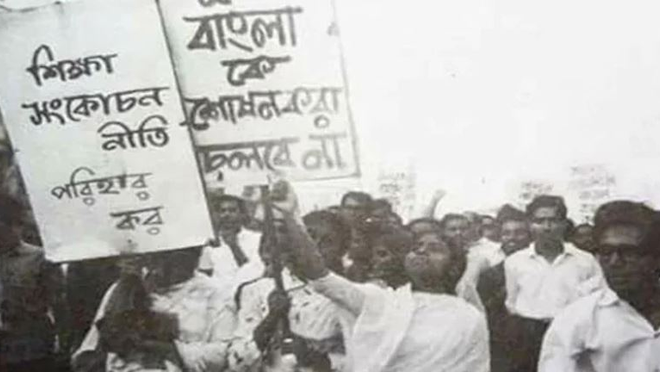
The day became significant in 1962, when this country was still East Pakistan. The Ayub Khan government brought in the Sharif Commission, a report that wanted to shape education around the state instead of the student and push Bangla, our language, out of the classroom.
The students did not accept it. Resistance built through the early sixties into a full movement of hartals, hunger strikes and colleges across Dhaka joining hands. On the morning of 17 September, students picketed from dawn, ministers’ cars were set ablaze and police opened fire near Abdul Gani Road, which resulted in the killing of a school student, Babul, a bus conductor, Golam Mostofa, and a domestic worker, Waziullah. Historical accounts also identify Babul, Mostofa and Waziullah among those killed during the movement.
Not all of them were students, yet they gave their lives for an education that belonged to the people, not to a dictatorship.
That is where 17 September comes from. From blood on the street.
What strikes me most is that even then, when this land had a different name, the students were already united. They did not wait for a flag to tell them when injustice was injustice.
And that spirit never left. The same blood that ran through the students of 1962 seems to run through us too, passed down from generation to generation, waking up when this country needs it. When we are talking about this blood, this spirit, we have to acknowledge the sacrifice of some of the movements of that spirit belonging to our generation.
2015: Protest for VAT against education
In 2015, the government slapped a VAT on tuition fees of private universities. Students, after a really long time, came out in numbers nobody expected. On 9 September, police opened fire on protesting students of East West University, and this led to outrage spreading across campus after campus, blocking roads all over Dhaka for days. On 14 September, the cabinet withdrew the VAT.
Students who were never supposed to have political weight had forced a government to reverse itself. Now, thanks to the movement, we do not pay that VAT anymore.
But why is education still this expensive?
2018: Protest for road safety
In July 2018, two school students were killed on Airport Road when a speeding bus, racing another for passengers, ploughed into a bus stop. This horrifying accident and the lack of justice led school children, some as young as fifteen, pouring onto the streets. They started checking driving licences themselves and organising traffic better than the police ever had.
I remember the slogan that roared on the streets of Dhaka, “police kar cheter baal”. This generation was raw and real from those times. The most memorable event of that movement must have been the students near Newmarket managing that intersection themselves. The traffic of that road became clean for the first and only time. Soon, a new law was pushed through.
But are the roads safe now?
2024: Protest for reformation
Then came 2024, over something as procedural as a quota system for government jobs, a colossal reform movement took place that shuddered the country. When the High Court reinstated a 30 percent quota for freedom fighters’ descendants in June, students began peaceful protests over merit being pushed aside. This was not the first time a quota reform movement was started by the students, though.
By July, it had turned into blockades nationwide, and after the prime minister called them the children of Razakars, students turned that insult into a chant that shook the streets. It turned violent in a way none of us were prepared for. What happened after that is still fresh in our hearts. Well over a thousand people, most of them students, lost their lives before it ended.
All the bloodshed aside, the Dakat watch nights were probably the most iconic parts of the movement for me. Nobody slept properly, taking turns, keeping watch, checking on each other room to room, because that was the only safety left, each other. Strangers who had never spoken before suddenly knew each other’s names, a whole generation becoming family because we had no one else.
The quota system was reformed, and the government that ordered the killings fell.
But are we safe now, or did just the names at the top change?
We, the students of this country, can do almost anything if we decide to. We have brought governments to a standstill, forced laws, taxes withdrawn, prime ministers to resign. When we come together, nothing feels impossible.
But then we win, or we lose, the moment ends and we go home.
We stop checking on each other, stop showing up, until the next time something breaks badly enough to pull us out again. Why does it take a national movement for us to demand what should be checked on every single day anyway? Why do we need an Education Day to remember that education should be fair, when that should be asked all year round? Why do we need a July Movement Day to remember what we fought for?
Sacrifices of precious lives are being honoured through the display of study tables inside random museums.
How baffling!
Shouldn’t every day be a day worth fighting for? Not in the sense of facing bullets daily, nobody is asking for that, but in the sense of not letting go of the crisis that passes.
Maybe the real question this Education Day should leave us with is not what we already fought for, but why we stopped fighting for the day after.