The YES Programme: Your ticket to that American dream
Almost every teenager has imagined themselves living out that whole American high school life you’ve only ever seen in movies.
The YES Programme: Your ticket to that American dream
Almost every teenager has imagined themselves living out that whole American high school life you’ve only ever seen in movies.

While people put that away as a daydream and move on, there’s actually a program that turns it into something real, and it costs nothing. Yes, we’re talking about the YES programme.
With this year’s deadline approaching fast (23 September), I talked to two alumni, Musfirah and Maria, who got in, lived the dream, and came back with a full book’s worth of advice for anyone thinking about applying next.
What YES actually is
YES stands for the Kennedy-Lugar Youth Exchange and Study Programme, a fully funded, merit-based exchange run through the US State Department. Selected students spend a semester living with an American host family and attending a local high school. You don’t choose either one. The programme places you.
Financially, it covers almost everything. Flights, host placement, school enrolment, insurance, and orientation are handled. What lands on the applicant’s side is a passport if they don’t already have one, immunisations, and the occasional small cost that comes up along the way.
To even apply, applicants need to be between 15 and 17 by the program’s start date, with a date of birth falling between January 15, 2010 and January 15, 2012. They have to be currently enrolled in grade 8 through 11 at a Bangladeshi secondary school. Private schools and coaching centres don’t count.
Applicants also need to maintain at least a B average with no failing grades during the last three academic years, with no gap year or repeated year anywhere in that stretch. Dual citizens and permanent residents of the US or any other country are ineligible. So is anyone whose parent works for the US Embassy or Mission in Bangladesh, anyone who has previously applied for US immigration through a relative, and anyone who is a sibling of a past YES participant.
None of this requires a standardised English certificate like IELTS or TOEFL. What it requires is enough spoken and written English skills to get through interviews and an in-house test, which is where ELTiS comes in.
Hearing about it in the first place
Musfirah’s English teacher at Tejgaon Government Girls’ High School mentioned it to her in seventh grade, and she was the first person from her school or area to ever go through it. Maria heard about it in 2019 when a senior at Government Mohammadpur Model School and College got selected, by which point three students from her school had already gone through the program ahead of her.
Their reasons for applying were completely different. Musfirah frames it almost as a personal rule: grab whatever opportunity comes your way. Maria’s reasoning was more specific, a childhood image of American teenage life pulled straight from movies, paired with the appeal of getting to represent her country while living it.
Stage one: the preliminary application
This is the entry point, and it runs through iEARN-Bangladesh’s website. The form itself asks for straightforward information: your name, date of birth, contact details, parents’ information, and your school’s information. Alongside it, you upload scanned documents: a birth certificate, a passport if you have one, and academic transcripts covering the current year and the two before it.
Once the form is filled out, you review everything, download the completed application, get a parent’s signature on it, scan that signed copy, and upload it a second time. That’s what actually counts as your finished preliminary application.
Maria’s advice here is almost entirely about precision. Check your own name and date of birth twice. Make sure your contact information and school details are correct before you hit submit. Keep every scanned document clear and legible. And don’t leave the signature step for the last night, because a rushed scan or a missing signature at the deadline can undo an otherwise solid application before it’s even been read.
Stage two: the phone interview
If the preliminary application clears, you get a call. It’s short, somewhere between three and five minutes, and it’s conducted entirely in English. The point isn’t depth. It’s whether you can listen, respond, and hold a conversation with reasonable confidence under a bit of pressure.
Expect questions about Bangladesh itself, its districts, its culture, things a fairly informed teenager should know. But Maria makes a point of saying the interview doesn’t stop there. She was also asked to describe a recent difficulty she’d faced, and she wasn’t really prepared for these types of life-related questions. Her advice is to prepare on two fronts at once: know your country, but also know your own life well enough to talk about it without stalling. Musfirah was interviewed and she describes the tone as testing listening, speaking, and general confidence more than any specific content.
Stage three: ELTiS and the in-class essays
This is where the process gets technical. ELTiS, short for English Language Test for International Students, is done on a computer and splits into two parts: a listening section, around 30 minutes, and a reading section, around 45 minutes. The listening portion plays conversations or short descriptions and asks questions based on them. The reading portion tests comprehension along with basic grammar and word usage in context.
Then comes the in-class essay component, done by hand with pen and paper under a strict clock. Musfirah wrote three essays with 15 minutes allotted to each. Maria remembers the same three-essay structure, roughly 45 minutes total, and two of her actual prompts have stuck with her: one asked her to describe a time she faced a challenge and identify the personal quality that got her through it.
The other asked about a time she had to ask for help while trying something new, which she answered with a story about joining her school’s handball team with no prior experience and turning to her coach and teammates.
Musfirah describes the essays more generally as a test of leadership and quick thinking on paper, and both her essays drew from her own school experiences.
The advice they shared on this stage is: Don’t memorise sample answers from past applicants as prompts vary year to year and person to person. Don’t chase impressive vocabulary at the expense of clarity. Read the actual question carefully, take a second to organise your thoughts, and answer precisely what’s being asked rather than what sounds good. When describing an experience, don’t stop at what happened; explain how you handled it and what you took away from it, and keep an eye on the clock so you’re not polishing one essay into perfection while two others sit half finished. Above everything else, don’t try to guess what YES wants to hear and write toward that instead of the truth.
Stage four: the final application
Clearing ELTiS gets you into a much bigger form. This one asks for detailed information about you, your family, your school, your interests, and your extracurricular involvement, along with written sections that go deeper than the preliminary form ever did. There’s a letter addressed to a host family you haven’t met yet. There’s a stack of additional forms, some requiring both your signature and a parent’s. There’s a lengthy medical form that needs to be completed with a doctor and a dentist, plus immunisation records.
Both the girls stress the same thing: this stage can feel like a lot all at once, and the fix isn’t rushing, it’s pacing. Read every instruction fully before acting on it, keep a running list of what documents you still need, and move through the form section by section instead of trying to finish it in one sitting. Maria’s sharpest piece of advice here is about honesty over polish. Don’t build a version of yourself you think looks better on paper.
Stage five: the final interview
This is the last gate, and it comes in two distinct parts.
The group interview: Applicants are placed together and given activities, questions, or scenarios that require interacting with each other in real time. What’s being watched isn’t who has the loudest opinion. Interviewers are reading communication style, teamwork, how you handle disagreement, whether you actually listen, and whether you can share space with other applicants instead of treating it like a competition. Maria’s advice is: don’t dominate the room to prove you’re a leader. Let people finish their thoughts, build on what someone else says instead of talking over it, and never make fun of or dismiss another applicant’s answer.
The individual interview: This is where the questions turn personal, and where both of them got hit with something they hadn’t prepared for. Musfirah’s panel, a mix of American and Bangladeshi officials, opened with a single question that knocked her off balance: what is friendship to you? Maria’s group round threw her a different kind of challenge, asking her to share something about herself that would genuinely surprise the interviewer.
There’s no real way to prep for questions like these beyond knowing yourself well. Individual interviews typically run with two or three interviewers and can move into strengths, weaknesses, past leadership moments, challenges you’ve actually faced, and hypothetical scenarios about how you’d handle a situation during the exchange itself.
Maria talked about how much this stage messed with her head afterward. Looking back, her advice is to trust yourself more than you think you should. Take a breath before answering something unexpected. Being visibly nervous isn’t a red flag; it’s normal, and it doesn’t cancel out a good answer. As she puts it, she assumed multiple interviews had gone badly and still ended up selected because, in her words, “sometimes you are much harder on yourself than the people evaluating you are.”
Musfirah’s takeaway from the same stage is simpler: have a clear sense of who you are walking in, because you won’t be able to predict what they’ll ask, and honesty will always read better than a rehearsed answer.
What actually makes an application stand out
Neither of the girls claims to have cracked some formula. Musfirah shrugs the question off almost entirely, joking that she had nothing going for her but instinct and a bit of nerve. Maria’s read is more concrete: she thinks leaning into ordinary, specific details, rather than inflating her achievements, is what separated her application from a more generic one. The small, specific stuff outdid the impressive-sounding stuff.
After the YES
Once selected, the process shifts from applying to preparing. Results generally arrive by email. From there, finalists go through a required set of pre-departure steps, an enhancement activity, visa paperwork usually handled with iEARN-Bangladesh’s direct guidance, and a multi-day Pre-Departure Orientation covering everything from culture shock to homesickness to what it means to represent Bangladesh abroad.
Family reactions varied more than the application process itself did. Musfirah’s family took the news with uncomplicated excitement, no resistance and no debate, since her parents had known about the program from early on through the dedicated parental section built into the application. Maria’s road there took longer. Her older sister was the first to know and later the one who helped bring their parents around. Her father hesitated mainly over her age and the academic year she’d lose, though he never refused outright; he only asked for time to think it over. In both households, whatever hesitation existed eventually gave way.
Life there, and coming back
Musfirah spent her exchange in Brown City, Michigan, with a host family she describes as unfailingly accommodating towards her faith and diet. Maria landed in Helenville, Wisconsin, suddenly the oldest of four siblings for the first time in her life, with host parents who shaped outings around her specific interests. The adjustments that stuck were small and domestic, unpredictable weather for one, wildly different meal timings for the other.
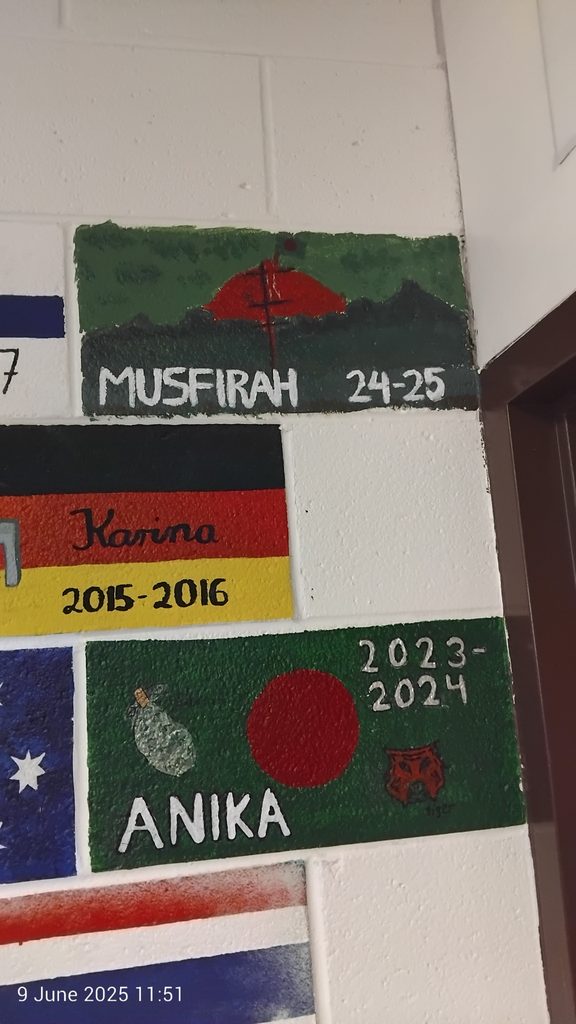
Photo: Courtesy
Returning was kind of hard for both. Musfirah had to repeat eleventh grade and found sliding back into Bangladesh’s academic intensity genuinely jarring. Maria lost close to a year academically too, since the school calendars never lined up cleanly, and what she missed most wasn’t the country itself but the independence she’d gotten used to.
What they’d tell you, directly
Asked what they’d say to someone about to start this process, here’s their answer to you:
Musfirah keeps it gentle: “Be true and kind to yourself. The application process itself is quite rewarding, I wouldn’t have any regrets if I wasn’t selected.”
Maria’s version is more of a warning against overthinking it into paralysis. Stop trying to guess the answer the panel wants. Stop measuring yourself against other applicants. And don’t wait until you feel fully ready, because nobody walks in with every stage figured out in advance. “You don’t have to have everything planned out from the beginning,” in her words.
And she is right.