Bengal's metallurgical heritage takes centre stage at Shilpakala Academy seminar
Bengal's metallurgical heritage takes centre stage at Shilpakala Academy seminar
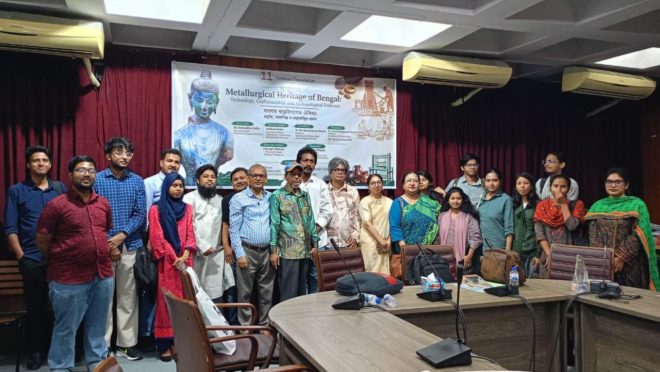
A seminar exploring Bengal’s rich metallurgical traditions, technological advancements and archaeological evidence was held on Saturday at the Seminar Hall of Bangladesh Shilpakala Academy.
Titled “Metallurgical Heritage of Bengal: Technology, Craftsmanship, and Archaeological Evidence”, the seminar brought together academics, heritage professionals, researchers and students to discuss the region’s often-overlooked history of metal production and craftsmanship.
Organised by Heritage Foundation, the event aimed to promote greater academic and public engagement with Bengal’s diverse cultural heritage, while highlighting the importance of archaeological research, conservation and heritage awareness.
Director General of Bangladesh Shilpakala Academy Reazuddin Stalin attended the event as the chief guest. The programme was chaired by Professor Md Masood Imran Mannu of the Department of Archaeology at Jahangirnagar University.
Associate Professor Sabikun Naher of the Department of Archaeology at Jahangirnagar University delivered the keynote presentation, examining the development of metallurgical traditions in Bengal through archaeological findings, technological practices and craftsmanship.
Her presentation traced the history of copper metallurgy in the Indian subcontinent and Bengal, covering the evolution of metal production from early copper objects and metallurgical remains to coins, ornaments, bronze bells, vessels, mirrors, metal sculptures, gilded images and cannons.
She highlighted the importance of crucibles and slag as archaeological evidence, explaining how these materials can help researchers understand ancient smelting, melting, alloying and casting techniques.
The presentation also explored archaeometallurgical studies of silver punch-marked coins and cast copper coins, demonstrating how scientific analysis of metal composition can shed light on production techniques, chronology, exchange networks and economic history.
Drawing on examples from archaeological sites in Bangladesh and the wider region, Sabikun Naher discussed the technological and cultural significance of copper-alloy bangles, bronze bells, vessels, mirrors and metal sculptures.
She also examined the techniques used in gilding sculptures and how scientific analysis can help identify ancient manufacturing and finishing processes.
The final section of the presentation focused on the development of cannon technology in Bengal, including bronze and forged-welded iron cannons. It highlighted the technical expertise, skilled labour and organisational capacity required to produce large metal objects.
Md Aksaruzzaman Nuri, Keeper (Director) of the Department of Conservation Laboratory at the Bangladesh National Museum, participated in the discussion as the designated discussant.
He brought a conservation perspective to the seminar, highlighting the importance of scientific research in understanding and preserving metal artefacts. His contribution also connected the study of ancient metallurgical techniques with contemporary challenges in conserving metal heritage for future generations.
The seminar was attended by students and young researchers from Jahangirnagar University, the University of Dhaka and the University of Rajshahi, alongside academics, heritage professionals and other participants.
The programme included a welcome address by Heritage Foundation Director General Jahangir Hussain, who highlighted the importance of creating platforms for meaningful discussions on Bengal’s diverse heritage.
Alam Ara Begum delivered the vote of thanks, expressing gratitude to the chief guest, chair, keynote speaker, participants and others involved in organising the event.
The seminar concluded with a call for greater interdisciplinary research into Bengal’s metallurgical heritage through the integration of archaeology, archaeometry, conservation science and traditional craftsmanship.
The discussions underscored how Bengal’s metal heritage offers valuable insights into the region’s technological knowledge, artistic traditions, economic activities and social history.