Going online to being intelligent: China is winning the adoption race
Over the years, the global AI race has been framed as a quest for pure technological supremacy, a battle over who can build the fastest chips and the smartest models. But while Silicon Valley stays fixated on the next frontier breakthrough, Beijing is playing a fundamentally different game.
Going online to being intelligent: China is winning the adoption race
Over the years, the global AI race has been framed as a quest for pure technological supremacy, a battle over who can build the fastest chips and the smartest models. But while Silicon Valley stays fixated on the next frontier breakthrough, Beijing is playing a fundamentally different game.
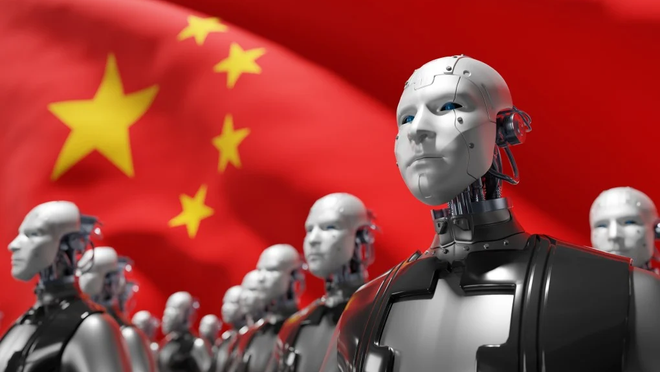
China is betting that the real winner of the AI era won’t be the nation with the cleverest algorithms, but the one that successfully embeds them into every factory floor, hospital ward, farm, and classroom across the country. After two decades of systematically laying the digital groundwork, China’s patient, step-by-step strategy is on the brink of paying off, and it might just give them an unassailable edge over the rest of the world.
For the past two decades, China’s technology strategy has followed a pretty similar trajectory: first, create capability, then digitise the economy, and finally modernise industry. This year the country is embracing what authorities call its most ambitious phase yet: “AI Plus”, a plan targeted not at expanding the AI business, but at blurring the line between AI and everything else. The word appears bureaucratic, yet the concept behind it is simple. Rather than treating artificial intelligence as a separate sector, like semiconductors and telecommunications, China wants AI to be integrated into nearly every aspect of its economy and society, including manufacturing, healthcare, agriculture, finance, education, government administration, and even consumer behaviour.
The movement we see in 2026 did not develop overnight. China’s quest for technical self-reliance began in the mid-2000s, when a national science and technology strategy focused on developing indigenous research capability rather than depending on foreign know-how. During the following decade, China focused on industrial transformation, with programmes aimed at improving production and expanding internet access into conventional sectors.
In 2017, China’s State Council issued a growth plan that identified AI as a general-purpose technology capable of transforming industry, healthcare, transportation, and agriculture. That paradigm, AI as infrastructure, has largely influenced policy ever since, with the following five-year plans focusing on computing power, data systems, advanced manufacturing, and semiconductor development.
By the middle of this decade, the Chinese policy lexicon had moved again, from “digital” to “intelligent.” That transition became official in 2025, when the State Council announced specific rules requiring AI to be incorporated into six major domains: science and technology, industry, consumption, public welfare, governance, and international cooperation, with deadlines set for 2027, 2030, and 2035 respectively. China’s 2026 Government Work Report reiterated this approach, advocating for a speedier rollout of AI agents and intelligent gadgets, as well as large-scale commercial AI deployment across critical industries.
Analysts have established a clear line between this programme and the previous campaign, “Internet Plus”, which attempted to connect conventional sectors to the internet around a decade ago. This is definitely a big shift. Whereas Internet Plus addressed how an organisation might become digital, AI Plus poses a more difficult question: how can an organisation become intelligent? In reality, this may mean industries utilising AI to detect equipment breakdowns and manage production lines, hospitals employing AI-assisted tools to aid diagnosis, banks using AI for risk analysis, and government offices utilising intelligent technologies to improve public services. China’s larger digital economy strategy, as recently outlined in its 2025 Digital China action plan, integrates AI Plus apps, data infrastructure, and digital-talent development, seeing them as components of a unified project rather than distinct endeavours.
If there is one less evident but perhaps more important aspect of AI Plus, it is that Chinese policymakers appear to have recognised that implementing AI at scale is basically a talent or intelligence challenge rather than a technical one. Software alone cannot alter a hospital or farm; people who understand both technology and their own expertise can. That awareness is changing the way China thinks about education policy, with science, technology, and talent development being portrayed as a single integrated aim for the years 2026-2030.
The consequences of this shift for the universities are significant. It is blurring the boundaries of the disciplines. A business graduate is expected to have data and AI literacy. An agricultural student may require a background in intelligent farming systems. Engineering graduates are increasingly working with AI technologies and robotics. Medical education is being tailored to prepare students for AI-assisted treatment. Crucially, the aim is not to generate more AI professionals in isolation. It focuses on developing a large number of professionals from many sectors who can effectively use AI in their own jobs. China’s universities have already begun to restructure in response: during the previous five-year planning period, institutions added thousands of new undergraduate programmes while discontinuing others, in an intentional effort to direct educational resources towards emerging industries and shifting labour-market demands.
This has an influence on the curriculum and assessment. If AI can eventually do routine analytical and writing jobs, education must place a greater focus on the areas in which AI now struggles: judgement, problem-solving, ethical reasoning, creativity, and subject knowledge. Chinese authorities are already going beyond today’s AI tools to what they refer to as the next phase: AI agents, which are systems capable of perceiving a situation, reasoning about it, and doing multi-step tasks with minimum human participation. In 2026, authorities in China issued guidelines for standardised AI agent development, recognising applications in research, industry, consumer services, public welfare, and the government.
In comparison to the broader arc of digital history, computers, smartphones, and cloud services, followed by generative AI chatbots, the agentic phase represents something different: digital “workers” capable of carrying out sequences of tasks on an organisation’s behalf, rather than new tools for people. If that transformation occurs at scale, it may necessitate another round of rethinking about what individuals need to learn and why.
China’s strategy does not provide a template that other nations can easily replicate; its institutions, resources, and economic structure are unique. However, analysts, including some from Bangladesh, have identified a more transferable lesson inherent in the strategy: the more helpful issue isn’t “how do we teach AI?” but “how does AI improve what we already teach, produce, and deliver?”
That reframe has practical implications, including introducing AI literacy across academic disciplines rather than just computer science departments, redesigning curricula around future job requirements, strengthening ties between universities and industry, developing digital infrastructure, retraining teachers, and shifting assessment away from rote recall and towards reasoning and application.
The core idea behind the “AI Plus” strategy isn’t about who can build the smartest tech, it’s about who actually uses it. Winning the AI race won’t just depend on having the top developers. It will come down to how fast everyday workers, like doctors, farmers, teachers, and civil servants, learn to partner with intelligent tools. China’s approach shows that real competitive power lies in widespread adoption, not just creation.

The writer, A F Wazir Ahmad, PhD, serves as an Associate Professor and Director of the BBA Program at the School of Business, ULAB. He writes on business, education, and strategic management.